
Management Software
Strategic planning tools and systems: 7 options
Measure corporate results and talent performance with strategic planning tools and systems. Check out the main options now.
In the pursuit of operational excellence and competitive advantage, companies of all sizes face the challenge of managing scattered information and aligning their strategies with long-term objectives. In response to that need, strategic planning systems turn complexity into clarity and vision into action.
These software tools make it easier to build detailed strategy mapsopens in a new tab, giving a clear view of the path ahead while centralizing critical information.
That is why, throughout this article, we highlight how the use of strategic planning software and systems can change the way companies formulate, implement and monitor their strategies.
By integrating information from several sources into a single platform, these systems provide an overview that is vital for planning. They let leaders define and track strategic objectives, adjust tactics and make sure every decision is aligned with the company’s vision.
Keep reading to learn about the main strategic planning software!
What is strategic planning software?
Strategic planning softwareopens in a new tab is a set of digital solutions built to help organizations formulate, implement and monitor their corporate strategies. These systems offer an integrated platform to manage the aspects of strategic planning, making the process more efficient, transparent and adaptable.
They are essential for companies that want to align their operations and business objectives with long-term goals in a systematic, organized way.
These tools also centralize data from different sources across the organization, providing a unified view that makes information easier to access and analyze.
These systems let managers set clear, measurable objectives aligned with the company’s vision and mission. Objectives can be broken down into specific goals for different teams or departments, so that everyone in the organization works toward the same ends.
And what are strategic planning tools?
Unlike strategic planning systems, strategic planning tools are methods or techniques organizations use to analyze their internal and external environment, set long-term goals and develop strategies to reach them.
They help managers make informed decisions about where the company should go and how it can get there more effectively. Different tools can be used at different phases of the strategic planning process, depending on the company’s specific objectives and needs.
4 strategic planning systems to help you
Applying every analysis tool takes work. Technology can support that task and make the process more precise and efficient.
Among the strategic planning systems available on the market are:
- Stratws;
- Perdoo;
- Appraisd;
- BetterWorks.
Here is more about each of these software tools:
Stratws
Stratws is a strategic and performance management platform created by Siteware. It connects planning to execution: the plan is broken down into goals and indicators, tracked in dashboards and supported by action plans, projects and results meetings.
With Stratws, you can:
- create and track indicators for processesopens in a new tab (in Portuguese), projects and people, in a visual dashboard with period-over-period comparison;
- break down strategic objectives into goals and indicators, in a strategy map, with methodologies such as BSCopens in a new tab and OKR;
- record deviations, analyze causes and track action plans until completion;
- manage the project portfolio and results meetings, with a history of decisions and pending items;
- run performance reviews and track each employee’s IDP.
See more about Stratws:
Perdoo
Perdooopens in a new tab is a strategic planning system focused on managing the OKR methodology, that is, objectives and results.
With this solution you can organize team tasks around common purposes. That is why it tends to be useful for tracking how much is left to reach goals, assessing performance and defining strategies to improve those results.
Appraisd
Appraisdopens in a new tab is a system focused on performance management, with the aim of contributing to strategic goal achievement and talent retention.
The system helps manage performance reviews, 360 feedback, training, setting and managing individual and group purposes, building and applying career development plans and more.
BetterWorks
BetterWorksopens in a new tab is another strategic planning system. It is focused on HR management and also supports the analysis and tracking of a company’s talent performance.
One of the main purposes of this system is to integrate goals and results, so that managers can define actions that help improve team performance and, as a result, deliver more results for the company.
3 strategic planning tools and how to use them together
Now that you know the strategic planning systems, let us look at the tools that support these software products.
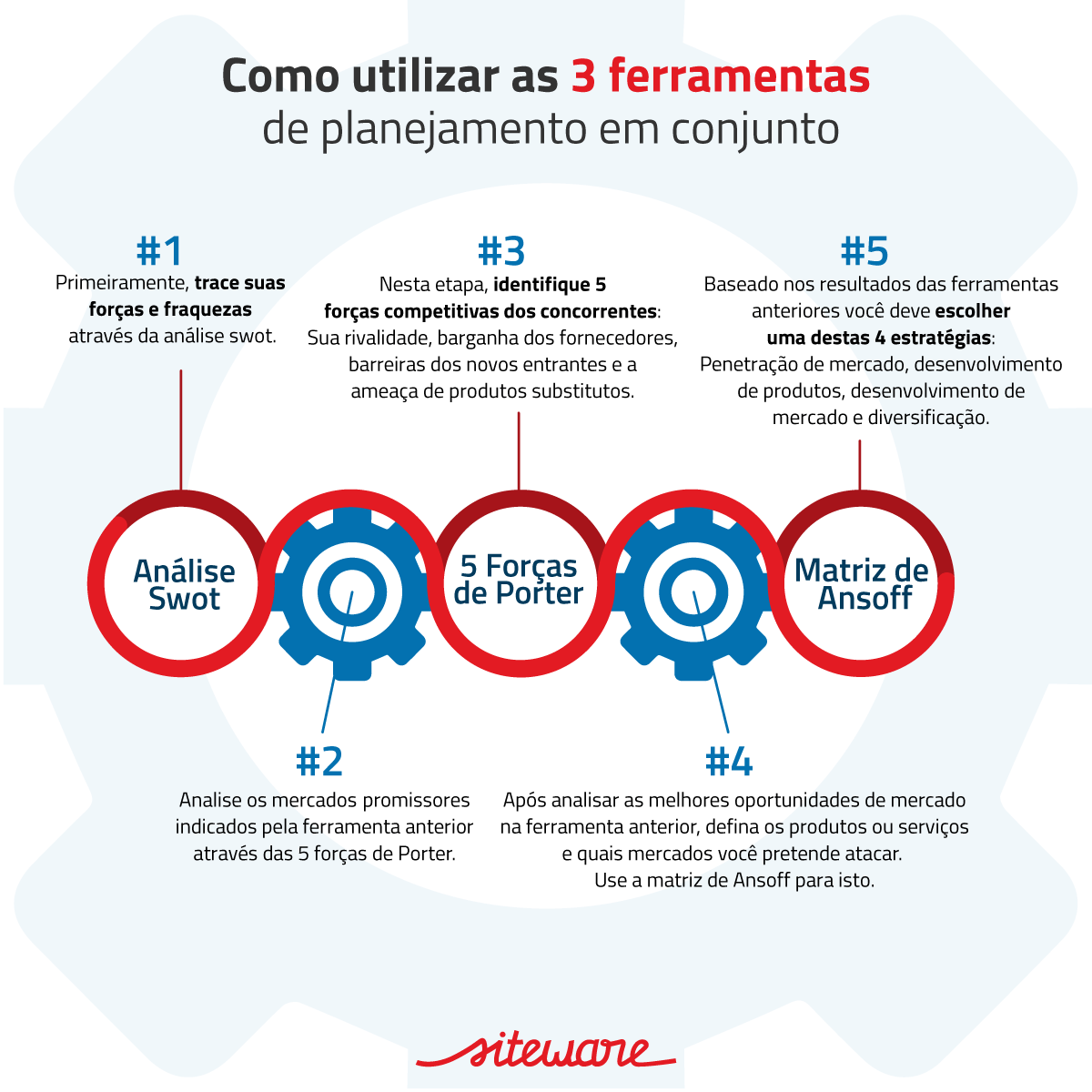
In this scenario, starting with a SWOT analysis makes sense. This tool lets you identify the company’s strengths and weaknesses, business opportunities and threats, based on analysis of internal and external factors.
Next, it is suggested to analyze the forces of the markets the company intends to operate in and, finally, use the Ansoff matrix to define how and with which products and/or services it intends to take part in the chosen sectors.
1. SWOT analysis
Among strategic planning tools, the best known is SWOT analysisopens in a new tab. It studies the company’s internal environment, the one you can control, looking for its strengths and weaknesses.
It also investigates the external environment, the one your company cannot influence, in order to identify opportunities and threats.
That is why the SWOT matrix is one of the most important tools for analyzing the internal and external scenario.
How does the SWOT matrix analyze the internal scenario?
A company’s strengths can be its brand, skilled labor, location, mastery of certain technologies or ownership and use of cutting-edge equipment and production assets.
Weaknesses can follow the same examples, in the sense that the company does not do well on those points and needs to improve them. In short, everything your business can directly control, such as:
- hiring and training employees;
- location of units;
- business capitalization;
- acquiring new technologies;
- branding work;
- customer relationships;
- renewing the machinery fleet;
- salary and incentive policy.
There are many other examples that are part of the company’s internal environment.
What is weak needs ways to improve, and what is strong should be kept that way.
How does the SWOT matrix analyze the external scenario?
The external environment is usually analyzed through PESTEL analysis, an acronym for these factors:
- political;
- economic;
- social;
- technological;
- ecological;
- legal.
That way, a new economic regulation that lowers taxes and a political climate favorable to falling interest rates, for example, can be considered opportunities for the company.
On the other hand, a restriction on CO2 emissions at a manufacturing plant (an ecological factor) or a law that bans a certain preservative your business uses are seen as threats.
SWOT analysis identifies how the company’s strengths can amplify opportunities and defend it from threats, and which weaknesses need to be strengthened so they do not widen the risks or hinder the use of opportunities.
Learn more about the SWOT matrix:
2. Porter’s five competitive forces
Another tool that stands out is Porter’s competitive forces.
Did your SWOT analysis point to some promising markets? Then analyze them with the help of Porter’s five forcesopens in a new tab, another strategic planning tool that belongs in your repertoire.
Porter’s matrix is a market analysis resource. It helps identify where your company stands in its industry and the pros and cons of that position.
To do that, this tool considers a few points:
- rivalry among competitors;
- bargaining power of customers;
- bargaining power of suppliers;
- threat of new entrants;
- threat of substitute products.
Rivalry among competitors
The greater the rivalry, the harder it is to enter the market you want to operate in, because those already there invest in marketing and research and accept low margins.
For example, consumer goods companies, such as food and beverage makers, usually compete in markets with high rivalry. That is why their margins are small and their marketing costs are high.
For reasons like this, it is important to think twice before entering a highly competitive sector.
Bargaining power of customers
When buyers have several similar options to choose from, or have time to make the purchase decision, they can pressure the market to lower prices and raise the quality of products and services.
So a segment with few buyers and many suppliers “is at the customers’ mercy,” since they have nothing to lose by making demands.
Another example of consumer bargaining power is selling to government bodies or very powerful corporate groups.
Large retailers that dominate a market and are therefore the only distribution channels for some companies are also customers with high bargaining power.
Bargaining power of suppliers
There are typical monopoly or oligopoly situations where suppliers practically dictate prices and conditions. But other factors can also raise or lower suppliers’ bargaining power, such as the degree of differentiation among them and the cost of production.
Threat of new entrants
Many markets have barriers to entry. In these cases, it is either very easy to join the market or extremely hard.
Patents, high setup costs, economies of scale already in place at some competitors and the strength of brands already in the market are some factors that determine the degree of the threat of new competitors saturating the sector quickly.
So barriers to entry are favorable if your company is already in the market. If you still intend to enter, you will need to overcome them. If you can, it may be an interesting market for your business.
Another important point is that a supplier can become your competitor. For example, imagine a supplier that sells essences to a perfume factory.
At some point, it may decide to invest in research and development and make perfumes too, becoming a competitor of the company that used to be its customer.
Threat of substitute products
Substitute products are those that meet the same needs of your company’s customers, but in a different way, sometimes better.
For example, think of how Uber replaces conventional taxis and how the Waze app shrank the car GPS market.
In other words, substitute products come from “out-of-the-box” thinking. So always watch for technological novelties that may appear and transform the market your business is in.
Because of situations like these, it is important to follow your target audience’s needs and find creative ways to meet them before competitors do.
After analyzing which market opportunities can be seized given the five competitive forces, it is worth defining:
- which products and/or services you intend to work with;
- which markets are most promising to explore.
To help with this analysis, good marketing researchopens in a new tab (in Portuguese) is recommended.
Here is a set of questions to help develop the strategy:
3. Ansoff matrix, or product-market matrix
The Ansoff matrixopens in a new tab, also called the product-market matrix, is a tool that helps analyze and plan strategic actions for a company’s growth.
To do that, it considers four points:
- the company’s market penetration;
- product development;
- market development;
- diversification.
Because of this feature, the Ansoff matrix can be used after identifying strengths and weaknesses, opportunities and threats and the degree of competitiveness of your business’s markets.
Market penetration
Your company decided to stay in the market where it is, trying to win new customers, but without developing new products and/or services to do so.
Product development
In this case, your company detected the opportunity to create solutions to offer in the market where it already operates.
Market development
This strategy consists of launching the products your company already sells in other markets it wants to win.
Diversification
This is the combination of the two previous strategies, that is, launching new products in new markets.
These decisions depend on the previous analyses. For example, if you found a market where the competitive forces are favorable and your company is strong in marketing and innovation, diversification may be worth choosing.
If your brand is strong and well known in its market and developing new products and/or services is a weak point, market penetration may be the way to go.
The Ansoff matrix is perhaps the least known of the strategic planning tools. So the video below helps you understand it better and complements the information we just gave.
Want even more training on this topic? Download our free e-book: How to do Strategic Managementopens in a new tab (in Portuguese)
How to choose a strategic planning system?
A good strategic planning system lets you track corporate performance in an integrated way, centralize indicators and turn each deviation into action with an owner and a deadline. Compare solutions by these criteria: what each one breaks down, what it tracks and how it records the decision.
More than 800 companies trust their management to Stratws, across more than 20 sectors of the economy, and more than 182 thousand people use it in day-to-day management. See how Grupo SBFopens in a new tab, Samarcoopens in a new tab and Hospital Careopens in a new tab use Stratws in strategic management.
Visit our website and explore all of the management features of Stratwsopens in a new tab.

About the author
Equipe Siteware
Content produced and reviewed by the Siteware team, curated by internal experts in strategic management and corporate performance.