
Strategy and Goals
SWOT analysis: how to analyze your company
Understand what a SWOT matrix is, what it is for, how to run the analysis in 3 steps and how to use it in strategic planning.

Many companies define where they want to go without knowing where they stand. Those who do not identify their own strengths and weaknesses struggle to measure the organization’s potential.
The SWOT matrix is a tool widely used in strategic planning and in building the business plan. It helps leaders see weaknesses, differentiators, opportunities and threats, and shows what the organization can actually achieve.
In this article, you will see what SWOT analysis is, what it is for, how to run it in 3 steps, examples and the tools that complement it.
Definition of the SWOT matrix
The SWOT matrix (called FOFA in Portuguese) is a tool used in the early stages of strategic planning and in business plans, to understand the company’s position in the market. It assesses the organization’s internal and external environments to support decision-making and to identify strengths and areas for development.
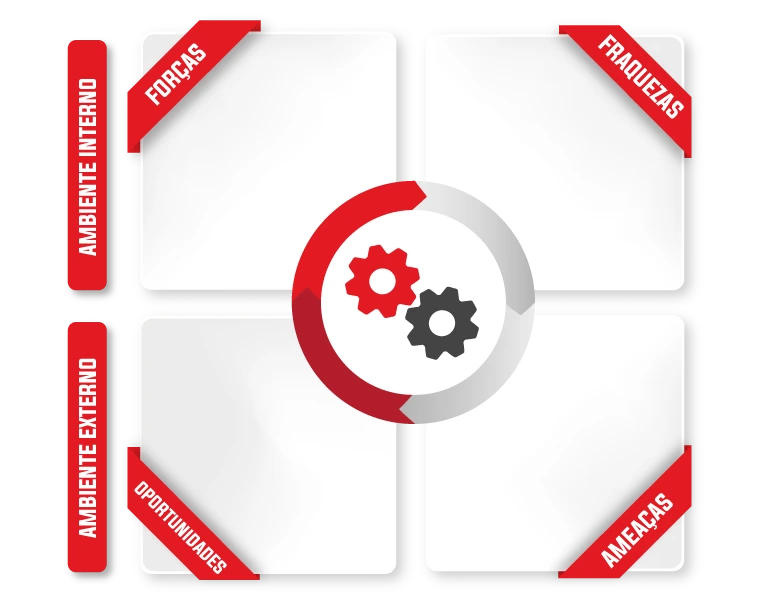
SWOT stands for Strengths, Weaknesses, Opportunities and Threats. In the matrix, each of the four quadrants has a purpose:
- Strengths: resources and capabilities that are competitive advantages of the organization or the product. Examples: a strong brand, a qualified team, proprietary technology or a good location.
- Weaknesses: internal limitations or disadvantages that hinder performance. Examples: lack of experience, limited financial resources, inefficient processes or a weak reputation.
- Opportunities: external elements the organization can use to grow or improve performance. Examples: an emerging market, favorable regulatory changes or new technologies.
- Threats: external elements that can cause problems or damage to the organization. Examples: an unstable economy, rising competition or legal changes with a negative impact.
Here is a representation of the matrix:
The tool’s origin is attributed to Albert Humphrey, of the Stanford Research Institute, in the 1960s, and to Harvard’s Business Policy course, in 1965. The goal has always been to improve companies’ strategic planning, with a focus on decision-making.
The tool has two fronts and four quadrants. The internal analysis examines strengths and weaknesses inside the business environment. The external analysis examines the opportunities and threats the plan may face over time, from external factors.
For SWOT-based planning to be effective, the company should repeat the analysis periodically. That way, the organization’s areas stay constantly updated and improving.
For practical examples, watch the video on the SWOT matrix (in Portuguese):
Purpose of the SWOT matrix
The SWOT matrix is used to analyze the internal and external factors that can affect an organization.
When filling in the matrix, everyone involved reflects critically on the quality of internal aspects, such as resources, capabilities, processes and organizational culture. Identifying strengths (positive aspects) and weaknesses (negative aspects) shows what the company does well and where it needs to improve.
The analysis also examines the external environment, including the market, competition, economic trends, technological changes and regulations. With that, companies can:
- set goals and objectives;
- make informed decisions;
- mitigate weaknesses;
- take advantage of opportunities.
How to build a SWOT matrix
To run a SWOT analysis, you need to understand what is an internal factor and what is an external one. Also bring together the whole team responsible for the project, because no plan is built alone.
Step 1: Define the subject of study
The first step is to identify the subject of study, that is, the objective that brings people together to fill in the matrix. It could be, for example, the “need to open a new branch in another part of the city”.
At this stage, research the market to collect the information you need, especially about competitors. This helps the external analysis: understand how competitors act and how the segment operates in the new location.
Remember that the matrix shows strengths and opportunities, on the positive side, and weaknesses and threats, as points of attention.
Step 2: Run the internal analysis
In the second step, the team analyzes the company from the inside, with its strengths and weaknesses. These points can be gathered in brainstorming meetings with the team.
The internal analysis of processes gives a broader view of the company’s advantages and disadvantages against the competition. Weak points can be eliminated or improved, and strong points become key pieces of the business’s success.
Strengths are the advantages the company has, mainly in relation to the competition. Weaknesses can harm results and the achievement of goals. That is why it takes maturity and honesty to identify them.
To find strengths and weaknesses, answer these 5 questions:
- How does our supply chain contribute to competitive advantage or represent a challenge that compromises it?
- How do the competence and quality of our leaders affect our competitive position, positively or negatively?
- How does our technology affect competitive advantage, strengthening or weakening it?
- How is our brand an asset that sets us apart from competitors, or a weakness that hurts us?
- How does our location benefit us or put us at a disadvantage in the market?
Some examples of answers:
- Strengths: a well-trained team, a strong brand, prime locations for points of sale, prepared managers, a well-capitalized company, modern machinery and a culture focused on excellence.
- Weaknesses: poor customer service, a demotivated sales team, outdated software, unprofessional management, a scrapped delivery fleet and a poor organizational climate.
Step 3: Run the external analysis
In this stage, you analyze opportunities and threats, which show the impact of the company’s external factors on planning.
These factors are beyond the company’s control, but the matrix lets you measure their impact. Putting them in the plan leaves the team better prepared for their possible effects.
Opportunities are external factors that favor the brand’s positioning and the achievement of goals. Threats are external factors that act negatively on the company.
To define opportunities and threats, the questions usually revolve around PESTEL analysis, an acronym for political, economic, social, technological, environmental and legal factors. Some questions:
- Which environmental issues may put the company’s operations and reputation at risk?
- Which technological advances or changes may threaten the viability of the business?
- Which legal and regulatory aspects may threaten the business and its compliance with applicable laws?
- Which social factors may pose challenges to the business?
- Which political factors may pose a risk to the business’s sustainability?
- Which economic factors may pose threats to the venture?
Some examples of external factors:
- Threats: rainy weather (for a beach resort), water scarcity, pricier raw materials, high interest rates and high taxes.
- Opportunities: a stronger real (for a travel agency selling trips abroad), constitutional reforms under way, a new road built at the factory’s door, a university opening near the gym and falling interest rates.
Turning weaknesses into strengths and threats into opportunities
By recognizing weaknesses, the company can invest in training and skills development to overcome gaps in skill or knowledge. If a lack of digital expertise is a team’s weakness, for example, a training program can reduce it and even turn it into a competitive advantage.
Many operational weaknesses can also be overcome with investment in technology. A company struggling with supply chain efficiency can implement modern management systems to optimize processes.
When the solution is not inside the company, strategic partnerships can be the answer. An organization with limited digital marketing skills can team up with a specialized agency and, through collaboration, turn the gap into a strength.
To turn external threats into opportunities, you need to reassess the business environment. A regulatory change that looks like a threat can open new market niches or lead to a redesign of products and services. A new competitor entering the market can also motivate innovation, a better offer or the exploration of new markets.
Examples of a SWOT matrix
Below are two practical examples of how the SWOT matrix can be applied.
Company X: international market expansion
Strengths:
- Globally recognized brand.
- High-quality products.
- Experienced management team.
Weaknesses:
- No presence in foreign markets.
- Dependence on specific suppliers.
- Language and cultural barriers.
Opportunities:
- Growing demand for products in the international market.
- Reduced import tariffs in target markets.
- Favorable industry trends in specific regions.
Threats:
- Fierce competition from local players.
- Unpredictable currency swings.
- Restrictive trade regulations.
Startup Y: launching a new health app
Strengths:
- Highly qualified development team.
- Partnerships with health professionals.
- Funds for research and marketing.
Weaknesses:
- Lack of brand recognition.
- Competition from established apps.
- Limited resources for large-scale marketing campaigns.
Opportunities:
- Growing interest in health and well-being.
- Trend toward telemedicine and remote care.
- No direct competitors in the market niche.
Threats:
- Negative reactions to health data privacy.
- Fast changes in health regulations.
- Possible emergence of innovative competitors.
Most common mistakes when using the SWOT matrix
Even though it is popular, the SWOT matrix is often applied with mistakes that weaken the analysis. The most common:
- Excessive generalization: listing points vaguely. Saying the company has a “good team” without saying what makes it stand out gives no useful information.
- Lack of prioritization: not every point in each quadrant has the same impact. Without prioritizing, effort goes to the wrong areas.
- Omission of critical factors: from lack of research or confirmation bias, some companies leave out factors that should be in the analysis.
- Stagnant analysis: the matrix is not a one-time tool. The business environment changes, and the matrix should be reviewed and updated regularly.
- No action after the analysis: the matrix is a means, not an end. Finishing it without implementing strategies based on the findings is a critical mistake.
- Isolated view: running the analysis without input from different departments or stakeholders produces a limited view. Diverse perspectives deepen the analysis.
Tools to complement SWOT
The SWOT matrix pairs well with continuous improvement tools, because it identifies points to improve and plan. Some techniques and methods that complement it:
PDCA method
The SWOT matrix is the basis of the planning phase of the PDCA cycle. In the Plan phase, the matrix’s information guides the setting of objectives and the formulation of strategies: the team can plan to capitalize on a strength or address a specific weakness. In the Do phase, the team puts the action plans into practice.
In the Check phase, it assesses whether the SWOT-based strategies work as expected. In the Act phase, it adjusts the plan based on what was learned and, if a strategy does not work, revisits the SWOT analysis to understand why.
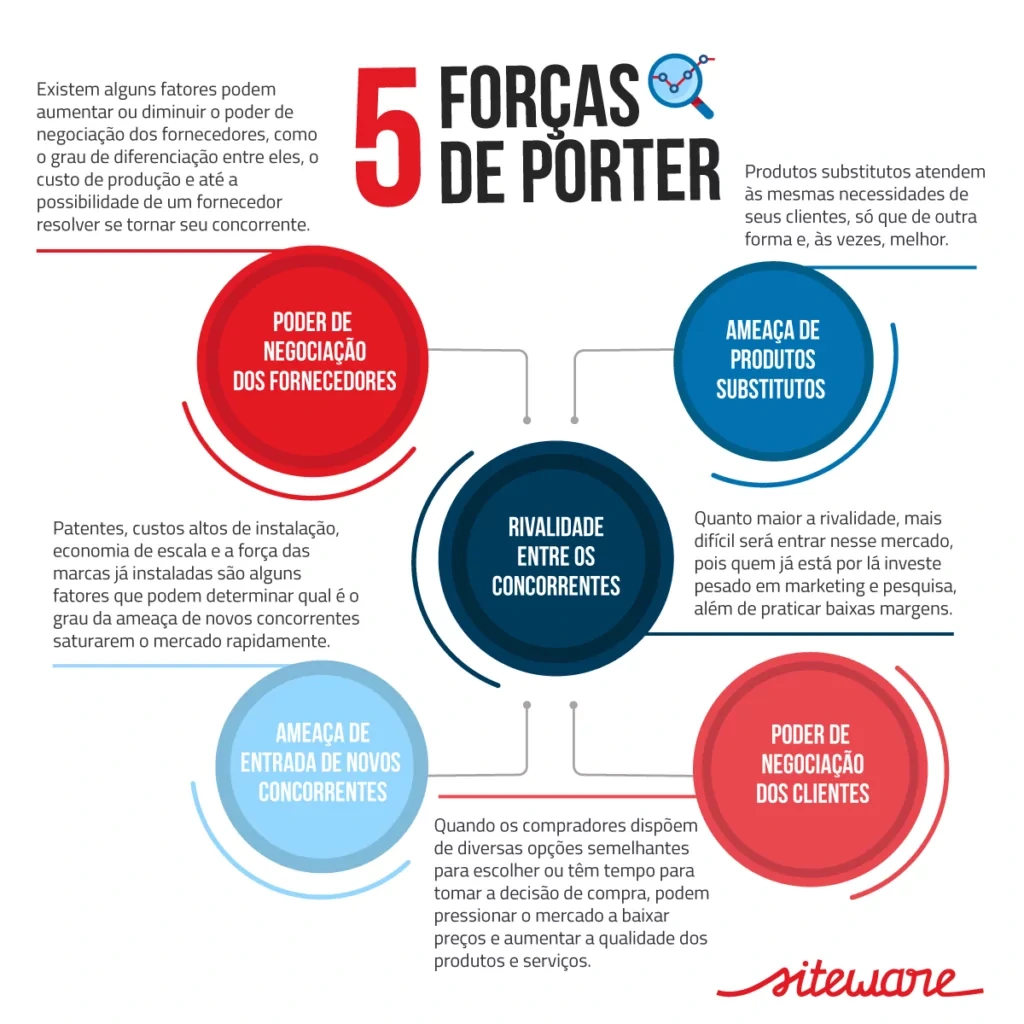
Porter’s Five Forces
Porter’s Five Forces analysisopens in a new tab focuses on market competitiveness. It examines rivalry among competitors, the threat of new entrants, the bargaining power of suppliers and customers and the threat of substitute products.
Combining this analysis with the SWOT matrix enriches the opportunities and threats quadrants with information about the market and the industry.
Business Model Canvas
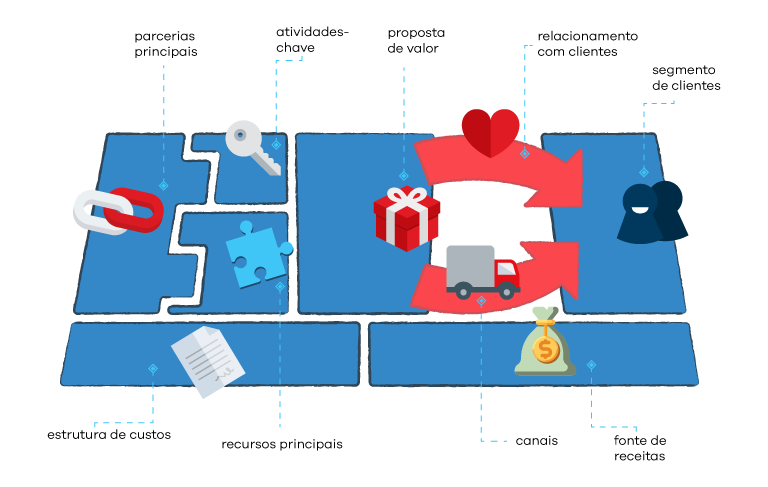
The Business Model Canvasopens in a new tab is a strategic planning tool for developing or documenting existing business models. Created by Alexander Osterwalder, it is visual and intuitive, and shows the main components of a business in a clear, structured way.
With the SWOT matrix, the Canvas shows how strengths, weaknesses, opportunities and threats relate to each part of the business model. A strength can be tied to a “Key Resource” in the Canvas, and a threat can affect “Customer Segments” or “Revenue Streams”.
From the SWOT matrix to action in Stratws
The SWOT matrix delivers the diagnosis, and the result comes from the actions that follow. Stratwsopens in a new tab is the management platform created by Siteware to track those actions. In it, each strategy defined from the matrix becomes an action plan, with tasks, owners and deadlines tracked by the team.
The feature called Scorecard links each strategy to its objective, indicator and goal, and the Farol shows whether the indicator is improving. Our guide to business strategy executionopens in a new tab shows how to take those actions through to results.
From the SWOT matrix to the action plan
Each strategy with a task, an owner and a deadline, and the indicator tracked in the Farol.
Frequently asked questions about the SWOT matrix
What are examples of Strengths and Weaknesses?
Strengths: a strong brand, a qualified team, advanced technology and a good reputation in the market. Weaknesses: lack of financial resources, low capacity to innovate, obsolete technology and poor team management.
What are examples of Opportunities and Threats?
Opportunities: new markets, favorable regulatory changes, growing demand in the industry and strategic partnerships. Threats: fierce competition, economic crises, technological changes that reshape the industry and unfavorable regulatory changes.
How does the SWOT matrix help strategic planning?
It shows the company's internal and external conditions and allows informed strategic choices. It makes it easier to set goals and action plans based on the company's strengths and market opportunities, and it points out areas for improvement.
When should I use the SWOT matrix?
Use it at the start of a project or product launch, in annual strategic planning, when the company faces internal or external challenges and to adjust strategy after significant market changes.

About the author
Equipe Siteware
Content produced and reviewed by the Siteware team, curated by internal experts in strategic management and corporate performance.