
Strategy and Goals
Business Model Canvas: what it is and how to build it
Understand the Business Model Canvas: the 9 blocks, a step-by-step to build yours and a filled-in example to use as a reference in your company.
The Business Model Canvas is a planning tool that shows a company’s main elements in nine blocks. From it, the team creates and adjusts strategy.
The tool is simple to use and helps entrepreneurs and companies quickly assess how a current business is performing or validate a new idea. It was published in 2010, in the book Business Model Generation, and is still in use at companies of all sizes.
In this article, you will see what the Business Model Canvas is, a step-by-step to build one, how it relates to the business plan and a template to fill in with your company’s data.
Definition of the Business Model Canvas
The Business Model Canvas is a visual strategic planning tool used to describe, analyze and design business models.
Created by Alexander Osterwalderopens in a new tab, it organizes the business into nine pre-formatted blocks. The blocks are the basis for creating a new model or adapting an existing one.
The 9 elements of the Canvas are:
- Customer segments;
- Value proposition;
- Channels;
- Customer relationships;
- Revenue streams;
- Key resources;
- Key activities;
- Key partnerships;
- Cost structure.
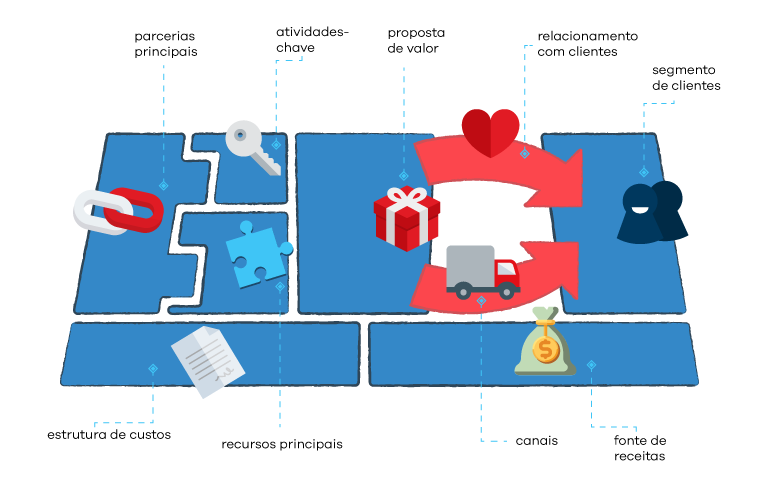
Because it is visual, the Canvas makes strategy easier and shows the organization’s structure on a single board.
A business plan is usually a long, detailed document that is hard to change as often as validation requires. The Canvas fills that gap, especially for companies that are just starting out or that change structure often.
When did the Canvas appear?
The method was developed by Alexander Osterwalder and Yves Pigneur, who are tied to the University of Lausanne in Switzerland, to help entrepreneurs visualize and develop innovative business models.
The first book on the methodology, Business Model Generationopens in a new tab, was published in 2010. Since then, companies around the world have used the method to create and improve business models.
Also watch the video about the Canvas (in Portuguese):
The 9 elements of the Canvas
The Canvas has nine blocks, which represent the main areas of a business. Below, what each one describes and how to fill it in.
Block 1: Customer segments
This block defines the groups of people or organizations the company wants to reach and serve. To fill it in:
- Identify the customer groups your company wants to serve.
- Split customers into segments with similar needs and characteristics.
Block 2: Value proposition
This block describes the products and services that create value for a specific customer segment. It is the reason customers choose one company over another. To fill it in:
- Describe what makes your product or service unique and valuable to customers.
- Explain how your offer solves problems or meets the needs of each segment.
Block 3: Channels
This block explains how the company communicates with customer segments and reaches them to deliver the value proposition. To fill it in:
- List the channels through which you will reach customers and deliver the value proposition.
- Include marketingopens in a new tab, sales and distribution channels.
Block 4: Customer relationships
This block describes the types of relationship the company builds with each customer segment. To fill it in:
- Describe how you plan to build and keep the relationship with each segment.
- Define whether the relationship will be automated, personal or self-service.
Block 5: Revenue streams
This block represents the money the company generates from each customer segment, that is, whether and how they agree to pay for the value proposition. To fill it in:
- Identify all of the company’s revenue streams.
- Consider direct sales, subscriptions, advertising and freemium, among others.
Block 6: Key resources
This block lists the most important assets for the business model to work. To fill it in:
- List the essential resources the company needs to operate and deliver the value proposition.
- Consider physical assets, people, technology and partnerships.
Block 7: Key activities
This block identifies the most important actions the company must carry out for the business model to work. To fill it in:
- Identify the activities needed to create and deliver value to customers.
- Consider production, marketing and customer support.
Block 8: Key partnerships
This block brings together the network of suppliers and partners that helps the company operate. To fill it in:
- List the strategic partnerships the company will build to obtain resources, reduce costs or reach other goals.
- Consider alliances, joint ventures and supply agreements.
Block 9: Cost structure
This block gathers all the costs of running the business model. To fill it in:
- List all costs associated with operating the business.
- Consider fixed, variable, personnel and marketing costs.
Characteristics of the Canvas method
The Canvas is a versatile tool, used by entrepreneurs and business development teams. Its main characteristics include:
- Business visualization: a board of 9 blocks gives an overview of how the business works;
- Focus on customer value: the first block to think through is the value proposition, which shows what the business offers customers;
- Key activities analysis: key activities are the actions the business must carry out, and the Canvas helps optimize them;
- Key resources identification: the model maps the business’s human, financial and technological resources;
- Focus on key partnerships: strategic partnerships are part of many businesses and should be optimized;
- Revenue streams analysis: the method highlights the importance of identifying and optimizing revenue streams;
- Understanding the cost structure: knowing costs is necessary to balance spending;
- Flexibility: the tool adjusts to the needs of each business.
The Canvas gives a visual, intuitive overview of how the company works, focused on customer value, key activities and partnerships, revenue streams and cost structure.
Besides defining the business model, the company needs a platform to bring the information together. See our post on the 13 best business management software options.
Business plan and the Canvas
Building a business plan is a good way to start strategy. To turn an idea into a project, you need a broad view of the market, of the product or service and of your decisions as an entrepreneur.
The Canvas works like a travel map: it describes the path the organization will follow to its overall goals and shows the logic of value creation. It also serves as an example of a simple business plan, to fill in with the company’s specifics.
The plan is an outline that must become executed strategy, through the organization’s structures, processes and systems.
How to build a Canvas: 9 steps
Below, a step-by-step to build yours.
Step 1: Customer segments
Ask yourself: who are we creating value for? Who are the most important customers?
This component defines the groups of people to whom the company delivers the value proposition, that is, the target audience.
Identify this audience’s wants, pain points, routines and goals. That shows which arguments to use.
Step 2: Value proposition
Ask yourself:
- What value do we deliver to customers?
- Which problem do we help solve?
- Which needs do we meet?
- What set of products and services do we offer each customer segment?
This component answers why customers choose your company and not a competitor. The value proposition must solve a problem or meet a customer need, according to segmentation.
Improving the performance of products and services is one way to add value. That is why identifying the strengths and weaknesses of the product helps build a realistic, valid proposition.
At this stage, the BCG Matrix helps to identify and analyze the performance of your products against the market.
Step 3: Channels
Ask yourself:
- Through which channels do customer segments prefer to be contacted?
- How do we reach them now?
- How do these channels fit together?
- Which one works best?
- Which have the best cost-benefit?
- How do they fit into customers’ routines?
Channels are how the company communicates with customers, from acquiring the product to post-purchase support. They can be direct (sales team and website) or indirect (resale stores).
Each stage of the buying journey may call for a different channel. A company can invest in Instagram to win new customers and use chatbots on WhatsApp after the sale. The stages of the journey are:
- Awareness: when the public gets to know the brand.
- Evaluation: how the company is evaluated.
- Purchase: what the customers’ buying process looks like.
- Delivery: how the company delivers value to customers.
- After-sales: how the company supports customers after the purchase.
Step 4: Customer relationships
Ask yourself:
- What type of relationship do customers expect the company to build?
- Which ones have we already built?
- What does each one cost?
- How do they fit into the rest of the business model?
The relationship with customers depends on what the company is after: winning, keeping or growing sales. It can be automated, with chatbotsopens in a new tab and automatic messages, or based on human interaction, with representatives and call centers.
Step 5: Revenue streams
Ask yourself:
- What amounts are customers willing to pay?
- What do they pay for today?
- How do they pay?
- How would they prefer to pay?
- How much does each revenue stream contribute to the total?
Revenue streams represent the money generated by each customer segment. To calculate profit, subtract costs from revenue.
In the Canvas, revenue streams include asset sales (physical products), usage fees, subscription fees, lending, rentals and licensing.
Step 6: Key resources
Ask yourself: which key resources does the value proposition require? What about distribution channels, customer relationships and revenue streams?
These are the resources the company needs to create its value proposition. They can be physical, such as factories, machines and vehicles, or intellectual, such as specific knowledge and patents. They can also be human, such as qualified teams, or financial, such as cash and shares.
Step 7: Key activities
Ask yourself: which key activities does the value proposition require? What about distribution channels, customer relationships and revenue streams?
Key activities are the ones that cannot stop happening if the company is to work well. Depending on the type of business, they can be production (development, manufacturing and delivery), problem solving or platforms and networks.
Step 8: Key partnerships
Ask yourself: who are our main partners and suppliers? Which essential resources do we get from them? Which key activities do they carry out?
These are the suppliers and partners that let the business operate in an optimized and economical way. With these alliances, it is easier to obtain resources and reduce risks and costs. In your Canvas, map these partnerships.
Step 9: Cost structure
Ask yourself: what are the most important costs in the business model? Which key resources cost the most? And which key activities?
The cost structure can involve fixed and variable costs. Some companies seek the lowest possible cost in their activities and use low-price value propositions. Others create value in the products, which makes activities more complex and raises the final price.
Example of a Canvas
See an example of a filled-in Canvas, from Mercado Livre:
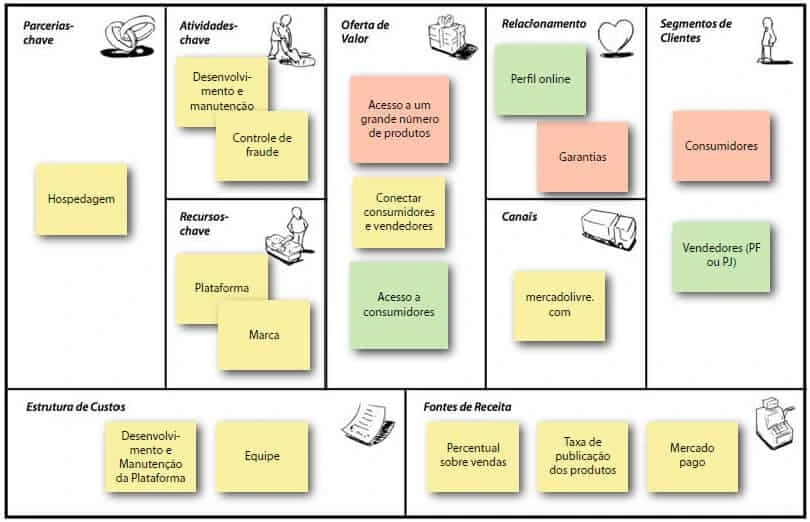
Tips for the Business Model Canvas
- Iteration: the Canvas is not a one-time task. Review and update the board as you gain insight into customers and the market.
- Visualization: use sticky notes, colors and icons to make the board easy to read and change.
- Feedback: share the Canvas with mentors, colleagues and potential customers to get new ideas.
- Focus: do not try to cover everything. Concentrate on the elements most critical to the business.
An effective Canvas has clarity, concision and an understanding of each component of the business. With these tips, the board maps the current model and also points to the strategic direction for the future.
How to implement the Canvas
With the Canvas structure in hand, follow this step-by-step to implement it in the company.
1- Understand the methodology
Understand how the method works, what its goals are and how to apply it in the company. Read the official documentation available online to get a full view of the tool.
To go deeper, read the book Business Model Generationopens in a new tab.
2- Identify the company’s goals
Before using the Canvas, identify the company’s goals and how they relate to the blocks on the board. Whoever applies the model needs to know the goal of the work and the company’s goals.
3- Fill in the Canvas
Bring the team together and fill in the Canvas with the information available in the company, such as financial and customer data. Involve everyone in the discussion to get a complete, accurate view of the business.
To fill in the board, use the instructions in this article. If you like, download our templateopens in a new tab (in Portuguese) and speed up the process.
4- Analyze the results
Analyze what filling it in revealed and identify the company’s strengths and weaknesses. A SWOT matrix helps with this reading.
Find the areas that need to improve and create action plans to fix each one.
5- Implement the actions
Implement the actions defined in the previous step and monitor the results over time. Review the Canvas periodically to check whether the actions are producing the expected results.
5W2Hopens in a new tab helps build action plans that leave the paper. A RACI matrix makes sure each action has an owner, which makes task management easier.
6- Share with the team
Share the Canvas and the results with the team, including managers, employees and others involved. Everyone needs to understand how the Canvas is used and how it helps improve how the company works.
In short, implementation involves understanding the methodology, identifying goals, bringing the team together, filling in the board, analyzing results, implementing actions and sharing. A collaborative approach, with everyone in the discussion, produces more consistent results.
Tip: the board works best printed or on a large screen, so the team can make constant changes, with notes on sticky notes or markers.
How to execute the Canvas with Stratws
The Canvas draws the business model, and the result depends on executing the plan that comes out of it. In Stratws, the Scorecard organizes objectives in a cause-and-effect strategy map, breaking them down into indicators, goals and projects.
The Farol tracks each indicator and compares results with previous years. Action plans come with tasks, owners and deadlines, and Stratwsopens in a new tab integrates methodologies such as OKRs, BSC and PDCA.
From Canvas to execution
Objectives, indicators and action plans tracked in one place.
Frequently asked questions
What is the Business Model Canvas?
It is a visual strategic management tool, created by Alexander Osterwalder and Yves Pigneur, to structure business models on a board of nine blocks. It shows in a simple way how a company creates, delivers and captures value.
What are the 9 blocks of the Canvas and what do they represent?
The nine blocks are customer segments, value proposition, channels, customer relationships, revenue streams, key resources, key activities, key partnerships and cost structure. Together, they show who the company creates value for, how it delivers and what it costs and earns.

About the author
Equipe Siteware
Content produced and reviewed by the Siteware team, curated by internal experts in strategic management and corporate performance.