
Continuous Improvement
What Is the 5W2H Method? Learn the Concept and How to Apply It in Action Plans
Learn how to apply the 5W2H method to organize ideas and turn strategy into action. See practical examples, tips and how to build an action plan.

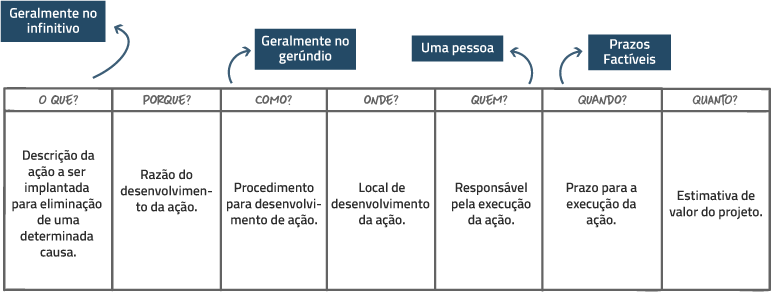
5W2H is a management tool that organizes ideas and turns strategy into concrete actions. The name comes from the initials of seven essential questions:
- What: What will be done?
- Why: Why is this action necessary?
- Where: Where will it take place?
- When: What is the deadline or execution date?
- Who: Who will be responsible?
- How: How will the action be carried out?
- How much: What is the cost or investment required?
This method is essential for creating a structured action plan, ensuring clarity about objectives, responsibilities and resources, and making it easier to communicate and execute strategies.
What do the 7 guidelines of the 5W2H method mean?
When you use 5W2H to build an action plan, for example, the logic is that questions are answered at each step, so that all the information needed for execution is available.
Here is what needs to be answered:
- What (what to do?): clearly describe the action to be carried out or the problem that needs to be solved. Example: “Implement a new management system.”
- Why (why do it?): explain the reason and the importance of the action. Example: “To increase operational efficiency and reduce errors.”
- Where (where will it be done?): define the location or department where the action will take place. Example: “At company headquarters and, later, at all branches.”
- Who (who will do it?): list the people or teams responsible. Example: “The IT team, supervised by project managers.”
- When (when?): set deadlines for each phase of the project. Example: “Start next quarter, with full implementation in 6 months.”
- How (how to do it?): detail the process and the methods to be adopted. Example: “System selection, employee training, pilot implementation and adjustments.”
- How much (how much will it cost?): provide an estimate of the costs and resources required. Example: “Investment of R$50,000 for purchase, training and adjustments.”
What are the advantages of 5W2H in project management?
The 5W2H tool matters to businesses because it helps plan and execute projects, tasks and activities efficiently, quickly and effectively.
It is a simple method that supports clear definition of objectives, responsibilities and deadlines, which is essential for the success of any initiative.
- Clarity and organization: everyone involved knows exactly what to do, why, when and how.
- Defined accountability: assigning tasks avoids ambiguity and overlapping roles.
- Control of deadlines and costs: makes it easier to track schedules and the investments required.
- Efficient communication: improves the flow of information between departments and teams.
- Fewer errors: detailed planning minimizes execution failures and waste.
- Data-based decision making: allows quick, strategic adjustments as the project progresses.
Another highlight is that the 5W2H method can also be used together with others, such as the GUT Matrix, also called a decision matrix.
When to use 5W2H?
The 5W2H system can be used whenever you need to create a simple or complex action plan in your company or in day-to-day management.
Whatever the purpose, this productivity tool is extremely versatile and can be used by companies of all sizes, quickly and practically.
Keep in mind that the system does not require intensive training: just answer its seven questions and you are done.
If you are unsure how to create an action plan, we have a free spreadsheet that can help with the first steps:

How to use 5W2H in practice? A practical example
The 5W2H method can be applied in many contexts, from business projects to personal tasks. Some practical applications include:
- Strategic planning: structure action plans to reach corporate goals.
- Project management: organize the implementation steps of new systems or products.
- Operational processes: improve efficiency on the production line or in the services provided.
Beyond these applications, there are specialized strategy execution software tools that have this kind of methodology built in, enabling 360-degree management and a systemic view. One example is Stratws, from Siteware.
Remember that the more detailed you are when answering the 5W2H questions, the lower the chances of assignment errors or problems in interpreting the information.
Imagine a company that needs to improve preventive maintenance on its production line. A 5W2H example for this project would be:
1. What (What will be done?)
Implement a preventive maintenance schedule.
2. Why (Why will it be done?)
To reduce unexpected downtime and increase productivity
3. Where (Where will it be done?)
On the main production line.
4. When (When will it be done?)
Start next month, with monthly reviews
5. Who (Who will do it?)
The maintenance team, led by the supervisor.
6. How (How will it be done?)
Develop a detailed schedule, define specific tasks, provide training and monitor the results.
7. How Much (How much will it cost?)
Estimated investment of R$10,000 for maintenance and training.
This example shows how a 5W2H action plan can turn a problem into a structured and effective solution.
How can technology help in business and project management?
To get the most out of 5W2H, make technology an ally. There are digital spreadsheets, specific management systems and even collaboration apps that allow teams to track progress together.
The best choice will depend on the management maturity of your business and the projects to be carried out.
Whichever tool you choose, always keep these good practices in mind:
- Be specific: answer each question in as much detail as possible to avoid ambiguity.
- Work as a team: involve everyone responsible so the plan reflects the reality of the project.
- Document and share: keep the plan accessible to all team members, making it easier to consult and monitor.
- Review continuously: periodic meetings help update the 5W2H as the project progresses and changes.
A strategic planning system helps organize the steps of this method, driving results, making it easier to track indicators and helping employees adapt to the method.
Stratws, from Siteware, is software that lets managers organize their work routine and corporate initiatives based on the seven questions and other features.
To see how it works in practice, click below and request your free demo.

Frequently asked questions
What is the 5W2H method?
5W2H is a management and planning tool that organizes actions through seven essential questions: What, Why, Where, When, Who, How and How much, to turn strategy into clear, detailed action plans.
How do you do 5W2H in practice?
1- Define the objective or problem clearly2- Answer each of the 7 questions with realistic data3- Document everything in a spreadsheet, whiteboard or form4- Assign owners and a schedule5- Use the results to guide execution and monitoring6- Integrate with other tools such as PDCA, Ishikawa or SWOT
When should a company apply 5W2H?
- Strategic, tactical or operational planning- Project management, marketing, logistics and purchasing- Problem solving or implementing improvements- Turning the results of a SWOT analysis or market research into actions
How do you combine 5W2H with other methodologies?
- PDCA: use 5W2H in the Plan phase to detail the actions.- Ishikawa: after defining the causes, apply 5W2H to build corrective actions.- SWOT, 5 Whys, Pareto: turn insights from these tools into concrete actions through 5W2H.

About the author
Equipe Siteware
Content produced and reviewed by the Siteware team, curated by internal experts in strategic management and corporate performance.