
Management Methodologies
Porter's Five Forces: how to analyze your market
Understand Porter's Five Forces, how each one affects your industry's profitability and download a free template to run the analysis.

Knowing your own market, how attractive it is and how much profit it allows is part of a well-structured business. Porter’s Five Forces analysis turns that study into a simple, systematic habit.
In this post, we give an overview of this strategic planning tool and tips on how to use it. Many specialists apply it to support strategic planning, which guides the company’s path to the results it wants.
Porter's Five Forces analysis template
Spreadsheet template (in Portuguese) to analyze your industry, force by force.
Definition of Porter’s Five Forces
Porter’s Five Forces is a tool created by Michael Porter and published in 1979 in the Harvard Business Reviewopens in a new tab. It assesses the structure of an industry and the external environment the organization operates in.
Its goal is to measure how competitive and attractive an industry is, that is, how much profit it tends to allow. If you run a software company, for example, the analysis shows which industry pressures limit your business’s profitability.
That way, the tool gives a broader view of the competition and helps you decide how to develop your own business. Porter updated the model in a 2008 articleopens in a new tab in the same magazine.
Watch the video on Porter’s Five Forces (in Portuguese):
What is market competitiveness?
The concept of competitiveness in this tool tries to answer questions such as:
- Is the market your company operates in profitable?
- Is it worth investing?
- If so, how do you beat the competition?
To answer these questions, Porter explains that 5 external forces influence your business and can make it less profitable. The stronger they are, the lower industry profitability tends to be. The weaker they are, the more attractive the industry is.
The 5 Forces
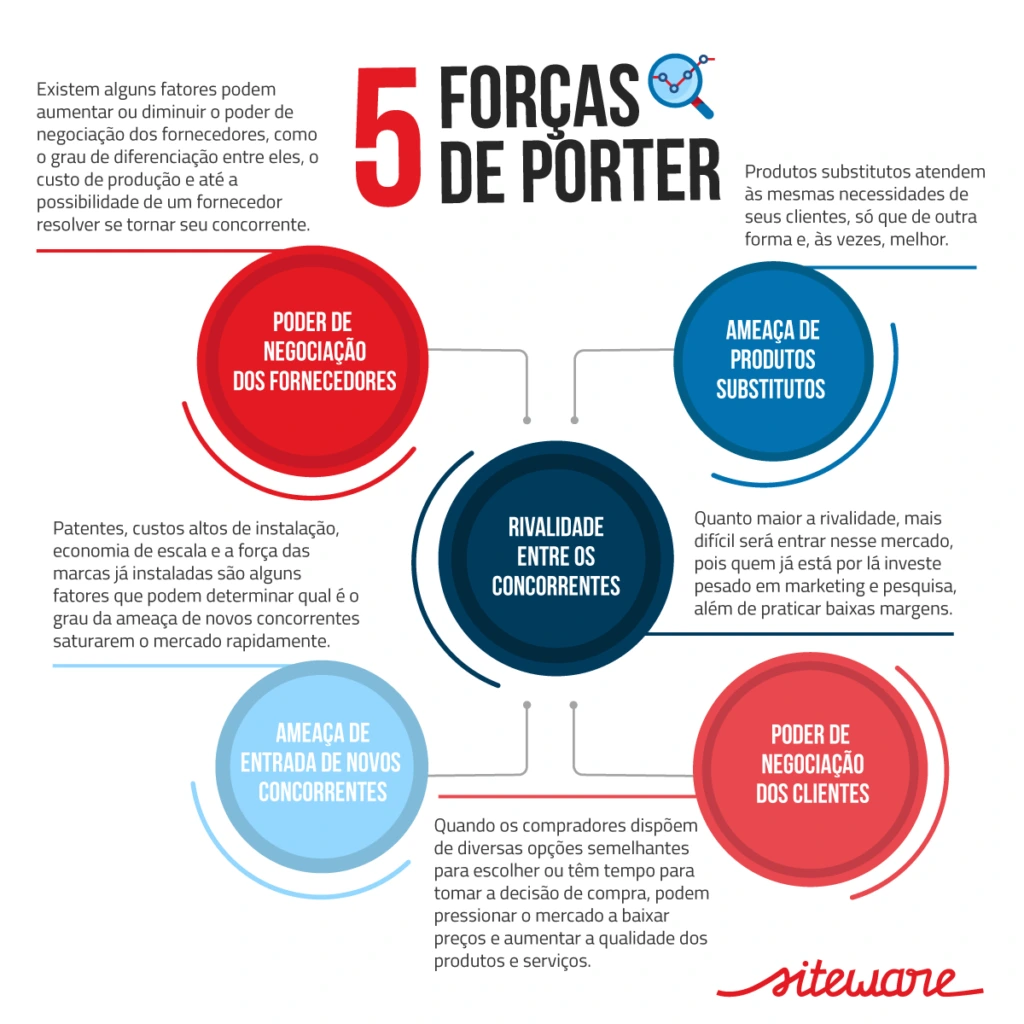
Rivalry among competitors
Rivalry between companies in the same segment is a central point of the analysis. You need to know who your direct competitors are and follow each one’s strategies and development.
Study competitors often. Ask which strategies they use and which advantages they have, and get to know their target audience, tactics and weak points. From there, work out how to stand out in the market where you compete.
Bargaining power of suppliers
Assess the impact suppliers have on your product and, as a result, on how the business develops. Ask yourself whether you depend on them.
To answer, count how many suppliers you have. If there are few, try to widen the relationship by comparing prices, delivery times and quality. Your bargaining power should exist in these cases.
Do not depend on just one or two. Suppliers are not exclusive to your company and probably serve your competitors too.
Threat of substitute products
The third point is substitute products. Your product or service meets a specific need or solves a problem, but no matter how innovative it is, that does not exempt it from competition.
List the competitors that offer similar or identical benefits to yours and invest in this analysis. What does your product have, or could it have, that is different enough for people to choose you?
Threat of new entrants
What can you and the current competition do to block, or at least hinder, the entry of new competitors?
This question is often left out of planning, but prevention saves a lot of headaches. Factors that block new entrants include established brands, patents and exclusivity contracts.
Bargaining power of customers
How much power do customers have over your product? Consumer decision power weighs mostly on price and on the quality offered. There is no good Five Forces analysis without looking at this picture.
Customer power grows when there are many similar options, little differentiation and it is easy to switch suppliers. The greater the competition in the market, the greater consumers’ control over sales. In the end, those who define the value of the product or service are the customers.
The average ticket, the average amount each customer spends, also matters. When it is high, the relationship between company and customer tends to be more balanced, because each depends on the other.
To measure customer power, ask yourself:
- What is the ratio of buyers to companies that supply the same or a similar product?
- How much power do these customers have to dictate the terms of my business?
- How does my customers’ average ticket influence the buying process?
- Is my customer base active on social media, whether to complain or to help my brand’s credibility?
Read also: SWOT matrix: step by step, and Ansoff matrix: what it is and how to fill it inopens in a new tab.
Why the analysis matters to organizations
Porter’s Five Forces analysis is a business management tool that suits any company of any size. Its conclusions show the organization’s position in the market, with the positive and negative points and the strengths and weaknesses of the company and of the competition.
With the analysis, the team gets to know its own services, customers and competitors better. That way, the company’s strategy can be developed in a more planned way.
To have a solid business, a good idea is not enough: you need to watch what others do that is different and innovative. That way, you learn from them and find out how to stay ahead.
From market analysis to execution in Stratws
Porter’s Five Forces analysis shows the business’s external environment, and the result depends on turning that reading into objectives, goals and action plans.
Stratwsopens in a new tab is the management platform created by Siteware to carry out that execution. In it, the Scorecard feature organizes objectives in a cause-and-effect strategy map, breaking them down into indicators, goals and projects.
The Farol feature tracks each indicator and compares results with previous years. For the full path, read about business strategy executionopens in a new tab.
From diagnosis to execution
Strategy objectives, indicators and action plans tracked in one place.
Frequently asked questions
What is Porter's Five Forces?
It is a model to analyze the competitiveness and attractiveness of an industry. It helps companies understand which factors influence profitability and strategic positioning in the market.
What are Porter's Five Forces?
They are rivalry among competitors, bargaining power of suppliers, bargaining power of customers, threat of substitute products and threat of new entrants. The stronger they are, the lower industry profitability tends to be.
What is Porter's Five Forces analysis used for?
It is used to assess the competitive environment and identify opportunities and threats that can affect a company's strategy and performance.
Do Porter's Five Forces apply to any type of company?
Yes. The model suits large corporations and small and medium companies in many industries, because it analyzes the industry the company operates in and not its size.
How do Porter's Five Forces relate to strategic planning?
The Five Forces usually enter the external analysis stage of strategic planning, and help support decisions on positioning and investment.

About the author
Equipe Siteware
Content produced and reviewed by the Siteware team, curated by internal experts in strategic management and corporate performance.