
Strategy and Goals
Ansoff Matrix: what it is and how to fill it out
Understand what the Ansoff Matrix is, see the template with practical examples and structure your company growth strategies with more rigor.

Sustaining growth and profitability takes clear tactics and well defined objectives. When the challenge is to innovate, the Ansoff Matrix works as a map of opportunities for exploring new revenue sources.
The market demands operational agility, yet many companies still leave the potential of this analytical model untouched. Mastering the tool creates competitive advantage, because it supports confident decisions about launching products and entering markets you have never served.
To help your company, we break down how the Ansoff Matrix works and show how to use it to raise the analytical rigor of your strategic planning.
What is the Ansoff Matrix?
The Ansoff Matrix, also known as the Product/Market Growth Matrix, is a strategic planning tool used to help companies define their growth strategies.
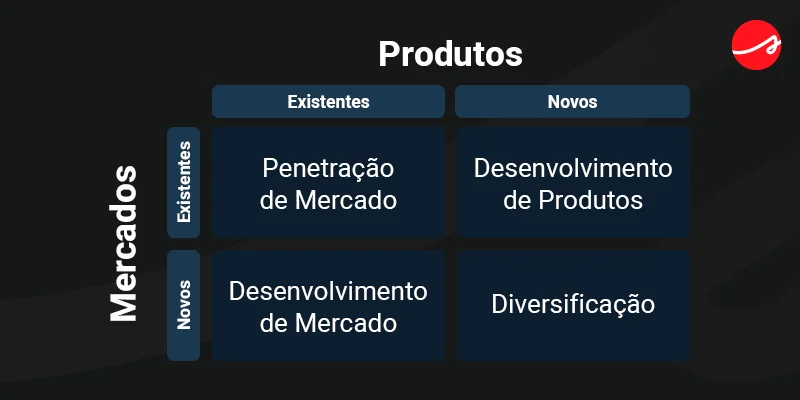
It lays out four strategies for expanding market share and widening the customer base, and it also lets you weigh the risk attached to each one:
- Market penetration: focus on growing share in the current market with existing products.
- Market development: expand by selling existing products in new markets.
- Product development: introduce new products in the current market.
- Diversification: launch new products in new markets.
The Ansoff Matrix was developed by the consultant Harry Igor Ansoff and published in Harvard Business Review in 1957. The tool has helped many marketers and leaders understand the risks behind business growth and which actions can minimize or manage them.
In practice, it connects new and existing products with new and existing markets. The intersection areas come from those two axes.
Here is a template example:
What is the Ansoff Matrix used for?
The Ansoff Matrix works as a tactical map for assessing how effective your current growth routes are. The model crosses the company portfolio with the customer profile, organizing a line of reasoning aimed purely at commercial expansion.
Instead of confining thinking to rigid rules, the matrix reveals hidden traction opportunities. Strategic analysis shows the exact moment to intensify the sales effort in the current customer base, launch innovations to refresh revenue, look for new demographic segments for established offers, or take the calculated risk of building solutions for territories nobody has explored yet.
Mastering this dynamic pushes guesswork out of decisions. The method grounds planning and supports a predictable rise in revenue by balancing portfolio renewal with the conquest of new territories.
How do you apply the Ansoff Matrix in practice?
To apply the Ansoff Matrix in practice, you need to understand the characteristics and the purpose of each strategy it covers. In general terms, the company should invest time in researching and assessing its own situation in order to diagnose the internal and external scenario.
Here is what each segment of the Ansoff Matrix represents:
1. Market penetration
In a market penetration strategy, the company sells its current products in the market it already serves. In other words, the goal is to grow its share of that market, the metric known as market share.
This business growth strategy fits when the company believes that certain aspects of its product or service are enough to take market share from current competitors.
Some of those aspects are:
- above average quality;
- a recognized brand;
- strong distribution channels.
Once those strengths are identified, there is no need to change the products or the marketing strategy.
Market penetration can be put in place by cutting prices to attract new customers or by expanding promotions and distribution channels.
In practice: every brick and mortar furniture store serves the same local market. To use market penetration, a manager can offer prices well below the market average and attract new customers.
2. Product development
In a product development strategy, the company creates an item to serve the market it already holds. This initiative involves extensive research to develop and expand the product line.
It is used when companies understand their current market well and can deliver innovative answers to the demands they observe. Trend research and close attention to customer behavior make that possible.
Here the focus is on developing new solutions or innovations for the customers the company already serves.
In practice: a company that sells skin moisturizers can start developing deodorants.
Also read: BCG Matrix guide: everything you need to know about this management tool
3. Market development
In this strategy, the company enters a new market with the products it already sells. That means expanding into new geographic areas or even into different customer segments.
For the strategy to work, the company has to understand how profitable the new market is and which consumer profile is the right fit to buy its products and services.
The behavior of the audience in the new market has to be compatible with the profile of the markets already served.
Market development can be carried out by entering a domestic segment, expanding regionally, or by gaining ground abroad, expanding internationally.
In practice: sportswear companies such as Adidas and technology companies such as Samsung enter new markets constantly. Both tend to offer the same products to a new demographic group.
4. Diversification
Diversification happens when a company pursues growth by creating a product for a new market.
It splits into two types:
- Related diversification: there is synergy between the existing business and the new product and market. A moisturizer company would be pursuing related diversification if it decided to manufacture sunscreens (complementary products).
- Unrelated diversification: there is no synergy between the existing business and the new product and market. That would be the case if the same moisturizer company decided to manufacture tomato sauce.
In practice: a company established in the moisturizer market decides to enter the manufacture of educational wooden toys (new product), focusing on a new audience of parents looking for sustainable products (new market).
How do you increase market penetration?
This approach is often seen as the least risky of the four strategies Ansoff proposed, because the company operates in a market and a product context it already knows well.
Here is how organizations can grow their market share:
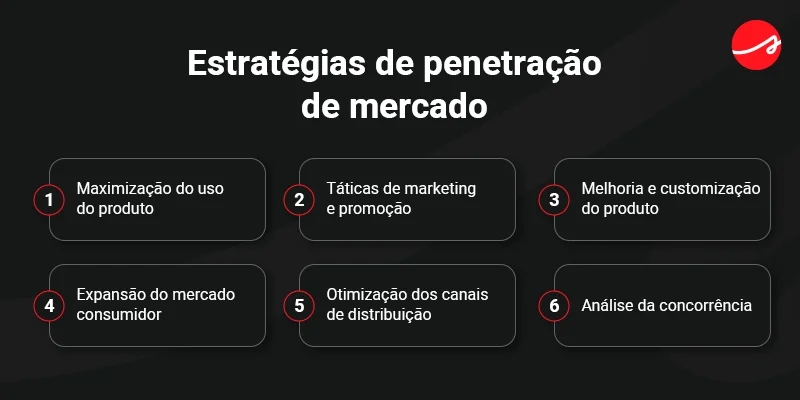
1. Maximizing product usage
- Encourage more frequent use: one tactic is to get current customers to use the product more often. A company that sells a cleaning product, for example, can run an educational campaign about the benefits of more regular cleaning, which encourages more frequent use.
2. Marketing and promotion tactics
- Aggressive marketing campaigns: raise product awareness and visibility through intensive advertising, online or offline.
- Promotions and discounts: discounts, promotions or temporary incentives can attract new customers and lift sales among existing ones.
- Loyalty programs: run loyalty programs to reward recurring customers and encourage continued use.
3. Product improvement and customization
- Product improvements: upgrade or update existing products to make them more appealing. That can mean gains in quality, design or functionality.
- Customization: offer customization options to meet the specific needs of different customer segments.
4. Consumer market expansion
- Reach new market segments: identify and target segments that are unexplored or underserved. A sports brand aimed at professional athletes, for example, can start focusing on amateur practitioners as well.
- Geographic expansion: widen the presence in new geographic areas inside the existing market, such as entering new cities or regions.
5. Distribution channel optimization
- Additional sales channels: explore new sales channels, such as e-commerce or partnerships with more retailers.
- Better distribution logistics: improve supply chain efficiency so the product is available where and when it is needed.
6. Competitor analysis
- Competitive analysis: monitor and respond to competitor moves, always working to hold on to a competitive advantage.
- Competitive pricing strategies: adjust pricing to make the products more attractive next to the competition.
Boost your company market growth
Adopting a solid strategic planning system shortens the distance between macro objectives and real results. Technology integrates and consolidates company information, so leaders can follow financial and tactical progress through centralized dashboards.
Stratws, the ecosystem developed by Siteware, delivers the level of control senior management requires. The platform offers advanced, intuitive resources to organize the management routine and engage talent around corporate goals.
Take your operation to a new level of maturity. Talk to a Stratws expert and bring predictability to the governance of your business.
Key questions answered
1. Who created the Ansoff Matrix and where did it come from?
The methodology was designed by the corporate consultant Harry Igor Ansoff. The tool became public for the first time in 1957, in an article published in the renowned Harvard Business Review.
2. Which of the four strategies in the model is considered the riskiest?
Diversification concentrates the highest level of business risk. That degree of uncertainty comes from the decision to explore completely new opportunities, launching products that did not exist before in areas where the organization has no prior experience.
3. What role does the SWOT Matrix play before applying the Ansoff method?
The first step toward adopting the model calls for a clear view of what sets the company apart. The SWOT Matrix works as a strong analytical support tool precisely to diagnose those organizational strengths and guide the choice of the most suitable strategy.
4. What separates related diversification from unrelated diversification?
The main factor is the presence or absence of synergy with the current portfolio. Related diversification creates items that complement the original niche, while unrelated diversification breaks that link and bets on completely disconnected sectors.

About the author
Equipe Siteware
Content produced and reviewed by the Siteware team, curated by internal experts in strategic management and corporate performance.