
Strategy and Goals
Strategy map: what it is, how to build one in 5 steps, and examples
Learn what a company strategy map is, how to build one in 5 steps, and see real examples from well-known companies such as Kodak and 3M.

Imagine trying to assemble a thousand-piece jigsaw puzzle without the reference picture on the box. You might get there, but it will take a long time, right? Managing a company and its people without a strategy map can be just as confusing.
It is no coincidence that, for management professionals, directors, and business leaders, a strategy map works like a compass that guides every action and decision in the organization. This tool translates the company’s vision and strategy into concrete, interconnected objectives, creating a visual picture that makes communication and alignment easier for the whole team.
But do you really know what a company strategy map is and how to build one? Do you know the main challenges and the tools that can help you along the way? Read on and get your questions about the topic answered.
First, check out our 100% free Strategy Map template, where you can build your own:

What is a company strategy map?
A strategy map is a visual management tool that represents an organization’s strategy in a clear and concise way. It is used to communicate the strategy so that everyone in the organization understands how their individual actions and goals connect to the big picture of the company’s strategic objectives.
Over time, strategy maps are reviewed and updated to keep pace with the organization’s development. In short, a strategy map is an essential tool for the strategic planning of any company.
A strategy map is essentially a diagram that illustrates the relationship between the different components of an organization’s strategy, such as mission, vision, strategic objectives, initiatives, and performance indicators.
Strategy map example
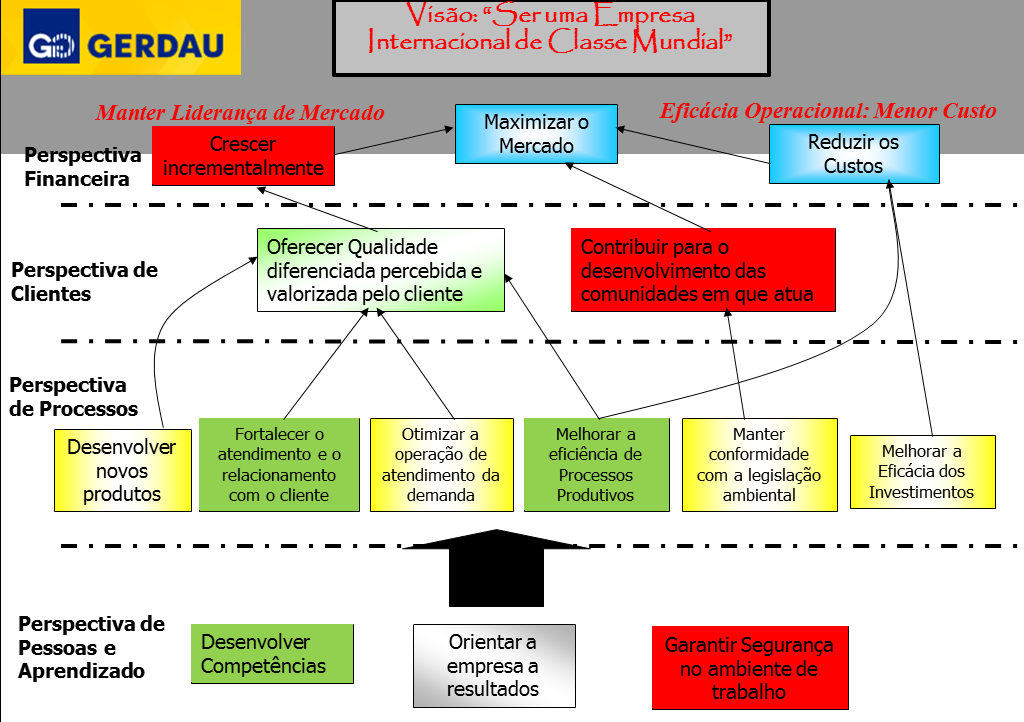
Why is a strategy map important?
A strategy map is essential to make sure you reach your professional goals. Whether you lead a large company or work on your own, you need a map to guide the path you should follow.
A strategy map is simply an execution plan that describes how the company will achieve the goals it has set. It gives direction and focus to your journey, and helps you stay focused and motivated.
It also allows employees to set clear goals, create a strategy to reach them, and determine how to measure their success.
This document is like a map of the roads you must travel to reach your destinations. Investing in a strategy map can help you improve customer retention, create growth prospects, improve sales, and manage your time more efficiently.
One of the most widely used methodologies for building a strategy map is the Balanced Scorecard. Learn more:
The 4 perspectives of the strategy map
The four perspectives of the strategy map, commonly used in the Balanced Scorecard (BSC) model, provide a comprehensive structure for translating organizational strategy into specific objectives and actions. These perspectives help ensure a balance between different areas of performance.
Here are the four:
1. Financial Perspective
The financial perspective focuses on financial results and objectives and on the organization’s economic performance. It includes goals such as revenue growth, cost control, improved profitability, and maximizing return on investment.
It is important that the financial objectives the company wants to reach are visible to everyone, such as revenue growth, cost reduction, and better profitability. This perspective looks at the financial performance the strategy is expected to deliver.
For a long time, the Financial Perspective was seen as the only one that could guide a company’s success. It was the BSC that established that there are other strategy map perspectives that help track that success.
2. Customer Perspective
This perspective addresses the organization’s relationship with its customers and the market. The objectives of this strategy map perspective can include increasing customer satisfaction and loyalty, improving service quality, expanding the customer base, and developing new markets.
Typically, the professionals involved in tracking the goals assigned to this perspective are Customer Success and Support, for example.
3. Internal Processes Perspective
It focuses on the internal processes that are critical to the organization’s success. This strategy map perspective involves improving operational efficiency, excellence in the quality of products or services, innovation, and process optimization.
The Quality Assurance (QA) area, for example, can be involved in this perspective to ensure higher quality in product deliveries.
4. Learning and Growth Perspective
This perspective looks at the organization’s ability to adapt, grow, and innovate. Its objectives include developing employee skills, fostering organizational culture, improving technology, and building the capacity to innovate.
If it is involved in deploying the company’s strategic objectives, the HR area can be assigned to deploy actions in this perspective, for example.
How to build a strategy map
Now that you know what a strategy map is and why it matters for your company, it is important to understand how to build one.
To help you, we prepared a step-by-step guide:
Step 1: Identify the organization’s objectives and goals
The first step to establishing a successful strategy is to identify the organization’s objectives and goals. What do we want to achieve? What are our objectives for the coming months, years, or decades?
It is also important to clarify how much time and how many resources we will need for each category of goal. The strategy map should reflect these objectives and goals, providing direction so that resources are used in the best possible way.
By building a Strategy Map after identifying objectives and goals, organizations and companies can chart the path to success.
Step 2: Run a SWOT analysis of the company
A SWOT analysis (Strengths, Weaknesses, Opportunities, and Threats) is an essential tool for judging the health of an organization or company and for identifying potential strategic opportunities and threats.
By analyzing an organization’s internal and external factors, such as its capital structure, market trends, human talent, or technology resources, you can gain an in-depth understanding and develop a suitable approach to building your strategy map.
By bringing all these factors together, you can better visualize your efforts and create a path to reach the organization’s strategic objectives.
Step 3: Group your objectives into categories and prioritize them
The third step of this process involves listing and grouping objectives into main categories and prioritizing them according to what matters most to the organization. To create a good strategy map, it is important to make sure objectives are set for the organization’s key areas, managing the priority level of each one.
Once the objectives are defined, they should be segmented into key areas, so you can identify which objectives matter most for achieving the best results. For example, if your organization has 3 main areas, Marketing, Operations, and Finance, you can divide your strategy map into 3 categories: Marketing objectives, Operations objectives, and Finance objectives.
After separating the objectives into categories, you need to prioritize each objective within those categories, ranking each goal by urgency and importance.
This way, you can isolate the objectives that must be achieved first and, at the same time, make sure strategic objectives are set for each area. This will let you establish clear guidelines for teams and reach the best results.
Step 4: Set goals for each priority objective
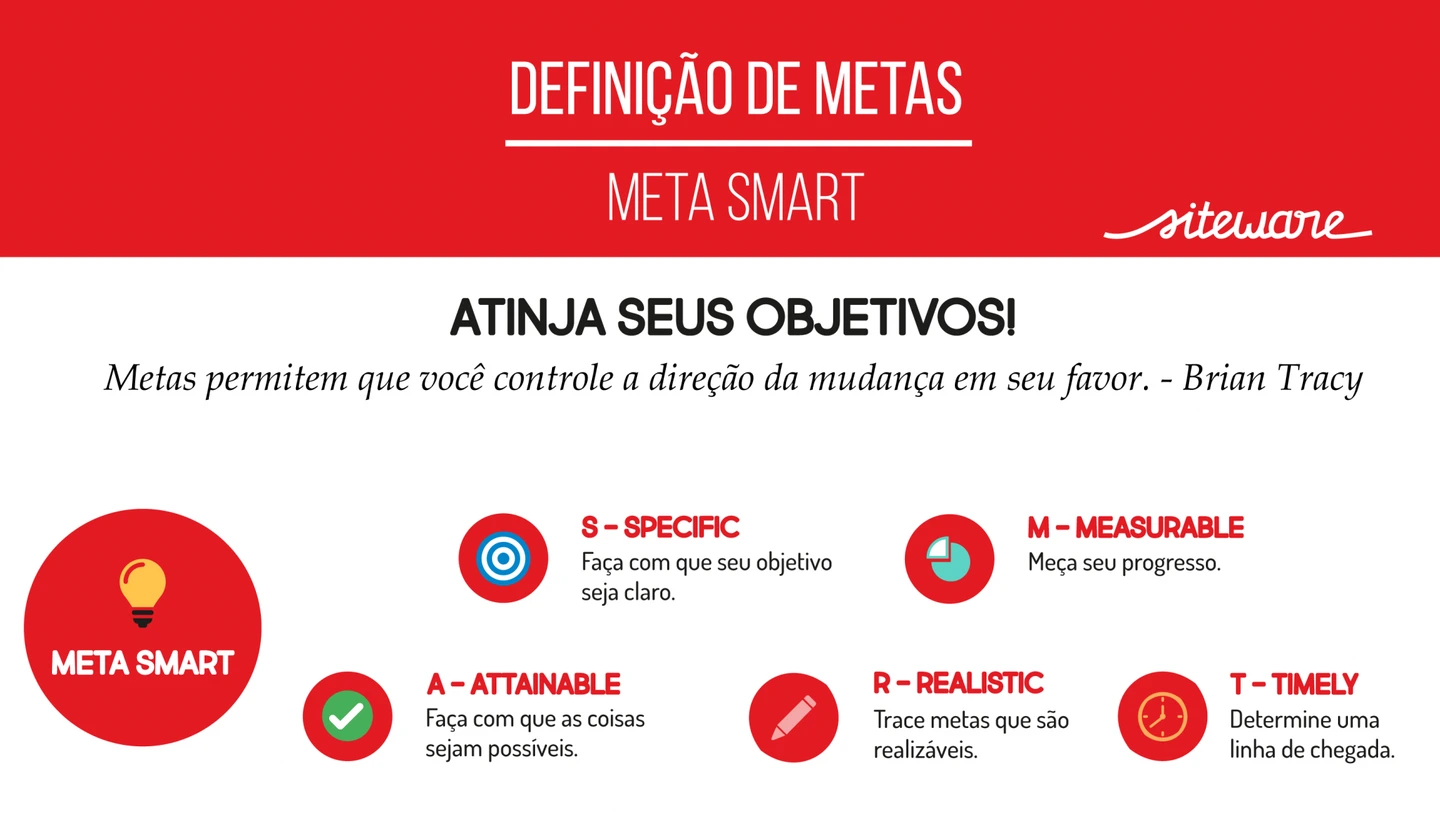
The goals set for each priority objective on the Strategy Map should be measurable and challenging. Each goal, defined as part of your strategic planning, should have an associated value, deadline, and key performance indicator (KPI).
This allows the results of the actions taken to be tracked and measured, helping you assess whether the Strategy Map is being delivered. By mapping and putting the Strategy Map goals into practice, you can establish real indicators of success for your company.
With good planning, it is possible to identify and monitor the main objectives of the strategy, allowing executives and company leaders to analyze the map’s performance.
See how to set goals for your strategy map with SMART Goals:
Step 5: Build an action plan to reach the desired goals
The final step in building a strategy map is to create and implement an action plan. This plan works as a guide to the actions and tasks the organization needs to carry out to achieve its strategic objectives and reach its defined goals.
The action plan should be clear, specific, and developed in detail so that it can be applied in real situations. An action plan should include information such as who must carry out the action, when it must be carried out, what its objective is, and how to measure its performance.
It is also important to set a schedule for the actions and to identify the main responsibilities of each person involved. It is essential to create monitoring and evaluation mechanisms to check whether the action plan is being followed as planned.
By defining each person’s responsibilities, the chances of reaching the goals set in the strategy map are considerably higher.
Which elements are part of a strategy map?
A well-built strategy map is essential for communicating a company’s strategy clearly and effectively. To make it effective, certain elements cannot be missing from this tool.
Here are 7 elements that your map to victory cannot do without:
1. Mission and vision
The foundation of any strategy map is the mission (the company’s purpose) and the vision (what the company aspires to become in the future). These elements set the direction and the ultimate purpose of all the strategic objectives that follow.
In this case, if the company itself does not know where it wants to go and what its mission in the market is, it is necessary to take a step back and review the organization’s pillars.
2. Balanced Scorecard perspectives
The four classic Balanced Scorecard perspectives provide a comprehensive structure for the strategy map, covering the financial, customer, internal process, and learning and growth aspects. These perspectives ensure that the map covers every critical aspect needed to achieve sustainable success.
However, it is worth noting that the perspectives can change according to the company’s needs. The 4 perspectives presented earlier are the most common, but they can be adapted.
The idea is simply to move away from the traditional view that only finance holds the key performance indicators that show whether the company is growing.
3. Strategic objectives
The strategic objectives within each perspective are the building blocks of the strategy map. They should be specific, measurable, and aligned with the company’s mission and vision, representing what the organization intends to achieve in each area.
4. Cause-and-effect relationships
A distinctive aspect of strategy maps is the clear indication of cause-and-effect relationships between strategic objectives. These connections show how objectives in different perspectives influence one another and contribute to reaching the financial objectives and the overall vision.
In the strategy map, the connection between objectives should be clear and illustrated, whether by arrows or other elements that can show that connection.
5. Performance indicators (KPIs)
For each strategic objective, specific key performance indicators (KPIs) must be defined. These KPIs provide a way to measure progress toward each objective, allowing continuous monitoring and adjustments.
If an objective cannot be measured, it will most likely need to be reviewed, because what cannot be calculated cannot be tracked.
6. Strategic initiatives
Strategic initiatives are the specific projects or actions that will be implemented to achieve the strategic objectives. They provide a direct link between strategy and execution, ensuring there is a clear plan to implement the strategy.
These action plans should be documented and easy for everyone involved to follow, ensuring that the pillars of the strategy map are respected.
7. Alignment and interdependencies
The map should clearly align objectives across the different perspectives and highlight interdependencies. This ensures that everyone in the organization understands how their work contributes to the broader objectives and how different areas of the company depend on one another.
Why a company’s strategy map needs to be flexible
Some companies that decided to follow their strategy map to the letter and ignored what was happening in the market around them nearly went bankrupt. Flexibility is essential when it comes to strategy maps.
For that reason, we have selected a few examples of companies that succeeded or failed when they had to change their plans:
1, Kodak:
Kodak, for example, is a recent case of this process.
By disregarding competitors and changes in consumer preferences, it kept focusing on analog photography, with film, and by the time it realized that sticking to that direction no longer made sense, it was too late to make up for lost time.
In 2012, Kodak nearly declared bankruptcy and was forced to sell part of its business units.
2, Swatch:
Another well-known case, though an older one, is that of the Swiss watch brand Swatch. The company led the market and worked without a care. Suddenly, it was threatened by Japanese industry technology, which produced a thin watch at a very affordable price.
So, to avoid losing ground, Swatch had to stop following its strategy map. It paid attention to what was threatening its position in the market.
With that move, it managed to reverse the crisis by launching a plastic watch that was very thin, high in quality, and fairly priced.
3, 3M:
On the other side of these examples, there are also stories of companies whose strategy maps were aimed at reaching a certain objective. Along the way, however, they realized that changing their strategic direction would be much better.
They did so and succeeded. An example of this happened with 3M. Post-its, so familiar in offices and schools, are a success worldwide.
But in fact, it was a mistake that worked out. The company actually wanted to produce an extra-strong glue and, to do so, tested the glue on a piece of paper and stuck it to the wall to test its durability.
The glue, however, was not strong enough to keep the paper stuck to the wall. But it was effective enough to let the paper be stuck and re-stuck many times. In this simple and innovative way, the Post-it was born.
Given all this, it is fair to say that keeping the focus only on the purpose to be achieved can be problematic. It is necessary to observe the world around you. Build the strategy map and keep it in a flexible version.
Who should be involved in creating a strategy map?
Creating a strategy map should involve the company’s senior leadership, including CEOs, CFOs, directors, and managers of strategic areas. It is also essential to include representatives from different levels and departments to make sure all perspectives and insights are considered, fostering a sense of ownership and commitment to the strategy.
How often should the strategy map be reviewed?
The strategy map should be reviewed regularly to make sure it remains relevant and aligned with changes in the business environment and in the organization. An annual review is recommended, but adjustments may be needed whenever there are significant changes in the company’s strategy, structure, or market.
What are the common challenges in implementing a strategy map?
Common challenges include:
- Resistance to change: employees may resist new strategies and processes.
- Lack of clarity: poorly defined objectives and strategies can lead to confusion and misalignment.
- Inadequate team involvement: lack of engagement and participation from employees can undermine success.
- Ineffective monitoring: lack of follow-up and adjustments can cause the strategy map to lose relevance.
Are there specific tools for creating and managing strategy maps?
Yes, there are several strategy map tools and software options available. One of them is Stratws, which makes it easier to define, track, and review strategic objectives, ensuring that everyone in the organization is aligned and working toward the same objectives.
These tools offer advanced features for visualization, monitoring, and performance analysis, making the process more efficient and effective.
The benefits of a strategy map for companies
Are the advantages of a strategy map still not clear to you? Then check out some of them:
1. Clear view of the strategy
Imagine being able to look at a single diagram and see your company’s entire game plan. That is exactly what a strategy map offers. It breaks the strategy down into clear objectives, distributed across different perspectives, such as financial, customer, internal processes, and learning and growth.
This visual representation helps everyone in the organization quickly understand where the company is heading and how it plans to get there.
2. Organizational alignment
One of the great challenges for companies is making sure everyone rows in the same direction. The strategy map is like a compass that guides every department and employee, showing how their daily activities contribute to the company’s larger objectives.
When everyone understands how their work fits into the bigger picture, engagement and motivation increase significantly.
3. Effective communication of the strategy
Communicating the strategy effectively can be as challenging as formulating it. The strategy map turns the strategy from words and complex documents into an understandable and accessible image. This makes communication easier at every level of the organization, from the boardroom to the shop floor, ensuring that everyone is informed and in sync.
4. Focus and prioritization
In a world full of distractions and new opportunities appearing all the time, staying focused can be hard. The strategy map helps companies stay focused on their strategic priorities, avoiding wasted resources on activities that do not contribute significantly to strategic objectives.
It works as a filter that keeps the company centered on what really matters.
5. Strategy monitoring and adjustment
The strategy map is dynamic and allows companies to track progress against their strategic objectives and make adjustments as needed. This ability to respond quickly to internal or external changes can be the difference between thriving and merely surviving in a competitive market.
Technology as an ally for the strategy map
The strategy map is an essential tool for the development and growth of any company. With it, you can set short- and long-term objectives in a clearer and more objective way. That is why relying on technology as an ally in building this strategy map can be extremely beneficial.
Technology, combined with individual strategies and collective objectives, can provide insights and business intelligence that help leadership reach its objectives and drive the company’s growth.
By using software systems, it is possible to create interactive strategy maps, with charts and real-time information, that can be viewed throughout the whole process of building a strategy map.
Another important advantage of technology is that it enables real-time collaboration among everyone involved in the process.
In Stratws, the software developed by Siteware, you can build your strategy map, track indicators, create action plans and tasks linked to it, and much more.

About the author
Equipe Siteware
Content produced and reviewed by the Siteware team, curated by internal experts in strategic management and corporate performance.