
Strategy and Goals
What Is the BSC? A Practical Guide to Implementing the Balanced Scorecard in Your Company
Learn what the Balanced Scorecard (BSC) is, its 4 perspectives and how to implement it in your company, with a free strategy map template.

For a long time, companies worried about a single scenario: the financial one. Over time, however, it became clear that money matters, although extremely important, are not the only ones an organization should prioritize.
From that shift came the Balanced Scorecard, also known as the BSC.
The idea is that the BSC presents four pillars for companies to prioritize, and they make sense for today’s world. By dividing performance this way, the organization builds a more solid foundation and can plan its growth.
Want to know more about the Balanced Scorecard? Keep reading!

What Is the Balanced Scorecard (BSC)?
The BSC is a strategic management method that goes well beyond traditional financial metrics.
If you are asking yourself what the BSC is or what a balanced scorecard is, know that this tool was developed to give a complete view of organizational performance, integrating four perspectives that are essential to business success.
They are:
- Financial;
- Customers;
- Internal processes;
- Learning and growth.
The logic is that, through these pillars, the company can measure and track its growth from different perspectives, beyond the traditional ones that involve only financial matters, since it evaluates performance in other vital areas of an organization.
- Want a short explanation of the BSC concept? Also check our ABC of Management page on the BSC or watch the video below:
For this reason, the tool contributes to setting goals and measuring their progress, making the strategy easier to communicate and understand across the organization.
In addition, the Balanced Scorecard also aligns individual and team activities with objectives, allowing problems to be identified quickly and corrections to be put in place, which results in effective strategic management.
You may also be interested in:
- BSC software: 5 essential features + tool tips
- Management tracking system: 12 essential characteristics
How Did the Balanced Scorecard Come About?
The Balanced Scorecard was created by professors Robert Kaplan and David Norton, of Harvard Business School, in 1992.
At the time, they published the first article on the concept of the tool as a way to measure results and define objectives. Its differentiator, however, was the use of several types of indicators.
This broad and innovative view by the researchers, which emerged as a response to the limitations of traditional performance evaluation systems, gave the method great repercussion, both in academia and in business.
With that article, the authors started an unexpected revolution. Their goal was to show the disadvantages of using only financial measures for evaluation.
After the first article, 5 books on the subject were published.
Over the last few years, the BSC concept has been adapted to different situations and organizations, and it is constantly updated.
The latest book, Execution Premium (2008), adapts to the challenges of the digital era we have lived through so intensely over the last decade.
Check the comparison between the most powerful and widely used management models on the market:

What Is the Balanced Scorecard Used For?
The BSC starts from the principle that a company should consider other perspectives, as important as the accounting ones, to evaluate its performance effectively.
In this way, companies that use the Balanced Scorecard can pay closer attention to specific indicators (also called Balanced Scorecard indexes), so that the manager can steer the business safely and satisfactorily, supporting decision making.
Keep in mind that the BSC method can be used not only to measure organizational performance, but also to establish:
- goals (individual and team);
- compensation;
- resource allocation;
- planning;
- budgeting;
- feedback;
- strategic learning.
Also read: BCG Matrix GUIDE: everything you need to know about this management tool
Putting the Balanced Scorecard Into Practice: The 4 Pillars
To implement the balanced scorecard successfully, it is essential to understand its 4 pillars, which form the basis for setting goals and monitoring performance:
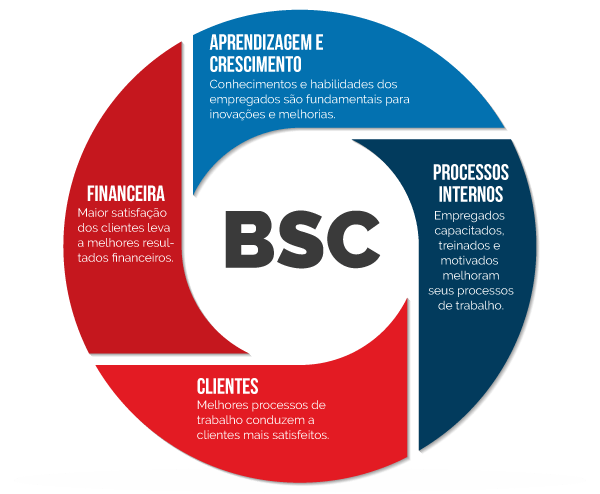
1. Learning and Growth Perspective
Ask yourself: how can we grow and create value?
The learning and growth perspective focuses on employee development, training and organizational culture, all essential for sustainable growth.
The idea here is to show that no company grows if its employees are not developing, learning new practices, keeping up to date, or even staying with the company, especially its top talent.
A company that keeps its turnover rate low, for example, conveys the image of a company focused on growth, but not at the cost of its employees’ happiness and health. This helps in several situations, such as attracting investors.
The important indicators to measure success in this perspective are:
- employee turnover;
- engagement;
- skills development;
- training;
- satisfaction.
See more: BSC performance indicators: check 8 examples to use in your business
2. Internal Processes Perspective
Ask yourself: how can we improve?
This pillar is largely about innovation. A company whose processes have been stagnant since the last decade is certainly outdated compared to its competitors.
You need to be constantly improving your processes.
To do that, evaluate the efficiency of operational processes, identify points for improvement and explore innovation opportunities that drive results.
Productivity, technology, cost and development time should be analyzed with an emphasis on constantly fixing damage, improvement and operational excellence.
One of the differentiators of the BSC is the insertion of new techniques at various stages of internal processes, to keep up with technological development and stand out in the market.
Kaplan points to 3 essential characteristics for this perspective:
- Innovation: a focus on meeting the needs of target customers and always thinking ahead;
- Operation: improvement of cost, quality and response time. The operation starts with the order for the product/service and ends with its delivery;
- After-sales: essential for building the company’s reputation. It includes warranties, repairs, successful communication, returns, etc.
3. Customer Perspective
Ask yourself: how does the customer see the organization?
This perspective measures customer satisfaction and loyalty, as well as market share and customer experience.
This pillar is important because a company that cannot retain its customers will hardly be able to grow… That is because it will always be busy acquiring new customers while those who already bought do not come back.
That said, it is important to identify your stakeholders and select the results that will be evaluated, such as: market share, acquisition, retention, satisfaction and profitability.
Think about the characteristics that attract this audience. This includes: product attributes (functionality, quality and price), customer relationship (quality of the buying experience and personal relationships) and corporate image and reputation.
In this respect, it is important to know how customers view the company.
According to the authors, this perspective should include an analysis of the following points:
- Market share: proportion of sales relative to the number of customers in the market where the company operates, sales and invested capital;
- Customer retention: percentage of customers with whom the unit maintains business relationships;
- Customer acquisition: percentage of new customers acquired;
- Customer satisfaction: level of satisfaction relative to previously established criteria;
- Customer profitability: measurement of the company’s profit in the specific niche, including the expenses needed to serve the customer.
Also read: What is the objective of the BSC (Balanced Scorecard)?
4. Financial Perspective
Ask yourself: how do we see the company, and how do shareholders see it?
This may be the easiest perspective to understand, since it is usually the growth compass for many organizations.
In this way, this perspective evaluates the company’s economic health through indicators such as revenue, profitability and return on investment, but also:
- financial processes;
- customers;
- internal processes;
- employees;
- systems.
To think about this perspective, it is important to reflect on the vision the company wants to convey to shareholders and the one it is actually conveying, for example.
Financial indicators are not left aside in the methodology, quite the opposite.
They are very important and are generally a symptom of what is going right and what is going wrong in the organization.
In the financial perspective, success can be measured by profitability, company growth and increased value for shareholders.
If results are not as expected, the problem may be poor execution, implementation or definition of strategies.
How to Align Financial and Non-Financial Perspectives?
The financial perspective concentrates on the company’s economic results, such as revenue, profit and return on investment. For that reason, for a long time this perspective was treated as the only one, or the most important one.
However, it is important to point out that all the other perspectives connect with it.
In the customer perspective, for example, to reach its financial objectives, the company needs to satisfy its customers. Indicators such as customer satisfaction, retention and acquisition of new customers are crucial.
In this way, to achieve a strategic objective of increasing revenue, the company would need to improve customer satisfaction, so that customers buy more and recommend its products.
In this way, to improve satisfaction, the company can focus on improving customer service and product quality.
Following this same logic, it is possible to connect all the perspectives and thus build a strategy map in which they speak to each other, so that the company as a whole is rowing in the same direction.
How Does the BSC Model Work?
The BSC encompasses a series of tools, such as: strategy map, strategic objective, performance indicators, goals and action plan. Together, they promote continuous process improvement and the achievement of effective results.
Learn more about each of them.
1. Strategy Map
The strategy map is a Balanced Scorecard tool that helps implement the company’s strategy. As a visual representation, it is a synthesis of the important measures taken with a focus on development.
Did you know that, according to the authors of the methodology, fewer than 10% of company strategies are actually executed? And that in approximately 70% of failures, the problem is not the strategy but its execution?
Building the strategy is an essential step for developing and implementing the Balanced Scorecard.
For that, you need to master the whole trajectory of the business and know where you want to go.
Good execution planning is what separates companies that have a strategy from those that manage to take it off the paper.
By the way, Siteware created a BSC Strategy Map template in PowerPoint to make it easier to implement the methodology, download it for freeopens in a new tab (in Portuguese)!
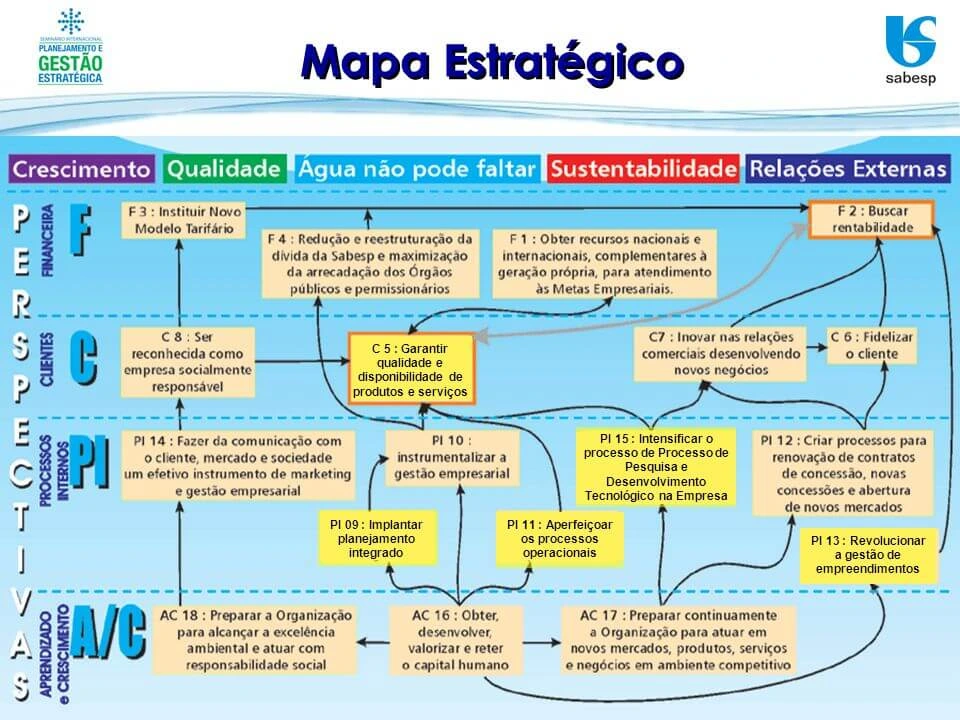
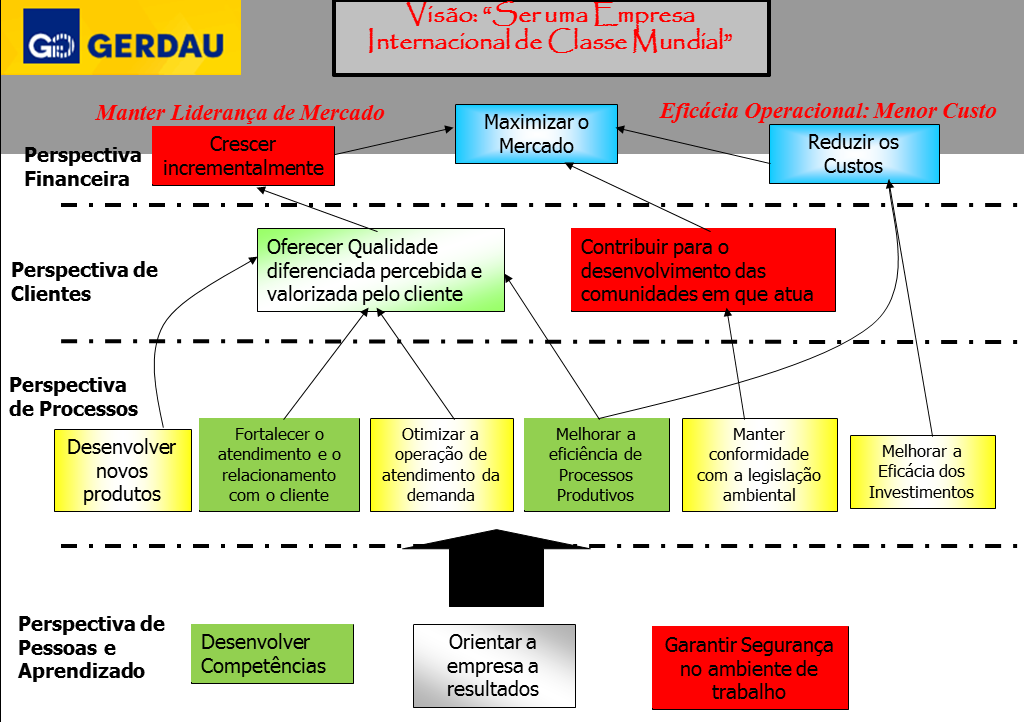
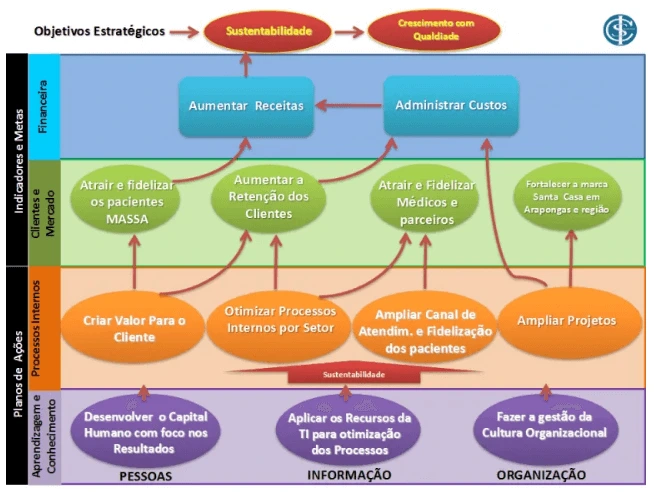
Balanced Scorecard Strategy Map Examples
If you are interested in implementing the BSC in your company and want Balanced Scorecard examples for inspiration, to see how it works in practice, here are some strategy maps from companies that use this tool.
Check them out below!
1- Sabesp
2- Gerdau
3- Santa Casa de Arapongas
2. Strategic Objective
Strategic objectives are developed to reflect and achieve the organization’s vision and mission, making sure every action taken contributes to those long-term ends.
They cover several areas of the organization, which in the BSC are divided into four main perspectives: financial, customers, internal processes, and learning and growth.
Each strategic objective should support progress in one or more of these areas.
Suppose a company has the strategic objective of “Increase customer satisfaction.”
To do that, it can define specific indicators, such as the score in customer satisfaction surveys, and implement actions such as improving customer support or personalizing services.
This objective can be linked to objectives in other perspectives, such as “Improve operational efficiency” in internal processes, which in turn can reduce waiting times or delivery errors, positively impacting customer satisfaction.
3. Indicators
Indicators are essential metrics used to measure the organization’s performance against its strategic objectives, discussed above.
They provide a concrete way to assess how the company is progressing toward its goals and are fundamental for strategic monitoring and management.
Suppose one of a company’s strategic objectives is “Improve operational efficiency.”
A relevant indicator for this objective could be “Average time to complete a process.”
By tracking this indicator, management can identify whether the initiatives to improve efficiency are effective and where adjustments are needed.
4. Action Plan
In the Balanced Scorecard methodology, action plans are the specific initiatives or projects developed to achieve the defined strategic objectives and, consequently, contribute to meeting the established goals.
These plans are essential because they translate strategy into practical, executable activities that can be implemented in the organization’s day-to-day operations.
Action plans are vital because they connect the organization’s strategic aspirations with operational reality.
They provide a clear roadmap for execution, allowing the organization to turn ideas and objectives into concrete results.
Benefits and Applications of the BSC Method
Implementing the Balanced Scorecard brings numerous benefits for companies, such as:
- Strategic alignment: Integrates all areas of the organization around common objectives.
- Comprehensive view: Allows a complete analysis of performance, considering financial and non-financial aspects.
- Better communication: Makes it easier to spread objectives and indicators among employees, promoting engagement.
- Informed decision making: Offers accurate data to guide adjustments and optimize results.
- Continuous tracking: Establishes a monitoring and feedback cycle that drives continuous improvement of processes.
These advantages make the BSC method an indispensable tool for companies seeking competitiveness and management excellence.
How to Implement the BSC in My Company? 4 Steps
Before you keep reading our article, watch the video below and learn tips for putting the Balanced Scorecard into practice:
Did you watch the video? Then let us show how you can implement the Balanced Scorecard in your company.
In short, Kaplan and Norton defined four essential management processes to implement the BSC: translating the vision, communication and linking, business planning and feedback.
Below, see the implementation in each of these steps.
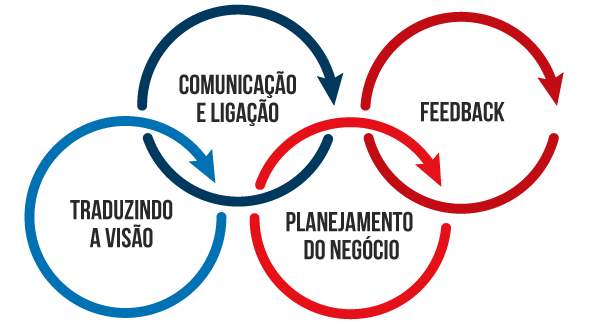
1. Translate the Vision and Strategy
The purpose of this first step is to harmonize and unite the company’s vision with the strategy created to reach its objectives.
This translation must be done with all employees, from the highest positions to the lowest.
Only then can strategy maps be created, making planning clearer and easier for the team to visualize, since the process becomes more dynamic and focused. Therefore:
- clarify the vision;
- build consensus;
- translate the vision and the strategies.
2. Communicate and Link
Team engagement and understanding of the action plan is what will make the BSC work. Communicate the company’s strategy horizontally and vertically.
With effective communication, organizational and individual objectives integrate more effectively. Thus:
- communicate and educate;
- set goals;
- link rewards to performance indicators.
3. Plan and Set Objectives
For the strategy to work, actions must be aligned with the available resources.
Controlling the budget, and reserving and acquiring resources to reach objectives, is a fundamental part of planning and execution. Therefore:
- set the objectives;
- align strategic actions;
- allocate resources;
- establish checkpoints.
4. Give Feedback
Feedback is essential for strategic growth and learning. It is a continuous process and, to work, it needs constant improvement from each employee.
Articulate a shared vision and give strategic feedback to the team. In this way, strategy review and learning become achievable.

What Mistakes Should Be Avoided When Using the BSC?
Now that you know why the Balanced Scorecard is important for your company, before we talk about its implementation, let us highlight the main mistakes that must be avoided.
1- Lack of Team Involvement
The BSC is a tool that requires the involvement of the whole team to be effective.
It is essential to engage employees from the start, making sure everyone understands the purpose and importance of the method for the company.
2- Excessive Focus on Financial Measures
Although financial measures are important, the Balanced Scorecard seeks to balance financial and non-financial perspectives.
Focusing only on financial measures can limit a comprehensive understanding of the organization’s performance.
3- Communication Failures
Effective communication is crucial to the success of the BSC.
It is essential to clearly communicate the strategic objectives, goals and metrics defined, so that everyone can understand them and align their efforts.
4- Inadequate Process Mapping
The Balanced Scorecard requires proper mapping of the organization’s internal processes.
If they are not correctly identified or are not aligned with strategic objectives, there may be a gap between strategy and execution.
5- Not Using the BSC Based on Feedback
The BSC is a flexible tool that should be updated and adjusted based on feedback and changes in the business environment.
Ignoring feedback and not carrying out periodic reviews can lead to an outdated and ineffective strategy.
6- Setting Unrealistic Goals
The goals set should be realistic and achievable.
Setting unrealistic goals can lead to team frustration and compromise the effectiveness of the BSC as a management tool.
7- Not Investing in Technology
Using appropriate technology can make it easier to collect, analyze and monitor data related to the Balanced Scorecard.
Not investing in appropriate technology can make implementation and tracking harder, limiting its effectiveness.

Connecting the Balanced Scorecard With Organizational Culture
Organizational culture represents the values, beliefs and behaviors shared within the company, and when it is aligned with the BSC, it translates that vision and mission into concrete, measurable objectives, distributed across the four perspectives.
It is also vital to integrate the BSC into performance management processes.
This means that employee performance reviews should be based on the objectives and indicators defined by the BSC.
By doing this, the company ensures that employees are focused on the right goals and working in line with the corporate strategy.
In this way, recognition and rewards for achieving these objectives reinforce the desired behaviors and help solidify the organizational culture around the BSC strategy.
Finally, it is essential to maintain open and transparent communication about progress toward the BSC objectives.
Regular reports, update meetings and other communication channels help keep everyone informed about what is working well and where improvements are needed.
This constant feedback creates a culture of transparency and accountability, in which all employees feel part of the strategic process.
Invest in Technology to Apply the Balanced Scorecard!
Finally, you now know everything you need about the Balanced Scorecard, and the moment has come to put the methodology into practice.
Know that pairing the method with strategic planning and well-articulated execution is what makes your strategy map pay off in guidance, measurement and support for good decisions.
In this way, the ideal is to have a strategic planning system that helps increase, engage and boost your results, with visual resources that improve the company’s strategic deployment.
This business management system allows integrated tracking of corporate performance, and the monitoring and centralization of all indicators, with a focus on decision making.
And on the market, software that has all these characteristics is Stratws, which lets managers organize their work routine with better management and engagement of the whole team.
It is ideal for achieving high performance in managing your team.
Through visual resources, this tool helps organize the work routine, making processes smoother, more accurate and more efficient.
Request a free demo!

Frequently asked questions
What does BSC mean?
The BSC (Balanced Scorecard) is a strategic management methodology that balances financial and non-financial indicators to offer a comprehensive view of organizational performance.
What are the 4 pillars of the BSC?
The 4 pillars are: Financial Perspective, Customer Perspective, Internal Processes Perspective and Learning and Growth Perspective.
What is the BSC model?
The BSC model is a tool that translates a company's vision and strategy into objectives, indicators and goals organized in a strategy map that integrates the four perspectives.
What is the BSC method?
The BSC method consists of implementing strategic management based on setting goals and indicators for the financial, customer, internal processes, and learning and growth perspectives, promoting continuous improvement and organizational alignment.

About the author
Equipe Siteware
Content produced and reviewed by the Siteware team, curated by internal experts in strategic management and corporate performance.