
Continuous Improvement
Continuous improvement: what it is, main tools and tips to implement it
Learn what continuous improvement is, which tools to use and get practical tips to refine your processes and reduce costs.

With the market in constant transformation and customers increasingly demanding about what brands have to offer, it is only natural that companies look to implement continuous improvement in their processes, products and services to stay competitive and relevant.
If you do not yet know what the continuous improvement cycle is, or how it can boost a business’s revenue, keep reading and learn all about it.
PDCA is one of the methodologies for applying continuous improvement to processes. We prepared a 100% free template for you! Download it now:

What is continuous improvement?
From an organizational point of view, continuous improvement is a set of uninterrupted actions to refine processes, products and services. This means the company measures and analyzes how it performs tasks, looking for failures, delays and bottlenecks that can be solved, leading to more efficiency and productivity.
It is not hard to understand what continuous improvement is if you see it as a constant search for opportunities to get better and a philosophy built into the organizational culture.
Read more: Meet the 8 best business management software products for TOP leaders
What is the principle of continuous improvement?
For Edward Demingopens in a new tab, considered the great master of continuous improvement, the principle is to practice quality from the very start of making a product or delivering a service, through every stage. This removes the need for a final inspection, which detects failures only after they have already happened.
He also held that a constancy of purpose focused on improvement must be established so that the organization becomes competitive and economically sustainable.
What is the main goal of continuous improvement?
The main goal of continuous improvement is to let the company perform its activities in the best possible way, creating more value for the end customer. It enables constant evaluation of the quality of products and internal processes to identify bottlenecks, reduce waste and increase efficiency.
What are the fundamental pillars of continuous improvement?
The main pillars of operational improvement in companies are: continuity, because it is a cyclical process; organizational culture, because to implement improvement, every hierarchical level of the company must think and act this way; and benefits for everyone, since it must have a positive impact on all areas.
We consider the first pillar to be organizational culture. A critical and constructive eye can only develop if everyone understands the importance of avoiding errors and improving processes. That way, the other pillars can be built on a solid, structured foundation.
Besides these three, see the other fundamental pillars of continuous improvement:
- process standardization;
- technical knowledge;
- strategy;
- processes;
- people;
- methods and tools to identify and understand problems.
What are the main types of continuous improvement?
The main types of continuous improvement are: process continuous improvement, which maps all internal operations; product continuous improvement, which analyzes production efficiency and quality; and service continuous improvement, which focuses on improving the quality of the work delivered.
Learn more about the main types of continuous improvement:
- process continuous improvement: the focus is on mapping the nuances of specific internal processes in order to fix failures and make changes that optimize them.
- product continuous improvement: the goal is to constantly evaluate products and make changes that make them more efficient.
- service continuous improvement: the intent is to improve the quality of the services offered to customers.
Advantages of implementing continuous improvement in business administration
The advantages of implementing an improvement process for processes, products or services are numerous, such as greater encouragement of teamwork, easier onboarding of new employees, higher productivity, lower costs and better risk management. Not to mention higher revenue, which follows from the actions taken.
Here are some of the main reasons to adopt this culture in the organization’s daily management.
1. Greater encouragement of teamwork
To drive this improvement process, employees must know how to work as a team and be willing to collaborate.
Bringing together professionals with different skills and points of view brings more clarity about the problems faced and helps find the most effective solutions.
2. Easier onboarding of new employees
Implementing improvement tools makes it possible to standardize processes. This supports the onboardingopens in a new tab of new talent, who can perform their tasks according to the quality standards and methodologies defined beforehand.
3. Higher productivity
The continuous improvement cycle helps teams become more productive, doing more with less.
Productivity in your company can be affected by several factors. Here are some of them:
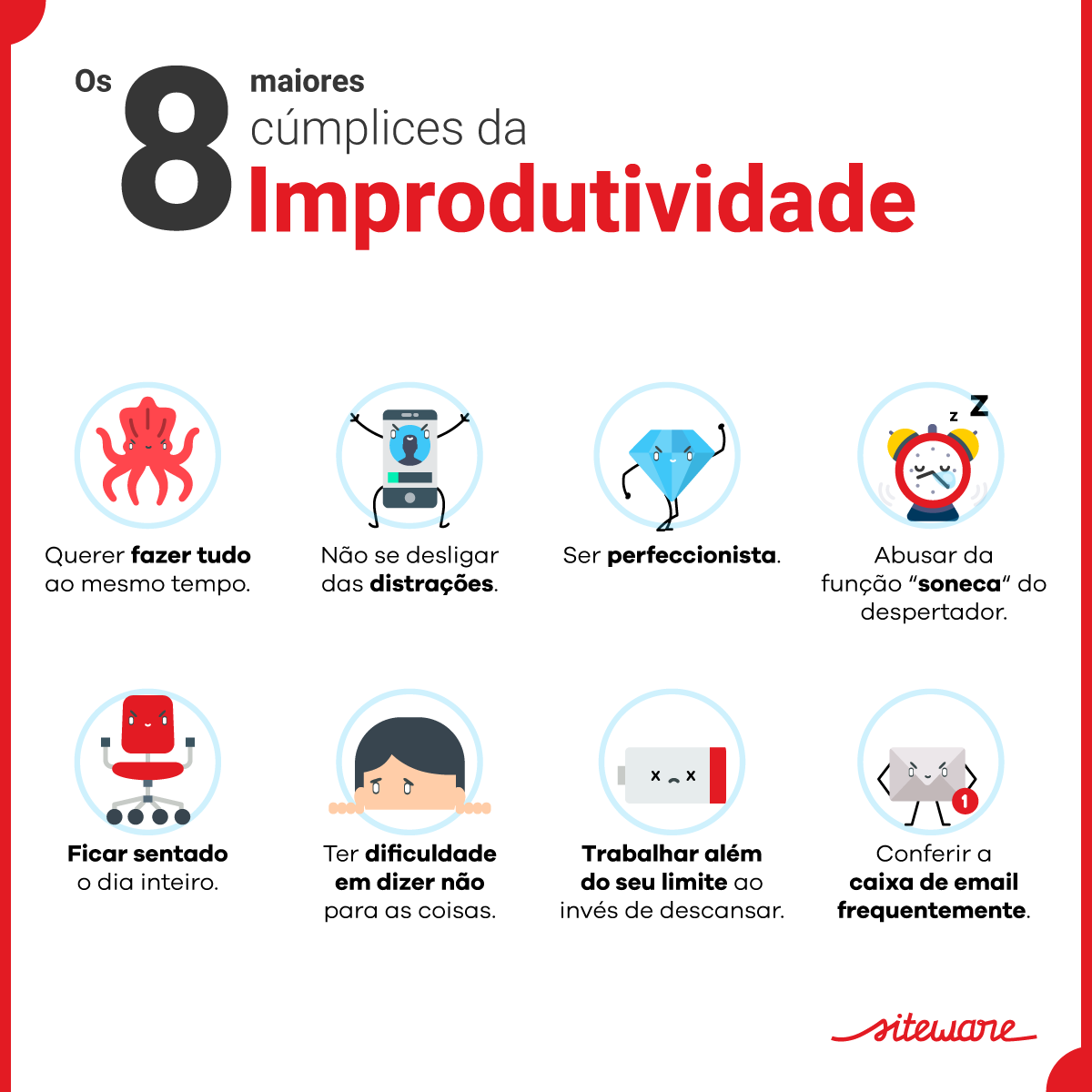
See also: Productivity goals: what they are and how to set them with 5 key tips
4. Lower costs
Speaking of “doing more with less,” continuous improvement makes it easier to identify bottlenecks, which contributes to a significant reduction in operating costs.
5. Better risk management
Committing to an improvement process is also a way to manage risks better, which lets the company take them on in a more calculated, predictable and prudent way.
What are the main tools for promoting continuous improvement?
There are several tools you can use to drive constant growth, refinement and innovation in your company’s processes, products and services: Business Process Management (BPM), BASICO Matrix, Kaizen (lean manufacturingopens in a new tab), Ishikawa Diagram, PDCA Cycle, among others.
You may already know, or have heard of, some of the continuous improvement tools we show below. Keep reading and see how they can help boost your business!
1. Business Process Management (BPM)
Business Process Management is a tool for analyzing a company’s most relevant processes and finding out how to run them more efficiently and effectively.
To do this, processes are mapped using flowcharts in order to identify points for improvement.
Then the flowcharts are redrawn, fixing the failures found. Each operation is monitored continuously and, if necessary, redesigned.
With a BPM tool, you can see more clearly the tasks, who is responsible for them, and the inputs and outputs of each step in the process.
2. BASICO Matrix
In this improvement tool, processes are analyzed using 6 criteria that form the BASICO acronym (a Portuguese-language acronym):
- Benefícios (benefits for the company);
- Abrangência (scope);
- Satisfação (employee satisfaction);
- Investimentos (investments required);
- Cliente externo (external customer);
- Operacionalização (operationalization).
Give each criterion a score from 1 to 5 to define which improvements should be implemented first.
3. Continuous improvement and Kaizen
Kaizen is one of the tools of lean manufacturing. This methodology was developed in Japan in the early 1950s as a way to rebuild the country, which had been devastated at the end of World War II.
Today, continuous improvement and Kaizen are practically synonyms, since there is a huge relationship between the two. That is because Lean is used by different types of companies and processes.
Kaizen means “change for the better.” It serves to promote personal, professional and business continuous improvement and follows the philosophy that tomorrow can always be better than today.
To apply Kaizen, you should:
- focus on eliminating waste and creating value;
- standardize processes;
- have a well-trained team;
- use materials only when needed;
- optimize the use of equipment.
4. Ishikawa Diagram
The Ishikawa Diagramopens in a new tab is a tool that aims to find the root cause of problems. To do this, the 6 Ms are analyzed:
- Method
- Material
- Manpower
- Machine
- Measurement
- Mother nature (environment)
The intent is to understand how each of these 6 aspects contributes to the problem at hand. Your business model may not include all 6 Ms. In that case, you can make the necessary adaptations.
If you want to know more, be sure to check out our Ishikawa Diagram template:

5. PDCA Cycle
Another classic tool for promoting continuous improvement is the PDCA Cycleopens in a new tab. It consists of 4 steps that must be carried out cyclically to constantly improve a given business process.
The steps are as follows:
- PLAN: plan objectives and methods to address the problems;
- DO: put the plan into practice, implementing the solutions;
- CHECK: verify whether the results obtained from implementing the improvements match what was expected;
- ACT: make the necessary adjustments based on what was observed during the check.
If you want to know more, be sure to check out our PDCA Cycle template.

How does Six Sigma relate to continuous improvement?
Six Sigma is a structured methodology that is intrinsically related to continuous improvement because it provides a systematic framework for optimizing processes by eliminating defects and variation and improving operational performance in organizations. The relationship between Six Sigma and continuous improvement can be explored from several perspectives:
1. Focus on quality and defect reduction
Six Sigma aims to reduce the number of defects and errors in a process to a minimum level, specifically fewer than 3.4 defects per million opportunities.
2. Data-driven approach
Six Sigma uses a strongly data- and statistics-based approach to identify problems and implement improvements, ensuring that decisions rest on concrete information and not on assumptions.
3. DMAIC methodology
Six Sigma’s DMAIC cycleopens in a new tab provides a structure for continuous improvement, allowing organizations to identify problems, analyze root causes, implement improvements and make sure those improvements are sustainable in the long term.

How do you do continuous improvement in your company?
You can do continuous improvement by following this step by step: map every detail of your current processes; find the root cause of the problems; analyze performance indicators; propose solutions; plan and implement the changes; constantly evaluate the results; and standardize the changes that proved most efficient.
Learn more about each step to implement the continuous improvement process successfully in your company.
1. Map your current processes
Mapping is a practice that lets you identify problems and improvement opportunities in the processes analyzed.
To do this, define where the process starts and ends, along with all the intermediate activities and the task flow options that depend on decisions.
With that, you can create a process diagram.
Read also: What is a workflow? Find out what it is for and how to use itopens in a new tab
2. Find the root cause of the problems
To improve processes, products or services, you need to tackle the root cause of the problems that are holding back good performance.
You can do this with the Ishikawa Diagram or with the 5 whys methodologyopens in a new tab.
Watch this video from our YouTube channel (in Portuguese) and learn how to find the root cause of a problem!
3. Analyze performance indicators
KPIs are valuable tools that give a clearer, more objective view of the performance of the aspects you want to improve in the business.
To better understand how to use indicators, be sure to look at one of the performance indicator tools available on the market. They are essential to the whole improvement process in the organization.
If you want to know more, download our material and see great tips for choosing the best indicator management softwareopens in a new tab.

4. Propose solutions and plan how they will be implemented
Once you understand the problems identified, propose the most suitable solutions and create an action plan to implement them, with deadlines, goals and owners for each activity.
5. Implement the changes
In the next step, put into practice what was defined in the action plan. One option is to implement solutions on a smaller scale as a test.
That way, if the results look positive, you gradually expand the scope of the changes until you reach the desired point.
6. Evaluate the results
Evaluate the results obtained after implementing the solutions. The intent is to check that everything is as expected and whether adjustments are needed.
Process standardization for continuous improvement
The concept of continuous improvement is vital to the growth and efficiency of organizations. Tools such as the PDCA cycle, as we saw, are widely used to identify improvement opportunities and implement them effectively.
However, to make sure these improvements are sustainable and built into the company’s daily operations, it is essential to standardize them. This is where the SDCAopens in a new tab method (Standardize-Do-Check-Act) comes in.
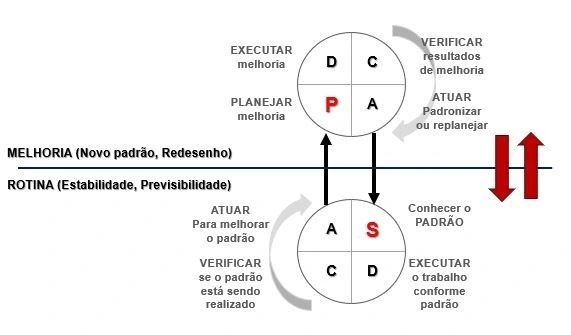
SDCA is an extension of PDCA, focused on standardizing improvements. While PDCA is used to plan and test changes, SDCA is applied to consolidate those changes and make sure they become part of the operational routine.
Let’s explore each step of SDCA:
Standardize
This is the additional, crucial step that sets SDCA apart from PDCA. After identifying an improvement and successfully testing it through PDCA, the next step is to standardize it. This involves creating clear procedures and guidelines that define how the improvement should be implemented consistently.
Standardization ensures that everyone in the organization understands the new way of working and adopts it in their daily routines. This can include updating procedure manuals, training employees and clearly communicating the new practices to all relevant parties.
Do
In this phase, the standardized improvement is implemented at scale. It is the moment to put the new procedures into practice and make sure they are followed. The “Do” phase in SDCA is about applying the new practices consistently across the organization.
Check
As in PDCA, the “Check” phase involves evaluating the results of the implementation. Here, the organization should closely monitor processes to make sure the standardization is being followed and to verify whether the expected results are being achieved.
This step can involve collecting feedback, analyzing data and directly observing the processes.
Act
Finally, in the “Act” phase, the organization takes action based on the results of the “Check” phase. If the standardization is working well and delivering the desired results, the practice is reinforced and maintained.
If there are problems or areas for improvement, adjustments are made. This phase is crucial to ensure that standardization is not only implemented but also continuously improved.
Continuous improvement: examples for inspiration
To close this guide, we bring you some successful examples of continuous improvement implementation for inspiration.
Continuous improvement examples
1. Strauss Coffee
A practical example comes from Strauss Coffee, a giant in the coffee industry with operations in more than 10 countries. A Siteware partner since 2017, the company implemented Stratws to scale its operational excellence program. Within a few days, it was able to identify important deviations, replacing reactivity with immediate action.
With 17,708 indicators tracked and 868 business units under active management, Strauss stopped discussing results and began focusing on root causes. For CFO Hilel Kremer, the biggest gain was the alignment across departments and hierarchical levels, proof that continuous improvement, with the right tool, becomes culture.
See the full Strauss Coffee case here.
2. Toyota
3. Berneck
4. Manserv
Is the importance of continuously improving business processes clear to you? The examples above are quite enlightening, and will surely point you in the right direction.
How do you take the first step in the improvement process?
The first step to implementing an improvement culture in your company is to have a strategic planning system to collect, store and analyze the results of the company’s current and future processes.
Integrated tracking of corporate performance and its indicators is one of the main reasons to use a business management system. It also lets you run analyses in one place, speeding up decision-making and making it more precise.
Stratwsopens in a new tab is software designed so you can create, analyze and share your performance indicators, which is of great value for anyone who wants to improve their processes.
See other advantages of this tool, which led more than a thousand companies to choose it and more than 180 thousand employees to use it:
- integrate people, operations and strategy;
- find improvement opportunities;
- manage meetings and the project portfolio;
- increase productivity;
- share KPIs quickly and transparently;
- strengthen corporate governance;
- share information quickly and transparently;
- use meritocracy and visual management to motivate and manage teams;
- apply the main strategic planning methodologies such as BSC, OKR and SWOT;
- manage risks and analyze scenarios;
- make it easier to exchange information and communicate between departments.
Frequently asked questions
Which methodologies can be used for continuous improvement?
The best known include PDCA (Plan, Do, Check, Act), Kaizen, Lean Manufacturing, Six Sigma and 5S. Each methodology has its own tools and techniques, but all share the goal of promoting constant evolution.
How do you implement continuous improvement in a company?
1- Map and document the current processes.2- Define performance indicators.3- Identify bottlenecks and improvement opportunities.4- Apply tools such as PDCA or Kaizen.5- Monitor results and standardize what worked.6- Repeat the cycle for new improvements.

About the author
Equipe Siteware
Content produced and reviewed by the Siteware team, curated by internal experts in strategic management and corporate performance.