
Continuous Improvement
What is the PDCA cycle and how can it improve your processes?
Learn what the PDCA cycle is, how each stage works and see a practical example to improve your business processes.

The PDCA cycle has become one of the most common and effective methods for continuous process improvement in companies across different sectors, including manufacturing, services, healthcare and government agencies.
If you want to know how to do PDCAopens in a new tab, this content was written to explain each stage in detail and show how to apply the method in practice to transform your company’s results.

What is the PDCA cycle?
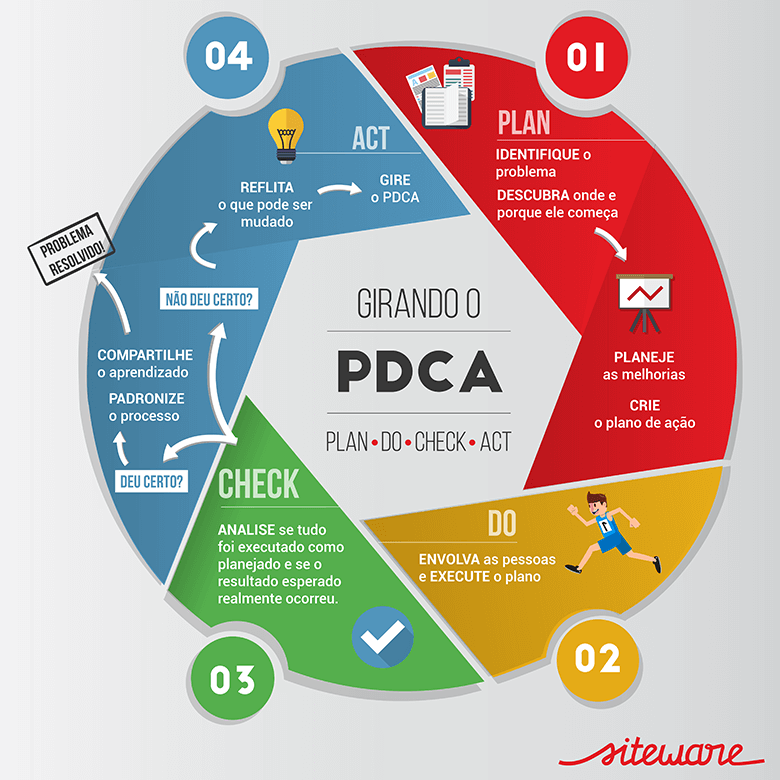
The PDCA cycle is a method divided into four stages (Plan, Do, Check and Act) and eight steps which, when applied correctly, aims to test possible improvements and document them within organizations.
The idea is that, by applying PDCA methodically, you can identify the root of a problem, plan an action plan to solve it, test whether the results are satisfactory and, finally, reflect on whether what was achieved was what you expected, then standardize it on a larger scale, for example.
If it succeeds, you can standardize the improvement. If not, you can run a new round of tests, always seeking continuous improvement.
In the following video (in Portuguese) you can watch a great class on PDCA in practice:
How did the PDCA cycle come about?
The PDCA cycle is also called the Shewhart cycle or the Deming cycle. It originated in the 1920s with the engineer Walter Shewhart.
However, it was only in 1950, with the contribution of professor William Deming, that the method became popular worldwide, especially in Japan. These pioneers inspired the consolidation of the PDCA method and its application in quality processes and continuous improvementopens in a new tab.
Its creators were inspired mainly by the Americans Clarence Irving Lewis and John Dewey, two of the founders of the philosophical school of pragmatism, as well as several other philosophers who wrote about how knowledge is generated.
Dewey reflected on problem solving in five steps, which were essential to the creation of the PDCA cycle we know today:
- Sense the difficulty;
- Locate the problem;
- Define the problem;
- Suggest possible solutions and work out, through reasoning, the consequences of the suggestions;
- Observe afterward the solutions applied, which lead to their acceptance or rejection.
Initially, the cycle was developed to be applied to quality management, with PDCA as a Quality toolopens in a new tab recommended for the continuous improvement of the quality of a company’s products and services.
But its use evolved. Today, PDCA is one of the main tools for understanding processes and solving problems.
Since then, the PDCA cycle method has gone through several changes over its more than 90 years of existence. And it can be adapted for use in any type of company, regardless of its size or field.
Siteware’s Stratws is strategic management software that helps you run the whole PDCA cycle, connecting it directly to the organization’s strategy.
Practical example of applying PDCA
Imagine a company in the automotive sector facing a problem with a high rate of material waste on one of its metal parts production lines.
This is directly affecting production cost and reducing line efficiency, which called for quick action to improve results.
Here is what a possible application of the PDCA method would look like in this case:
1. Plan
First, the problem data is gathered, using the Ishikawa diagramopens in a new tab to identify the root cause of the problems. With the Ishikawa diagram, the team found that the waste was due to gaps in operator training (I) and in how the machines were used (II).
Still in the first stage, the goal is set: reduce waste by 20% in three months.
And to reach that goal, an action plan is built that included:
- Reviewing the machine operation process;
- Specific training for operators on the correct handling of the equipment;
- Adjusting the machine parameters to ensure greater precision when cutting the materials.
2. Do
In the second stage, the team puts the action plan into practice. The team applied the action planopens in a new tab in a pilot phase on the production line, training the operators and adjusting the machines as planned.
To do that, it was defined who would do what, the deadline to carry out the agreements and the costs the training would involve.
This phase also included a week of testing to make sure all the changes were being applied correctly. Production was monitored to check the impact of these changes.
3. Check
In the third stage, with the action plan completed and all tests done, the results were evaluated.
The quality management team analyzed the data collected on material waste before and after the changes were implemented.
The results showed a 15% reduction in waste, which indicated an improvement but was still below the established goal of 20%.
Also read: PDCA vs PDSA: the choice for scaling continuous improvement
4. Act
Finally, in the fourth stage, based on the results, the team realized there was still room for further improvement, especially in machine calibration.
They decided to refine operator training and make additional adjustments to the equipment.
So the PDCA cycle was repeated to keep monitoring and improving the process until the 20% waste reduction goal was reached.
However, in many companies the cycle is not repeated again, but that depends a lot on the goal of the improvement.
What are the benefits of the PDCA cycle for companies?
Using the PDCA cycle brings many advantages, such as:
- Continuous improvement: lets teams identify and solve problems systematically.
- Effective problem solving: helps identify root causes of problems and implement effective solutions.
- Higher efficiency: eliminates waste and optimizes processes.
- Better quality: keeps quality standards in place through continuous monitoring.
- Team involvement: promotes a collaborative environment focused on continuous improvement.
- Informed decision-making: relies on real data to guide corrective actions.
When to use the PDCA cycle?
The PDCA cycle can be used in any situation where you want to achieve continuous improvement of processes or results.
Some of the situations in which the PDCA cycle is often used include:
- Identifying and solving problems: clearly define the problem and gather its history.
- Process improvement: useful for improving existing processes, whether in production, services or company management.
- Implementing new projects or initiatives: the PDCA cycle is used to plan, implement and monitor new projects or initiatives, making sure they reach their expected goals and results.
It is a flexible, versatile tool that can be applied in many different situations, depending on the company’s needs.
How to apply the PDCA cycle step by step
Stage 1: PLAN
The first step of the cycle is planning. Planning itself is divided into 4 steps.
Its logical order starts with PLAN, which focuses on identifying and analyzing the problem and proposing a solution (plan).
The goal here is to gather and analyze information to set out proposals for solving the problem and/or improving results.
The four phases within the planning stage are:
1. Identifying the problem
Clearly define the problem and gather its history.
To get a better view of the problem, you can use reports, data, charts or images to truly understand which problem you want to solve.
2. Observing the problem
Analyze its characteristics and identify points of attention. Tools such as Pareto analysisopens in a new tab are normally used to support this step.
Once it is complete, it will let the group estimate the budget needed to solve the problem (in step 4) as well as the goal to be reached with the solution.

3. Root cause analysis
The question to ask during PDCA analysis is: “Why is this problem happening in the areas I focused on?”
This is the phase where possible causes are listed. List the possible causes, put them in order of relevance and choose the most likely ones.
Testing these hypotheses with newly collected data and discarding the least likely ones are also part of selecting the causes of the problem.
Here, for example, you can use tools such as the “5 Whysopens in a new tab”, Hypothesis Testing or the Cause and Effect / Ishikawa diagramopens in a new tab.
4. Action plan
Once the possible causes of the problem are identified, it is time to propose action plans to solve it.
Develop a detailed planopens in a new tab, using models such as 5W2Hopens in a new tab, defining what will be done, by whom and by when.
In addition, the action plan needs a goal, so that at the end of the cycle you can tell whether the action plan was effective or not.
We prepared a video on a complete action plan to help you get through this step (in Portuguese):
Stage 2: DO
Implement the action plan, following the defined guidelines and closely monitoring the execution of tasks.
Although this is a fully hands-on stage, it is important to follow up on the action plan weekly or every two weeks.
The idea is to understand whether the actions are having the expected effect, or whether the people carrying them out need help.
That way, you don’t have to wait until the end of the action plan to find out whether the hypothesis will be confirmed.
Stage 3: CHECK
Analyze the results obtained, comparing what was planned with what was executed, and identify points for improvement.
In the first stage you defined the goal. So here you verify whether the numbers were successful or not.
Stage 4: ACT
At the end of the cycle there are two possible paths.
Path number one, when the hypothesis worked and the goal was reached, is to standardize the processes that worked well in the test, applying them at scale.
Path number two is for scenarios where the result was not what was expected. In this case, it may be necessary to start a new cycle to fix any deviations and promote continuous improvement.
However, if the result fell so far below expectations, the initiative can simply be closed and left at that.
Finally, it is important to share what was learned and what to do about any remaining problems.
Used preventively and continuously, this method helps identify possible process improvements, avoids impulsive decisions by the team and wasted resources, and prioritizes measuring the data and results that are essential for good management.

For these advantages of the PDCA cycle to show up in use, the people involved in the process need to be careful when forming the team responsible for developing the PDCA, providing proper training so that everyone masters the tools used and the stages succeed.
Finally, the cycle should be used whenever necessary! Its phases need to be in constant development and should not be abandoned.
Only that way will process and activity improvements be cumulative and visible to the whole organization.
Now that you know the step-by-step of the PDCA cycle and why it matters, it is time to apply it to get better results! See here a more detailed step-by-step on how to run a PDCA cycle.
What is the difference between PDCA and SDCA?
The SDCA method (Standardize-Do-Check-Act) is a management approach focused on standardizing and maintaining processes already established within an organization.
Remember that I told you that at the end of the cycle, if it worked, it is standardized at scale for the company? SDCA is the method for doing that standardization.
So SDCA is normally used after an improvement is found while running PDCA. That way, it helps standardize the improvement for the rest of the company or the sector.
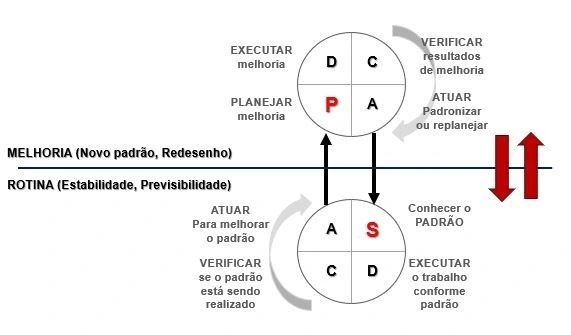
The cycle starts with “Standardize,” where operating standards are defined and documented. Next comes the “Do” phase, in which processes are carried out according to the established standards.
In “Check,” performance is evaluated to make sure the standards are being maintained. Finally, in “Act,” corrections are made to resolve any deviations or problems identified.
So the relationship between SDCA and PDCA is intrinsic and complementary. While PDCA is used to introduce improvements and changes to processes, SDCA is applied to maintain and standardize those improvements.
Once a process is optimized through PDCA, SDCA steps in to make sure the new standards are consistently applied and maintained.
In this way, SDCA acts as a mechanism that sustains the improvements achieved by PDCA, making sure the benefits of the changes are preserved over the long term.
What is the difference between PDCA and CAPDo?
Compared with CAPDo, PDCA works in a complementary way, but with a different starting approach.
While PDCA begins with structured planning followed by implementation and analysis, CAPDo begins with an analysis of the current situation and immediate corrective actions, followed by planning and implementation.
This CAPDo approach is particularly useful when you need to respond quickly to critical problems or when a deep understanding of the current situation is essential before developing an action plan.
In many companies, CAPDo can be seen as a way of preparing the ground for the PDCA cycle. By starting with analysis and immediate correction, CAPDo helps stabilize the environment and provides insights that can be used in the PDCA planning phase.
So CAPDo can be used to deal with urgent issues and prepare the organization for a more structured, long-term continuous improvement process, as proposed by PDCA.
How to use technology in the PDCA cycle?
As we saw in this article, the PDCA cycle is fundamental to ensuring improvement in your business processes. To be more efficient, a good management tool can be useful.
A strategic planning system helps increase, engage and drive your results, with visual resources that improve the company’s strategic deployment.
This business management system allows integrated tracking of corporate performance and monitoring and centralization of all indicators, with a focus on decision-making.
With Stratws, you discover improvement opportunities, use the PDCA cycle and then create action plans in a single tool.
Frequently asked questions
What is the PDCA cycle?
The PDCA cycle is a continuous improvement methodology made up of four stages: Plan, Do, Check and Act. It is used to identify problems, implement solutions, test results and adjust processes
What are the 4 stages of the PDCA cycle?
The 4 stages of the PDCA cycle are: Plan: identify the problem and define objectives and goals. Do: implement the action plan. Check: monitor and evaluate the results. Act: standardize what worked or start a new cycle to correct failures.
What are the 4 steps of the continuous improvement cycle?
The 4 steps of continuous improvement within PDCA can be summarized as: 1. Identify and understand the problem. 2. Develop and implement solutions. 3. Monitor the results of the actions. 4. Standardize and repeat the cycle to promote constant improvement
How to do PDCA step by step?
To do PDCA step by step, follow these steps: Plan: gather data, identify the problem and define an action plan using tools such as 5W2H and the Ishikawa diagram. Do: put the plan into practice and record the actions. Check: compare the results obtained with the goals set and identify points for improvement. Act: make the necessary adjustments, standardize the processes and, if needed, restart the cycle.
In what contexts can PDCA be applied?
- Continuous improvement projects (Lean, Kaizen, Six Sigma); - Quality management and certifications (ISO 9001); - Operational, administrative or service problems in any sector or company size.

About the author
Equipe Siteware
Content produced and reviewed by the Siteware team, curated by internal experts in strategic management and corporate performance.