
Continuous Improvement
5 Whys Method: What It Is and How to Use It [WITH TEMPLATE]
Learn what the 5 Whys method is and how to apply it to find the root cause of problems in your company's management. Includes a free template.
![5 Whys Method: What It Is and How to Use It [WITH TEMPLATE]](/midia/imagens/posts/porques-utilizar/metodologia-5-porques.webp)
The 5 Whys analysis method is an essential resource for leaders who need to eliminate operational failures at the root and achieve operational excellence.
As part of corporate continuous improvement practices, this model moves teams away from treating symptoms with stopgap fixes and focuses on permanently resolving deviations.
Many organizations waste important resources on superficial solutions, such as giving ongoing discounts to customers unhappy with delays instead of optimizing the logistics route, which do not prevent problems from coming back. Understanding how this method works therefore supports fast, data-based decisions aimed at high business performance.
In this article, we detail how to apply the technique in your management to ensure scalable results.
Take advantage of your visit to the blog and download our free 5 Whys template. Click here to get yoursopens in a new tab (in Portuguese) and start analyzing the causes of problems in your company today.
What is the 5 Whys method?
The 5 Whys method, also known as 5-Why, is a strategic tool focused on root cause analysis.
It originated in Toyota’s factories in the 1950s, developed by Taiichi Ohno, the architect of the company’s production system.
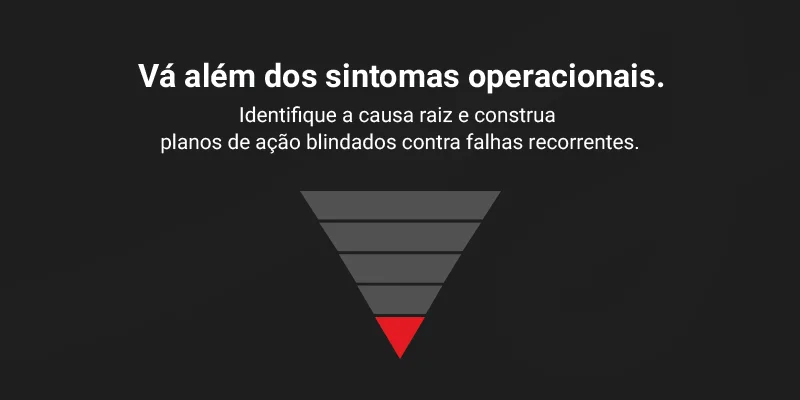
The goal of the method is to ask “why?” repeatedly when facing an operational bottleneck. In other words, the leader investigates the many layers of a problem until reaching the original factor that triggered the failures in the process.
The technique therefore keeps management from directing executive effort only at immediate consequences. By focusing on the true cause of the inefficiency, the company builds lasting solutions that sustain profitability over the long term.
How does the 5 Whys technique work?
The 5 Whys technique requires the team to investigate a deviation progressively and with rigorous logic.
The number five is only a directional guide: some scenarios need fewer questions, while complex structures call for a longer investigation.
The success of this approach depends on technical precision and the full transparency of the team involved. In addition, professionals should base their answers on observable facts and concrete metrics, avoiding assumptions or unsupported opinions.
This way, the working group can map the cause-and-effect relationship at any level of the organization. The deepening stops at the exact moment the answer points to a missing or inefficient process that can be corrected.
Also read: Performance indicator management: why and how to handle a deviation?
Practical example of the 5 Whys
To illustrate how effective the format is, imagine an organization facing a significant increase in complaints about late deliveries.
The manager needs to find the source of this situation using the structured question-and-answer model of the 5 Whys method.
The technique is applied as follows:
- Why are deliveries late? Because products leave shipping later than planned.
- Why do products leave later than planned? Because the internal production cycle exceeded the established time limit.
- Why did the production cycle exceed the limit? Because raw materials were not available at the plant.
- Why were the materials not available? Because the purchasing department did not contact the supplier in time.
- Why did the department not contact the supplier? Because inventory control did not keep up with the increase in demand.
In this corporate scenario, focusing only on delivery logistics would mask the real deficiency, which lies in inventory management.
The method quickly reveals the exact point that requires executive intervention from leadership.
When to use the 5 Whys tool?
The 5 Whys tool delivers high value when applied in structured strategic meetings to solve recurring problems or deviations in indicators. On the other hand, scenarios with multiple simultaneous causes may call for complementary methods.
In these broader cases, leadership can combine the technique with the Ishikawa Diagram, which maps external and internal factors in a highly visual way.

After identifying the central point of the bottleneck, the team must build a correction plan using execution frameworks such as 5W2H.
Finding the root of an operational deviation is therefore only the first step of the corporate improvement process.
Real efficiency happens when the company turns that finding into a permanent prevention barrier.
Turn analyses into effective action plans
Manually tracking indicators and process corrections slows down senior leaders.
Excellent management requires centralized data, real-time operational visibility, and a rigorously secure environment for decision-making.
Stratws consolidates your company’s governance on a single, scalable platform. The Siteware solution connects strategy to operations through integrated performance modules, operating end to end under the international SOC 2 security standard.
This way, your leadership eliminates systemic failures, automates complex routines, and focuses on raising overall results.
Request a Stratws demo now and ensure the continuous improvement of your processes with the highest reliability on the market!
Summary of key questions
1. Is it mandatory to ask exactly five questions during a 5 Whys analysis?
No. The number five serves only as a directional guide for the team. Simple deviations may need fewer questions, while more complex operational bottlenecks call for a longer investigation until the original failure is revealed.
2. How do you know when to stop asking “why”?
The investigation should stop when the answer points to a missing or inefficient process that can be corrected. Once the team finds this originating factor, it can focus on permanently resolving the problem.
3. What if the bottleneck has multiple simultaneous causes?
In these broader scenarios, the technique alone may not be enough. Leadership should combine the 5 Whys with complementary methods, such as the Ishikawa Diagram, which helps map internal and external factors visually.
4. What is the next step after finding the root cause of the problem?
Identifying the source of the deviation is only the first step. Next, the team must build a practical action plan, using execution frameworks such as 5W2H, to turn the finding into a permanent correction.

About the author
Equipe Siteware
Content produced and reviewed by the Siteware team, curated by internal experts in strategic management and corporate performance.