
Continuous Improvement
How to Do PDCA: A Complete Step-by-Step Guide
Learn how to run the PDCA cycle step by step. Apply the Plan, Do, Check and Act stages with the help of Siteware technology.
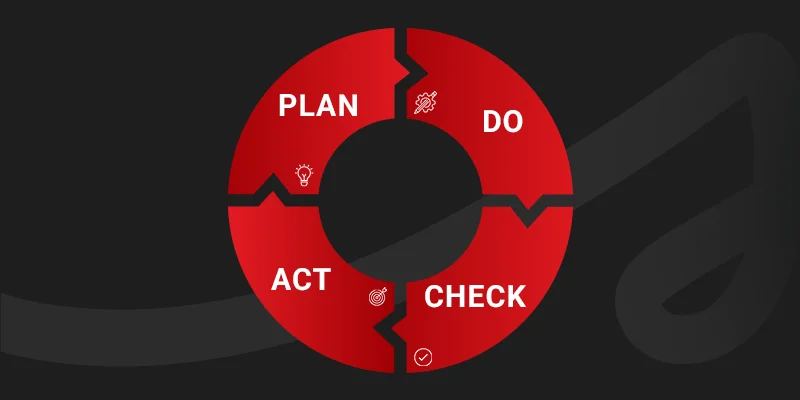
Knowing how to do PDCA, step by step, is essential to improve the results of your team and, as a consequence, of your company. In short, the PDCA Cycle is a management tool that points the way to continuous improvement.
As the term “cycle” suggests, it is a continuous process that starts again as soon as one round ends. In this sense, PDCA is a management improvement methodology, just like OKR and FCA.
It is used to improve activities (such as projects and processes that are essential to how the organization runs) and to solve their problems.
The PDCA Cycle can also be called the Deming Cycle or the Shewhart Cycle, named after the people who created the methodology.
Created in the 1920s, it is made up of the basic cycle of Plan, Do, Check and Act.
Want to know how this methodology can be implemented in your organization to improve the processes you already run? Keep reading!
How to Do PDCA? A Simple Step-by-Step
Once you know that the PDCA Cycle helps identify problems and improve processes in a company, the next step is to understand how to use this tool.
Each of the four PDCA stages corresponds to a phase of the process, which must be respected and carried out with care. See what they are below:
Step 1: P for Plan
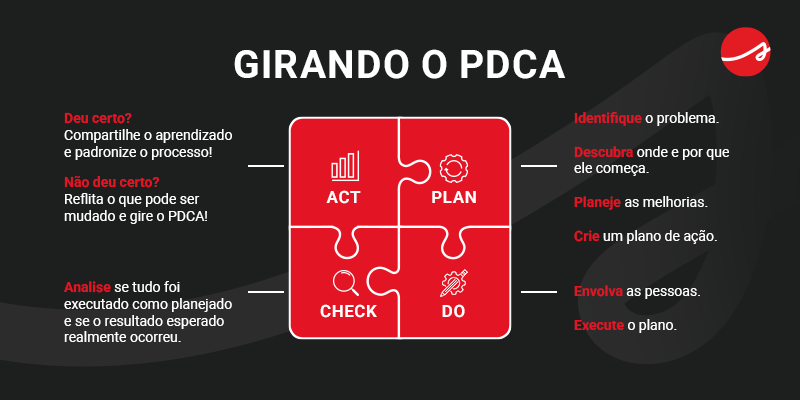
This is where you create a strategic plan focused on solving the problems previously found in your activities.
To do that, you need a competent project team responsible for this analysis, one that develops a plan that is viable for the company.
In planning, you choose the most qualified people to run the cycle, select which complementary methods will be used and define which objectives need focus at that moment.
That way, you not only identify the problems, but also rank them by priority and create action plans to solve them in the best possible way.
Step 2: D for Do
The “Do” stage is the execution of the action plan created in the previous step. It is essential to the success of the methodology, so it must be carried out and reviewed carefully to avoid failures and increase the chances of success for the actions.
In this stage of the cycle, it is important to record all results (good or bad) and the date they occurred, and to communicate with and train the employees selected for the proposed actions and their deadlines.
Without that, there is no way to run a truly effective PDCA.
Step 3: C for Check
This is the moment when the team checks and analyzes what was carried out and the results obtained according to the action plan.
This analysis can also be done throughout the plan’s cycle, since it serves as a constant verification of the work (an assessment of what is being carried out) and of its results (an assessment of the data, such as failures and errors).
It is important to verify the implementation of what was planned, and also to compare the before and after results and how far the proposed goal was reached.
When the results gathered in the check are not satisfactory, it is recommended to go back to the planning phase.
Step 4: A for Act
This is the last step of the cycle, which consists of putting into practice the corrective actions for the problems found. The failures identified in the previous stage (Check) are corrected here.
This is the time to standardize the process, share what was learned with everyone involved, reflect on what can be changed and make PDCA turn again.
Not sure how to do that? See how to turn PDCA in this infographic:
Read also: 5 main mistakes when applying PDCA and how to avoid them
How to Use PDCA in Practice?
PDCA emerged as a quality management tool, but today it is used for the continuous improvement of many other processes in a company.
As we noted, the PDCA Cycle has no end: the tool should be run every time a process finishes.
To do that, in the last stage, the opportunities for improvement in the company’s procedures should be observed and addressed with the help of the cycle.
PDCA is also a preventive tool. This means it should be run while problems have not yet caused serious consequences.
This is also one of the reasons why it should always be reviewed and run again.
Still have questions on the subject? See how PDCA can help you reach operational excellence:
Read also: Learn how to use the See and Act methodology for the immediate solution of problems
Use PDCA to Boost Your Business Results
The PDCA Cycle can be repeated as many times as needed, since its knowledge is cumulative. It is worth stressing that its phases must be in constant development and must not be abandoned. Only then will the improvements in processes and activities be visible to everyone.
For that, having a complete strategic planning and continuous improvement system makes a difference.
A good business management system improves the tracking of corporate performance and centralizes all indicators and action plans, making monitoring and decision-making easier.
To put the cycle into practice in a structured way, technology support can bring many benefits. Stratws is an example of a system that helps centralize indicators and lets you organize your work routine, engaging the whole team in day-to-day activities.
Frequently asked questions
How do you fill out a PDCA?
Filling out a PDCA requires four sequential steps:- Plan: identify the problem and create a viable action plan.- Do: carry out the plan carefully and record the results.- Check: analyze the data obtained and verify whether the goal was reached.- Act: fix failures, standardize what worked and make the cycle turn again.
How are the stages of the PDCA Cycle connected?
PDCA is a continuous improvement process with no end. Each phase feeds directly into the next: execution depends on planning, and the corrections in "Act" are based on the data gathered in "Check". When results are not satisfactory, the cycle restarts, returning to the planning phase.
What are the most important tips for applying PDCA?
1. Do not try to solve all problems at once;2. Define clear indicators to prove whether there was improvement or not;3. Involve the team;4. Document each stage;5. Repeat the process whenever necessary, because PDCA is a continuous cycle.
Which tool should you use to run the PDCA Cycle?
You can use Google Sheets spreadsheets, Trello, Notion or management software such as Stratws to follow the whole cycle, record action plans and monitor indicators in real time.
Why use a ready-made PDCA template to fill out?
A ready-made template makes it easier to monitor and keep the methodology running. Using a management system centralizes indicators, lets you record action plans in real time and ensures faster strategic decision-making.

About the author
Equipe Siteware
Content produced and reviewed by the Siteware team, curated by internal experts in strategic management and corporate performance.