
Continuous Improvement
Action plan: what is it? Get the complete template
Learn what an action plan is and how to create one in 5 steps. Turn strategic objectives into achievable goals for your company.

Every manager has been there: something is not going well, and the first reflex is to call the team together to build an action plan. The document is so popular because it helps turn final objectives into achievable goals, based on specific information.
The problem is that, despite being so common, the action plan rarely works the way it should. The reasons tend to be the same: it is born disconnected from the company’s strategic objectives, gets lost in the routine of those involved, or is simply poorly defined from the start.
The good news is that these failures have a fix. With the right approaches, you can build much more effective action plans. That is what we explain in this article. Keep reading and get your questions answered!
What is an action plan?
An action plan is a document that details all the steps needed to reach specific objectives within a company.
In practice, it comes up as a response to a concrete problem, such as a missed goal, a drop in performance or a process that went off track. From that diagnosis, the plan charts the path to overcome the challenge and get back on the planned course.
More than a task list, it works as an operational management roadmap, setting objectives, assigning responsibilities, establishing deadlines and mapping the resources needed.
What are the benefits of an action plan in projects?
Action plans are fundamental for building and carrying out strategic planning. See what changes in practice when one is applied correctly:
- Organized activities: all the tasks needed to reach the objectives are listed, detailed and sequenced, removing doubts about what needs to be done and in what order.
- Clear communication: each employee knows exactly what is expected of them (what, how and when). This reduces noise, rework and unnecessary alignment meetings day to day.
- Easier follow-up: with defined steps and deadlines, it is much easier to monitor progress, spot deviations and make corrections before problems have more serious consequences.
- Team integration: the plan connects individual actions to the company’s strategic objectives, promoting a shared sense of direction and contributing to more consistent team performance.
- Smarter use of resources: when responsibilities and deadlines are clear, you can plan the allocation of people, time and budget precisely. This avoids waste and delays.
Here at Siteware, for example, action plans are used and put into practice whenever we identify improvement opportunities, whether in internal processes or as part of project management with our customers.
Read also: What is the best action plan software?
Tools for creating an action plan
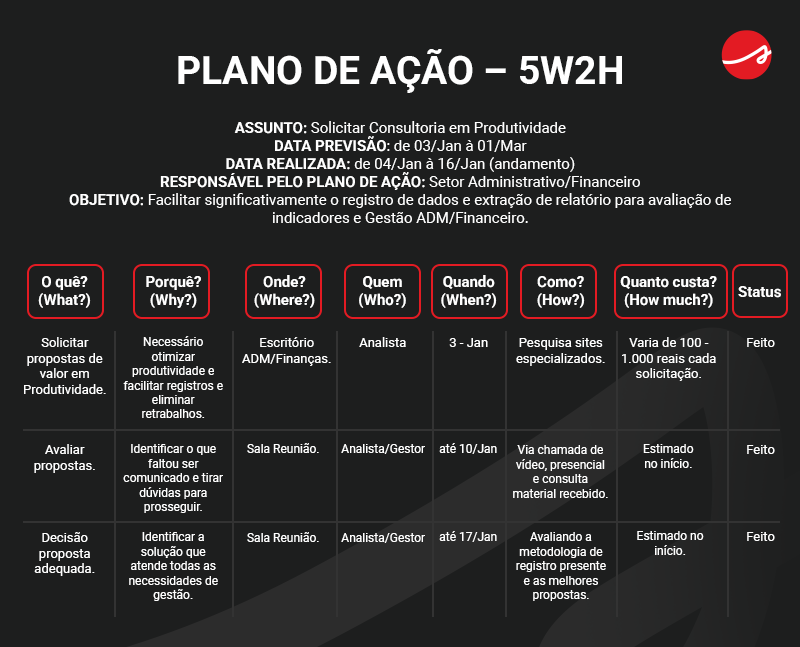
There are different methodologies and tools for action plans. One of them is 5W2Hopens in a new tab, which is simple to apply and brings excellent insights for management.
Basically, it has seven questions that need to be answered carefully to result in an action plan that makes sense:
- What: what will be done?
- Why: why will it be done?
- Where: where? (If the plan involves a specific location)
- Who: who will be responsible for carrying out the plan?
- When: what is the deadline for execution?
- How: how will it be done?
- How much: how much will it cost?
This methodology helps eliminate doubts and set a clear schedule. For that, it is important to fill in the information correctly and monitor the planned steps to make sure every action moves forward.
Having a visual resource that unifies the plan, the status and the management indicators of each project is a differentiator for strategies. At Siteware, we use Stratws’s Improvement Opportunities module, and it is what we recommend to our customers too.
When integrated with the Project Portfolio and Visual Management modules, we get a clearer, more complete view of each initiative.
How to create an action plan in 5 steps?
Building a good strategy needs to follow a pattern to make sure all the essential points are covered. Here is a step-by-step guide to creating an action plan for your company:
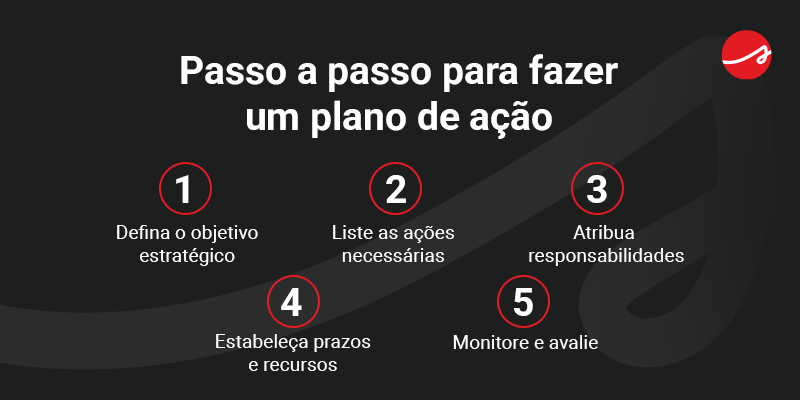
1. Define the strategic objective
Clearly identify where the company wants to go and how the action plan can contribute to the implementation of strategic planning.
Always keep in mind that action plans are used for course corrections or to reach some major objective. Define that finish line.
2. List the necessary actions
List all the tasks that must be done to reach the objective, detailing the activities. Depending on the action plan, this will require multiple steps and cross-department work.
To avoid bottlenecks at the start of the project, you can do it in parts, making sure the first tasks are already mapped.
3. Assign responsibilities
Determine who will be responsible for each action, making sure everyone knows exactly their roles.
It is important that the people involved in the project understand why all of this is happening and what the objective is.
4. Set deadlines and resources
Define start and end dates for each task and estimate the financial, human and material resources needed. Track progress to identify possible bottlenecks.
5. Monitor and evaluate
Follow the progress of activities with weekly or biweekly meetings, review the results and adjust the plan if necessary.
Read also: Resource planning: the 5 steps to ensure the best result for your company
Practical example of an action plan
Imagine a company that wants to increase its sales by 20% in the next six months. An action plan for that objective could be structured like this:
Objective:
- Increase sales by 20% in six months.
Actions:
- Develop a digital marketing campaign to expand brand visibility.
- Run sales training for the team.
- Rearrange the store layout to improve the customer experience.
Owners:
- Marketing team for the campaign.
- Sales manager for the training.
- Store manager for the layout.
Deadlines:
- Marketing campaign: start immediately and run for six months.
- Training: start next month.
- Rearrangement: complete in two months.
Resources:
- Budget of R$30,000 for the campaign and R$10,000 for training and layout improvements.
Follow-up:
- Weekly meetings to assess progress and make adjustments as needed.
Action plan template and model
How to make your action plan more robust and tangible?
As promised, here are some management tools and methods that can help make your action plan much more robust:
1. Define SMART goals
You already know action plans need goals and objectives. However, it is quite common for that definition to be confusing or too abstract.
To map opportunities, the tip here is to set that finish line based on the SMART methodopens in a new tab. For that, every goal must have five characteristics:
- Specific: the goal cannot be generic and broad, with no references for the team. It needs to be very objective, focused, and detail the final objective beyond any doubt.
- Measurable: ideally, the goal is represented by a number to be reached. It is important that it is easy to measure.
- Attainable: goals beyond the team’s reach only lead to demotivation. It is essential to set ambitious objectives, but never impossible ones.
- Relevant: when reached, the goal should bring some important benefit toward achieving the organization’s strategic objectives.
- Time-bound: the deadline to reach the goals must be set and monitored, in order to keep actions consistent.
2. Apply a PDCA (company improvement action plan)
The PDCA methodopens in a new tab is a cyclical logic for improving processes and products.
First, you build a theory of something that can be improved. Then you create an action plan to test the theory.
With the data in hand, try to understand whether there was improvement and, from there, create a continuous improvement cycle. PDCA is divided into 4 steps:
- Plan: find the problem and its root cause, plan the improvements and develop an action plan.
- Do: this step is for engaging employees and executing the plan.
- Check: verify the results and analyze whether everything really went as expected.
- Act: did things go well? Great, the process improvement will be permanently implemented. Did it not work? Restart the cycle.
3. Use the Ver e Agir method
Despite everything we have said about how to create an action plan and what its steps are, it is not always easy to see what the problems are and how to solve them.
To help you, we brought another tool suggestion, the Ver e Agir method (“See and Act”, in Portuguese).
See the steps below:
- Survey the company’s problems through meetings with the team, already thinking about possible solutions.
- Rank the most serious problems with the help of the GUT Prioritization Matrixopens in a new tab and the Eisenhower Matrixopens in a new tab.
- Analyze the causes of the problems with the team and think of possible actions to solve them, as well as the resources needed.
- Is everyone involved in agreement on what must be done? Then get to work.
- Follow and monitor the progress of the work, check that it is on the right track and make the necessary adjustments.
Best practices for your action plan
An action plan’s success depends on continuous follow-up. The points below will help you with this task:
- Milestones and indicators: split the plan into smaller steps with specific goals to make monitoring easier.
- Progress meetings: hold regular meetings to discuss challenges, adjust strategies and make sure everyone involved is up to date.
- Continuous feedback: encourage employees to give feedback to quickly identify possible problems.
- Results analysis: at the end of the cycle, compare the results achieved with the objectives defined, document lessons learned and adjust processes for future projects.
- Flexibility for adjustments: be ready to adjust the plan as needed. Adaptability is the key to handling surprises and keeping the plan on track.
Now, see the main mistakes and how to avoid them in your action plan (video in Portuguese):
What to do after the action plan?
When the action plan is finished, it is important to analyze and consolidate the results obtained, in order to identify lessons and points for improvement. Here is what to check:
- Results evaluation: compare the results achieved with the objectives initially set. This involves analyzing quantitative and qualitative data to assess the plan’s success.
- Lessons learned: document the lessons learned during the process. This is vital to improve future action plans and for the continuous development of the teamopens in a new tab (in Portuguese) and the organization.
- Sharing results: communicate the action plan’s results to all stakeholders. This not only promotes transparency but also recognizes the team’s effort.
- Ongoing action plan: consider the need for an ongoing or follow-up action plan, especially if some objectives were not fully reached or new opportunities came up.
Create an action plan with the help of technology
Carrying out an action plan is essential to any company’s success. However, it takes organization, documentation and reliable data for decision-making to be right.
A strategic planning system that helps increase efficiency, engage the team and drive results, with visual resources that improve the company’s strategic deployment, can be a good choice.
To understand how this kind of tool works in practice, talk to an expert about Stratws.
Frequently asked questions
What are the essential elements of an action plan?
An effective action plan turns ideas into concrete results by bringing together these seven elements: - Clear, measurable objectives (ideally SMART);- Detailed task list;- Realistic deadlines and visual schedule;- Owners for each activity;- Allocated resources (financial, human and technological);- Indicators to measure progress;- Monitoring, evaluation and flexibility in the plan.
What are the 5 steps of an action plan?
These are the five essential steps to build an action plan:1. Initiation: defining the objective and scope;2. Planning: detailing actions, deadlines and resources;3. Execution: carrying out the scheduled tasks;4. Monitoring: follow-up, evaluation and adjustments;5. Closing: analyzing results and lessons learned.
How do you write a report for an action plan?
To write a report, clearly compare what was planned with what was executed. The document should summarize the objectives, task status, performance indicators (KPIs), resources used and bottlenecks faced, highlighting the corrective measures to support future decisions.
What are the benefits of creating an action plan for a project?
A well-structured action plan guides the team, optimizes time and resources and anticipates possible risks. It also increases engagement by setting clear responsibilities and makes continuous monitoring of project results easier.
What are the most common mistakes when creating an action plan?
These are the most common mistakes in action plan planning:1. Vague or unrealistic objectives;2. Lack of clear owners;3. A schedule disconnected from reality;4. No indicators;5. A static plan, without periodic reviews.

About the author
Equipe Siteware
Content produced and reviewed by the Siteware team, curated by internal experts in strategic management and corporate performance.