
Management Methods
How to use the GUT matrix, or process prioritization matrix
The GUT matrix is a tool for assessing and prioritizing problems and tasks in a company. Learn how to calculate and apply it, with a template.

Chances are your routine includes a large volume of demands flagged as “urgent.” That is more common than you might think. To help you prioritize those tasks, we present the GUT matrix!
Companies use it to rank activities, initiatives and projects.
A study published in the journal European Academic Researchopens in a new tab (in English) showed the use of the GUT Matrix as a tool to support strategic planning, allowing teams to assess alternatives systematically and based on clear criteria, instead of making reactive decisions.
For companies that manage several improvement fronts at the same time, this prioritization structure becomes even more valuable: it turns the list of problems into an ordered, traceable action plan.
This shows that using the GUT matrix can improve the quality and efficiency of decision-making in different scenarios.
Want to know more? In this article, we explain why the GUT matrix is one of the greatest allies of managers and the whole team in quality managementopens in a new tab.
What is the GUT matrix?
The GUT matrix, also called the process prioritization matrix, is a management tool used to prioritize problem solving, decision-making or actions in a company or project.
The idea is that by using the same parameter for all actions, the team can prioritize which is most urgent relative to the others.
To understand the matrix better, it helps to explain that the name GUT is an acronym derived from the words Gravity (severity), Urgency and Tendency (trend), which are the criteria the matrix uses to assess and rank problems or tasks.
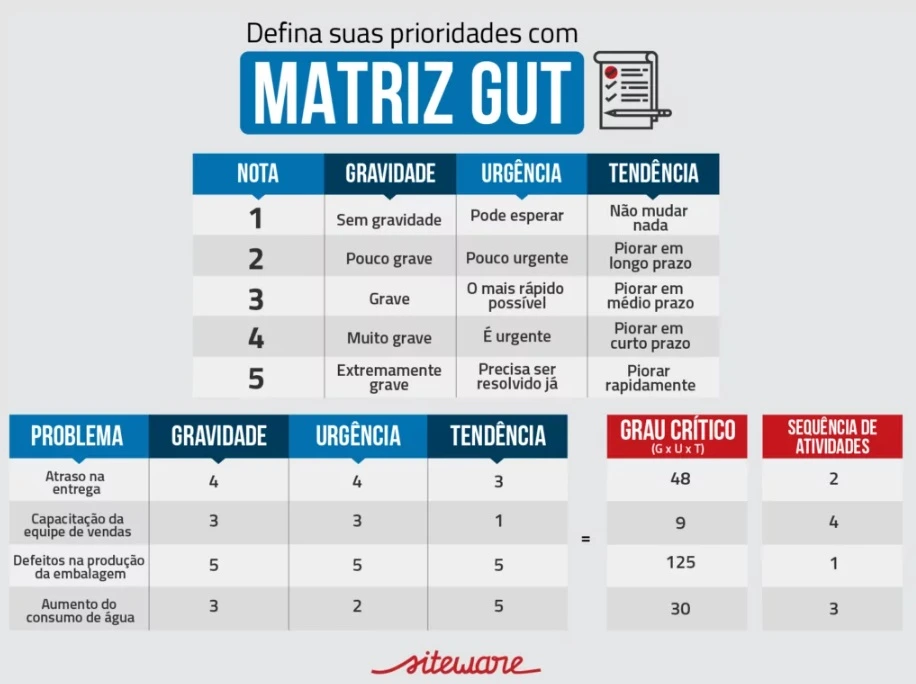
In the matrix, we use numbers from 1 to 5, where 1 is low and 5 is high impact.
Understand each of these criteria better:
- Gravity: refers to the impact the problem can cause if it is not solved. Problems with serious consequences for the company, such as loss of customers, damage to reputation or legal issues, receive a score closer to 5, for example.
- Urgency: indicates how quickly the problem needs to be solved. Time-related problems that require immediate action to avoid negative consequences are considered urgent and receive a higher score on this criterion.
- Tendency: refers to how the problem evolves or repeats over time if no action is taken. Problems that tend to get worse quickly or that grow in scale receive a higher score on tendency.
Example of ranking tasks with different gravity, urgency and tendency in the GUT matrix:
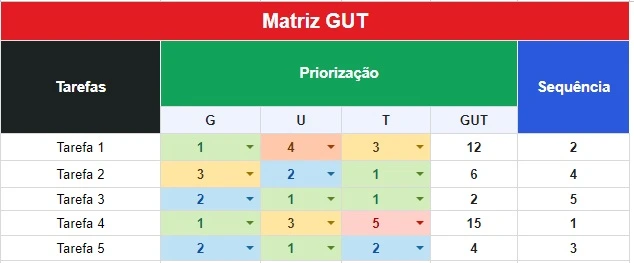
As you can see, the GUT matrix lets you clearly see which options are more favorable under each criterion and which ones have more significant trade-offs.
In the previous table, for example, tasks 4 and 1 are the ones the team should prioritize.
When was the GUT matrix created?
The GUT matrix was created by Charles H. Kepner and Benjamin B. Tregoe in 1981 and, for that reason, is also known as the Kepner-Tregoe matrix among the more technical. Today, it is one of the most widely used tools for prioritizing tasks and is applied in quality management.
Because its parameters can be used in any project or task, the prioritization matrix is often integrated with other quality management methods, such as the PDCA cycleopens in a new tab, in the strategic planning phase, SWOT analysis or even other tools, such as 5W2Hopens in a new tab, to give more priority when building an action plan for each problem.
How does the GUT matrix work?
Below, we detail each of the three letters of the GUT matrix:
1. Gravity
The letter “G” refers to the Gravity of the problem being assessed.
To understand whether it should get a high or low score, you should analyze the impact or intensity of the situation in question. This gives a quantitative and qualitative sense of how the problem can affect the company.
By default, the following scale is used:
- not serious;
- slightly serious;
- serious;
- very serious;
- extremely serious.
When an online payment fails in an e-commerce store, for example, it is a problem of maximum gravity.
However, the same problem at a supermarket checkout, where other checkouts are working, is a less serious problem, because it will not prevent the purchase from happening, it will “only” disrupt the customer experience temporarily.
2. Urgency
Urgency is related to the deadline and the time needed to solve the problem. In other words, it considers the period and the speed required to solve it.
A situation with a tight deadline, for example, will have higher urgency than one with a longer delivery date.
This way, you can use the scale as follows:
- can wait;
- slightly urgent;
- urgent, deserves attention in the short term;
- very urgent;
- needs immediate action.
3. Tendency
The third criterion for setting the priorities of the problems listed in the GUT matrix is Tendency. This criterion concerns the pattern of the problem repeating or getting worse over time.
In this case, a situation that may get worse will weigh more than one that, although urgent, will not worsen over time.
An example is a marketing campaign with incorrect information. The logic is that the longer it is being published, the greater the chance that the message will mislead people.
Keep the following criteria in mind:
- will not change;
- will get worse in the long term;
- will get worse in the medium term;
- will get worse in the short term;
- will get worse quickly.
How to build a GUT matrix step by step
1. Identify the problems
First, list all the problems, tasks or actions that need to be solved.
This is an initial brainstorm, so include everything that comes to mind, without worrying about prioritization yet.
At first, having many actions to prioritize may seem chaotic, but having this overview will bring parameters that help define what to do first according to the degree of impact.
2. Apply the GUT criteria
The second step is to apply the three criteria to each problem, task or action listed. A problem on the production line, for example, may have gravity 3, urgency 4 and tendency 3.
- Gravity: how important the problem is. The more serious it is, the greater the negative impact if unresolved. Rate from 1 to 5, with 5 being extremely serious.
- Urgency: how much time pressure there is. Assess how quickly you need to act. Rate from 1 to 5, with 5 being extremely urgent.
- Tendency: the potential for the problem to get worse over time. If nothing is done, does the problem grow? Rate from 1 to 5, with 5 being a problem that gets worse very quickly.
Take the chance to download the following tool for free, which already includes a template for you:

3. Calculate the level of each demand
For each item, multiply the values assigned to Gravity, Urgency and Tendency (G x U x T). The result will be the score of the problem, task or action. This score will help determine each item’s priority.
A problem with gravity 4, urgency 3 and tendency 2, for example, has a score of 24 (4 x 3 x 2).
4. Organize the prioritization
Sort the problems, tasks or actions in descending order of score. Those with the highest scores should be handled first, because they are the most critical problems that need immediate attention.
On the other hand, items with a lower score can be placed in the queue, to be handled in sequence.
5. Create the action plan
For the highest-priority items, develop a detailed action plan. It should include what will be done, who will be responsible, what resources will be needed and a schedule with an end date.
This will give visibility to the completion of the highest-scoring problem and also help set a deadline for the other problems to be handled.
Since some will need more planning time, this will help them too.
Read more: Action plan: how to build one in 7 steps for a companyopens in a new tab
6. Monitor and adjust as needed
After the actions are implemented, it is crucial to monitor progress and make adjustments as needed. This may include re-evaluating the GUT scores for unresolved problems or adding problems to the list.
Useful tips:
- Be objective when assessing Gravity, Urgency and Tendency. This helps keep consistency.
- Periodically re-evaluate the list of problems and the GUT Matrix, especially after solving some of the most critical problems, because priorities may change.
- Communicate clearly with the team or stakeholders about how prioritization decisions were made, and keep everyone up to date on progress.
GUT matrix examples
Example 1: Company IT department
- Situation: The company’s management system has recurring failures.
- Gravity (5): The system failures can cause data loss and affect every department.
- Urgency (5): The fix is needed immediately to avoid losses.
- Tendency (4): If not fixed, the problem may get worse and affect other integrated systems.
- GUT score: 5 x 5 x 4 = 100
Example 2: Project management at a marketing agency
- Situation: A client is unhappy with delivery deadlines.
- Gravity (4): The client’s dissatisfaction can result in lost future business.
- Urgency (5): The situation needs to be resolved by the next project.
- Tendency (3): If not addressed, the agency’s reputation may be harmed.
- GUT score: 4 x 5 x 3 = 60
What are the benefits of using the GUT matrix?
By now it is clear that the GUT matrix is vital for decision-making in project management or in other organizational contexts, right?
To complement that, the benefits include:
- prioritization: lets you prioritize problems or opportunities according to their importance and urgency. This helps make sure the team focuses its efforts on the most critical aspects of the situation;
- assertive communication: provides a clear view of problems and opportunities, making it easier to understand and discuss next steps;
- goal alignment: by clearly identifying high-priority goals, the GUT matrix helps make sure everyone on the team works toward the same objectives, which can lead to more efficient collaboration.
In short, this is a powerful tool to help managers prioritize their actions, communicate objectives and ensure alignment, leading to more efficient and effective results.
If you have made it this far, you know the GUT prioritization matrix is a simple method that can be used at any moment in the organization.
The methodology can also be adapted to the specific needs of each situation, and is easily integrated with other quality management tools.
Even so, it is important to pay attention to how each step is carried out so that truly positive results appear in process improvement. And, of course, team participation and integration are also essential for the method to pay off!
If you want to boost your management, having a strategic planning system that helps increase, engage and drive business results can be a differentiator for corporate performance.
Frequently asked questions
What is the GUT Matrix?
It is a prioritization tool that ranks problems, demands or projects based on three criteria: Gravity, Urgency and Tendency. Each criterion receives a score (1 to 5) and the final score is obtained by multiplication (G × U × T), indicating what requires priority action.
How do you build a GUT Matrix in practice?
Step 1 - List the problems or demands. Step 2 - Assign scores from 1 to 5 for each criterion (G, U, T) per item. Step 3 - Calculate the score: G × U × T. Step 4 - Sort the items by the resulting value (higher = higher priority). Step 5 - Create action plans (5W2H, PDCA) for the priority items.
When and where should you apply the GUT Matrix?
- Quality management, problem solving and nonconformities;- Strategic planning, projects and risks;- Assessing opportunities or choosing between competing initiatives;- Personal or operational uses that need clear priority setting.

About the author
Equipe Siteware
Content produced and reviewed by the Siteware team, curated by internal experts in strategic management and corporate performance.