
Continuous Improvement
Lean Manufacturing: what it is and the 5 basic principles
Find out what Lean Manufacturing is, how lean production works in practice and how to apply the five principles to optimize your processes.

Lean Manufacturing is a management philosophy focused on eliminating operational waste in a structured way. With it, organizations raise productivity and lift the technical quality of everything they deliver.
The goal of the methodology is to deliver as much value as possible to customers while using as few corporate resources as possible.
In this article, we break down the strategic concepts behind the system and show how to connect these practices to your results and, from there, sharpen your operational excellence.
What is Lean Manufacturing?
More than a set of tactical tools, Lean Manufacturing takes hold as an organizational culture oriented toward continuous improvement and a shift in mindset across the company.
By adopting that mindset, the company encourages every employee, from the shop floor to senior management, to act as a problem solver, looking at the workplace with a critical eye that is always after better processes.
This approach shows up in the long term sustainability of the business, and it makes the organization more agile when the market shifts.
The focus stops being isolated cost cutting and becomes the construction of a cycle in which every step is designed to deliver real value. That strengthens the competitive advantage of the company and keeps final deliveries aligned with the actual needs and expectations of the target audience.
When did Lean Manufacturing appear and who created it?
In 1950, right after the Second World War, the industrial scene in Japan faced a severe shortage of resources and needed highly efficient answers to survive.
It was in that moment of crisis that the manufacturer Toyota took the lead in production and restructured its management. Lean Manufacturing was created by the Japanese engineers Taiichi Ohno and Eiji Toyoda.
They developed the Toyota Production System (TPS) with absolute focus on fighting excess inside the factories. Later on, the term gained worldwide corporate fame through publications by researchers at the Massachusetts Institute of Technology (MIT).
What are the benefits of Lean Manufacturing?
Adopting this methodology creates competitive advantage for high performance organizations.
We have separated four direct effects that lean production brings to your operation:
- Better operational efficiency: your team spots bottlenecks quickly, which cuts unnecessary costs and protects the profit margin of the business;
- Less waste: smart use of resources keeps the operation clean and generates more value for the end customer;
- More flexibility: an environment of transparent processes allows fast, structured adaptation to new market demands;
- Higher quality: analytical rigor cuts failures sharply and standardizes deliveries at a level of excellence.
How does Lean Manufacturing work in practice?
To understand how Lean Manufacturing works, the company needs to see the operation as one continuous flow. Every step of the production process has to add something useful and tangible to the final product or service.
Anything that consumes time and resources without generating real results is direct waste. Keeping high idle inventory or running unnecessary transport, for example, hurts the return on investment severely.
Lean production also requires constant monitoring of team performance indicators. That is how executives map bottlenecks, isolate problems and put strategic corrections in place well before the errors reach the end customer.
What are the five principles of Lean Manufacturing?
Applying this corporate philosophy effectively takes governance, aligned leadership and solid technical knowledge.
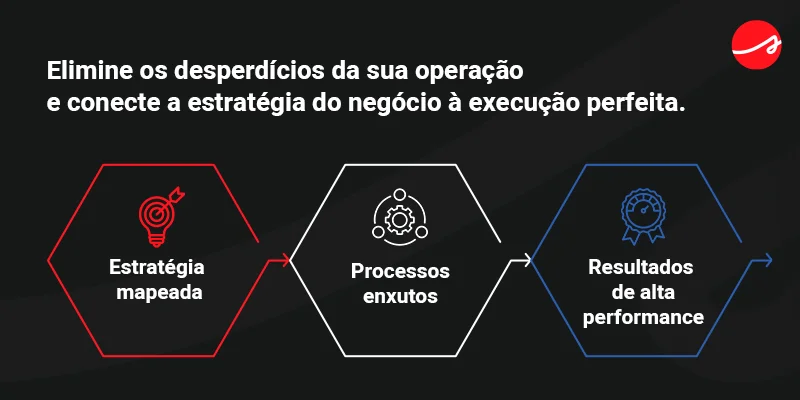
That is why we have organized the five pillars that hold up an operation genuinely built to optimize value:
- Specify value: define clearly what the market requires and is really willing to pay for;
- Map the value stream: record every production step systematically to locate bottlenecks;
- Create continuous flow: make sure team activities run without interruptions or piles of inventory;
- Establish pull production: start manufacturing or service delivery only when there is actual demand;
- Pursue perfection: promote continuous improvement of routines until the operation reaches maximum efficiency.
On that last point, it is worth talking about the 5S program.
The 5S philosophy, also called the five senses, aims to make everyone in the company aware of cleanliness and organization in the workplace, in a logical and effective way.
According to some authors, the program was developed by the engineer Kaoru Ishikawa, in Japan, also after the Second World War.
It is still used today in most companies that follow the philosophy of fighting waste.
The name 5S comes from the initials of five Japanese words:
- Seiri: sense of use and disposal;
- Seiton: sense of order;
- Seiso: sense of cleaning and inspection;
- Seiketsu: sense of standardization and hygiene;
- Shitsuke: sense of discipline.
As you have seen, the main focus of Lean Manufacturing is avoiding waste in your company.
Main Lean Manufacturing tools
To reach the expected results, managers need to apply proven methods for fighting waste.
In other words, execution requires techniques that connect strategic planning to the routine of the teams.
Here are the main tools for your management:
- 5S: organization and standardization of the physical work environment;
- Kaizen: continuous improvement driven by small daily changes;
- SMED: structured reduction of tool changeover and machine setup times;
- VSM: value stream mapping to identify operational bottlenecks;
- Kanban: visual system that manages production flow and quick inventory replenishment;
- Poka-yoke: error proofing devices used to prevent process failures;
- Andon: visual alert systems used to signal problems on the line.
How do you apply Lean Manufacturing in your organization?
The answer depends on how engaged the executive level of the company is. First, the leadership team has to draw the current scenario in full to understand how data and tasks move.
Next, the company needs to train and develop the operational employees so they can spot inefficiency on the front line. In other words, the organizational culture has to reward transparency and encourage proactive handling of deviations.
Technology is the engine behind this transformation. Automated tools make it easier to consolidate visual panels so leaders can follow the progress of corrective actions in real time.
Connect strategy and efficiency with security
Sustainable high performance takes validated methods and rigorous control over business data. Following action plans by hand, on the other hand, undermines the security and the scalable growth of large organizations.
A centralized platform is what secures full methodological alignment between the areas of the company. Stratws, the corporate performance management software from Siteware, unifies management modules and indicator tracking in a cloud environment backed by SOC 2 compliance.
Your company can then eliminate manual failures and focus on evolving the project portfolio.
Talk to a Stratws expert and see how to structure efficient processes with strong data security.

Key questions answered
What is the Lean Manufacturing system?
Lean Manufacturing is a management philosophy focused on eliminating waste and optimizing production processes continuously. Its goal is to deliver more value to the customer using fewer company resources, which reduces operational costs and production time.
What are the five principles of Lean Manufacturing?
The methodology works on five fundamental management pillars: specify value, defining exactly what the customer demands; map the production flow, eliminating steps that add no results; create continuous flow, structuring the operation without logistical interruptions; establish pull production, manufacturing only what is needed; and pursue perfection, keeping a culture of continuous improvement.
What are the seven Lean Manufacturing tools?
To put efficiency into practice, the organization can use the following tools: 5S, organization of the work environment; Kaizen, daily continuous improvement; SMED, setup time reduction; VSM, mapping of operational bottlenecks; Kanban, visual management of the flow; Poka-yoke, failure prevention; and Andon, visual signaling of problems.
Which types of waste does lean production set out to eliminate?
The methodology focuses on eradicating the classic operational losses of the industry, such as overproduction, waiting time between steps and unnecessary transport of goods.
Lean production also works firmly to cut excess processing, idle inventory, inefficient movement of teams and the defects that generate rework or scrapped materials.

About the author
Equipe Siteware
Content produced and reviewed by the Siteware team, curated by internal experts in strategic management and corporate performance.