
Continuous Improvement
How to manage your daily work routine
Learn what work routine management is and get 7 tips to implement it: standardize, categorize and monitor tasks in your company!

Everyone knows that disorganization reduces productivity and lowers the quality of the services and products of every company.
It is no coincidence that work routine management has become an essential practice for companies focused on continuous improvementopens in a new tab.
Among the problems that affect a company’s routine, the most common are lack of focus, difficulty setting priorities for delegated tasks and procrastination.
To keep this scenario from happening, it is important to look for techniques that improve the organization’s routine management, raising the quality of team performance and helping teams overcome the challenges of everyday work.
To help you overcome those challenges, there are effective techniques that should be applied to your company’s routine. Want to know what they are?
Keep reading to see how to manage your daily work routine.

What is daily work routine management?
Managing the daily work routine of a company is a set of practices and methods used to make sure everyday activities are carried out efficiently, effectively and consistently, in order to reach organizational goals.
This management involves planning, organizing, leading and controlling daily activities.
The goal is to make sure employees can carry out their assigned activities satisfactorily and work around the setbacks that are part of everyday corporate life.
Want to learn more about managing the daily work routine? Press play on the video below (in Portuguese)!
What difficulties do companies face without routine management?
Routine management is fundamental to the success of any company, because it ensures consistency, efficiency and quality in daily operations.
Companies that fail or neglect to put effective routine management in place can face several difficulties that hurt their productivity, their organizational culture and, ultimately, their financial results.
Some of these common difficulties include:
1. Low productivity, efficiency and quality
Without clearly defined and optimized processes, employees can waste time on unnecessary or repetitive tasks, lowering overall productivity and the company’s operational efficiency.
In addition, the lack of clear standards and procedures can lead to significant variations in the quality of work or products, affecting customer satisfaction and brand reputation.
2. Ineffective communication and decision-making
Without routine management that includes clear and efficient communication channels, information can get lost or misread, leading to errors, misunderstandings and internal conflicts.
In this way, the absence of structured processes makes it harder to collect and analyze data, which is essential for informed, evidence-based decision-making.
3. Disengaged employees
Unclear expectations, responsibilities and goals can create a demotivating work environment, resulting in high turnover and difficulty attracting talent.
In this scenario, the absence of a continuous improvement culture built into routine management can make the organization resistant to change, making it harder to adapt to new technologies, processes or markets.
4. Poor time management and higher costs
Without an organized routine, the company may struggle to prioritize tasks and projects, resulting in missed deadlines and wasted opportunities.
In addition, inefficiencies and errors caused by poor routine management can lead to rework and waste, increasing operating costs.
The importance of work routine management
Having a well-defined and well-managed work routine is essential for companies that seek productivity and high performance.
That is because controlled and organized processes minimize unexpected problems and let employees see their priorities systemically, setting effective and consistent schedules.
Want to know more about why the daily work routine matters? See some additional advantages below.
1- Routine management and easier communication
Establishing work routine management is essential for companies that value smooth communication between teams and departments.
After all, it is impossible to spot opportunities for collaboration, or to promptly deliver key information to partner departments, when there is no command of the tasks under way, or of priority and strategic projects and initiatives.
2- Fewer delays and missed goals
Keeping the activities in progress well organized is essential to meet deadlines and reach goals.
With good routine management, employees can systematize their tasks, set urgencies, understand the scale of each demand and dedicate time and energy to each one in a balanced and appropriate way.
Imagine, for example, that an employee fails to produce the results report for their department.
Their justification is that they did not have a good task dashboardopens in a new tab, which led them to wrongly spend their time categorizing documents in the archive (a low-priority, highly operational demand).
3- Protecting mental health
Employees who manage their routine effectively feel less overloaded and, as a result, are less likely to suffer from conditions such as burnoutopens in a new tab and organizational stress.
In addition, the benefit of routine management shows when activities are understood as a whole and employees can split their time according to the effort each one demands.
Likewise, good management helps identify cases of overload and fix the problem before it has serious consequences for the employee’s mental health.
4- Fewer errors and slips
The saying holds true: haste really is the enemy of perfection. When a team works in a disorganized way and without routine management, it ends up constantly “putting out fires.”
As a result, outcomes become prone to errors, mistakes and slips caused by lack of attention.
How to implement daily work routine management in your company
To implement daily work routine management in your company, you should:
- keep processes standardized;
- define projects;
- categorize operational routines;
- monitor performance;
- split routines according to priorities;
- delegate tasks;
- organize the workspace;
- use tools to improve routine management.
Let’s go through each step in detail!
1- Keep processes standardized
For good daily work routine management, it is vitally important that all processes follow the same standard.
This brings more speed, confidence and cohesion when putting tasks into practice.
Standardizing processes also benefits teamwork.
The practice means the same task can be carried out by different employees who are already familiar with the same standard, which makes the team more collaborative.
2- Define projects
Defining projectsopens in a new tab is very important when it comes to sticking to the planned routines.
From there, it is possible to reach the intended goals within an acceptable time frame.
It is therefore essential to make clear that failing to complete certain scheduled tasks can cause delays and overload in the future, making bigger goals harder to reach.
3- Categorize operational routines
This is a very valuable strategy for increasing performance on routine tasks.
The practice also includes grouping shared procedures by similarity and affinity.
This way, the manager can measure the time needed to complete all the activities in the same category, which in turn makes it possible to sustain focus for longer on similar duties.
4- Monitor performance
For routine management to work, a major factor is monitoring the performance of the group, the individual and the company against data and projects.
Effective performance monitoring requires task control and accountability.
Otherwise, it is almost impossible to see a noticeable improvement in corporate performance.
This strategy becomes even more essential at the beginning, when preserving the status quo and rising pressure for change are deeply rooted in the teams’ routine.
To overcome these challenges, every leader needs to monitor the team closely using checklists, spreadsheets, tables and other tools that help keep group or individual tasks moving.
Thanks to routine management, it is also possible to spot inefficiencies and difficulties in carrying out different routines, and to change them, expand them or split them among team members.
5- Split routines according to priorities
One way to improve daily work routine management is to split routines by clear and objective criteria. Separating critical activities from regular ones is a good example of segmentation.
Another option is to use time-based systems, where work with the nearest due date is prioritized over work with longer deadlines.
Another way to classify a company’s routines is by the resources involved. For example, the bigger the project, the more important it is.
We can also classify demands by the degree of impact a resource has on how the company operates and by how much collaboration between professionals is needed and how hard it is, keeping, for example, individual tasks for after the collective ones.
Practical example of prioritization
You can segment all the tasks you receive each day into:
- Urgent: those with a short deadline.
- Important: those that take time to be done properly.
- Circumstantial: they are dispensable and make you lose time.
Done! After identifying each one, you know exactly how to organize your work routine!
Your main goal is to prioritize urgent tasks and solve them quickly, eliminate circumstantial activities and gain extra time to handle important matters.
You might also like (all in Portuguese):
- Complete kit: Productivity methodsopens in a new tab
- Infographic: 10 project management best practicesopens in a new tab
- Spreadsheet: Track your company’s action plansopens in a new tab
6- Delegate tasks
One of the basic principles of daily work routine management is carrying out activities correctly within the scheduled period.
It is therefore necessary to drop centralizing habits in favor of efficiency in meeting deadlines.
It is vitally important to delegate routines to other employees based on two criteria: the professionals’ skills and the priority of the procedures.
The criterion of professional skill means assigning duties according to the professional capabilities and personal strengths of direct reports or teammates.
Procedure priority means handing off first the activities that do not require special attention and can be done by other people without problems.
A common mistake many leaders make when assigning tasks is choosing an employee who lacks the qualities needed to carry them out.
That poor choice can have a negative effect, because inefficiency or errors in carrying out operational routines often increase the manager’s uncertainty about delegating activities.
7- Organize the workspace
Keeping the workspace in order is fundamental to organizing the corporate routine.
To give you an idea, it is estimated that a person spends, on average, 50 minutes of each day looking for information.
To keep that statistic from multiplying in your company, keep documents, papers, magazines and books organized.
To do that, use drawers, cabinets, boxes and labels (they matter) to help identify the material the team needs to access easily.
8- Use tools to improve routine management
It is a fact that applying daily work routine management optimizes operational procedures and processes.
One option, then, is to adopt toolsopens in a new tab that aim to improve internal workflow and promote a routine of habits that strengthen employees’ discipline.
A good example is the use of calendars, spreadsheets, notes and other organizational tools that help control the daily routine.
Adopting a reward system is another interesting example that supports management.
In other words, for each period of duties fulfilled and goals reached, a reward can be given to employees or to the team.
This practice allows the company culture to change gradually, making the team more productive and the environment more organized, collaborative and capable of execution.
It also builds quality as a discipline, along with teamworkopens in a new tab (in Portuguese).
Routine management and PDCA
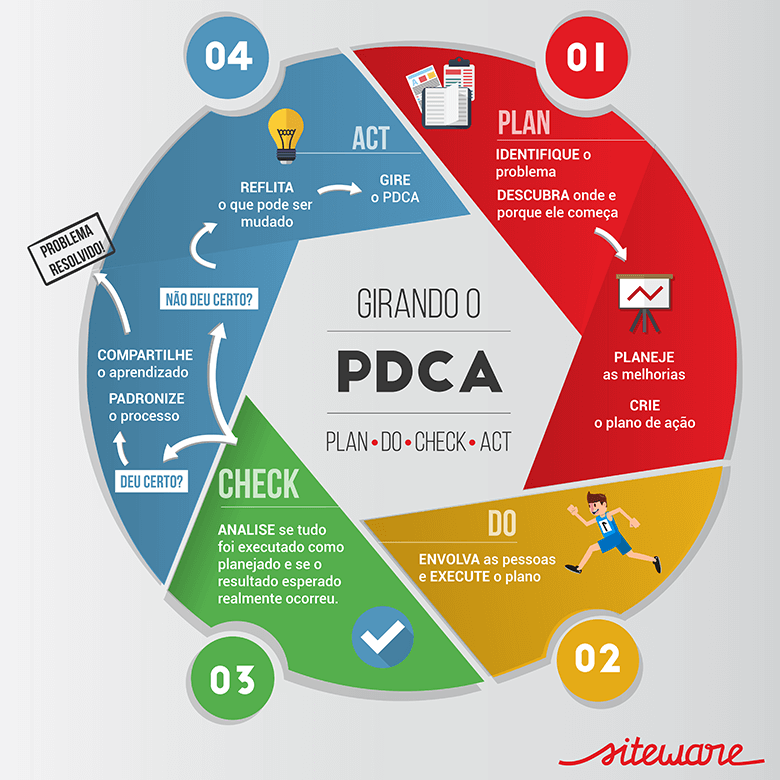
PDCAopens in a new tab (Plan-Do-Check-Act) is an iterative four-step method used for the control and continuous improvement of processes and products.
This method is intrinsically connected to routine management and to the culture of continuous improvement in companies because of its flexible yet systematic structure, which promotes a proactive approach to problem solving and process optimization.
Let’s explore how each PDCA step relates to routine management and continuous improvement:
1. Plan
In this phase, problems or improvement opportunities are identified and clear goals are set. A detailed action planopens in a new tab is also developed to address the problems identified.
In the context of routine management, this means defining operating standards and clear performance goals, which are essential for the consistency and effectiveness of daily activities.
2. Do
The execution phase involves implementing the action plan.
This includes carrying out tasks as planned, communicating changes effectively and training those involved to make sure the new processes are adopted correctly.
In routine management, effective execution ensures that day-to-day activities are carried out according to the established standards, promoting efficiency and reducing variability.
3. Check
At this stage, the results of the execution phase are monitored and evaluated against the established goals.
Data collection and analysis are crucial here to understand whether the changes made are producing the desired results.
In routine management, this continuous checking makes it possible to identify deviations, inefficiencies and areas that need adjustment, a critical component for maintaining quality and operational efficiency.
4. Act
Finally, the action phase involves making adjustments based on the results of the check phase.
This may include making changes to improve processes or implementing new strategies to reach the desired goals.
In routine management, this translates into continuous adjustments to work processes to improve the organization’s efficiency, effectiveness and adaptability.

Technology as an ally in daily work routine management
Thinking about boosting your daily work routine management with a technology tool?
Then here is our tip!
A performance review system lets all routine HR processes be handled in one place, supporting connected and strategic talent management by automating tasks very simply.
With a people management system, you give HR more autonomy, with more automated processes that encourage a feedback culture through intelligent talent management.
And one of the best systems on the market is Stratwsopens in a new tab, which lets you run the entire review cycle in one place, enabling a fast and strategic analysis of the results.

About the author
Equipe Siteware
Content produced and reviewed by the Siteware team, curated by internal experts in strategic management and corporate performance.