
Project Portfolio
Project management: what it is and 10 best practices
Want your projects to succeed? Learn what project management is and 10 practices that make a real difference in reaching your goals.
Good project management depends on the strategic management of people, operational resources and finances, so that the product, service or result is delivered as well as possible. That is not always the case, whether because leadershipopens in a new tab lacks a strategic view of its projects or because there are gaps in management.
With that in mind, this article lists the 10 best project management practices that are essential to hitting your goal, whether through tools or other techniques.
Each time you start a new project, review this list to make sure you are not overlooking a small detail that could help your project succeed.
Keep reading and enjoy!
What is a project?
A project is a temporary endeavor with a defined beginning and end, carried out to create a unique product, service or result.
In other words, a project is a planned and organized initiative to achieve a specific set of objectives within certain parameters, such as deadline, budget, scope and quality.
Go deeper and read also:
What is project management?
Project management is the discipline of planning, organizing, controlling and monitoring projects and activities successfully in order to reach specific objectives within a set timeframe.
In this scenario, project management usually goes through several stages, from the conception of the project to its completion and evaluation.
In addition, so that leaders can follow project management more closely, it is common for companies to use software and toolsopens in a new tab (in Portuguese). They give more visibility into resources, deadlines and success indicators.
By planning, organizing and applying these pillars, different areas of a company can monitor the whole project. This makes it easier to integrate the entire team and becomes a major competitive advantage for the organization.
Project management is an essential process for companies that seek efficiency.
See also:
- Examples of project evaluation indicators to track
What is the project life cycle?
The project life cycle is a way of organizing and understanding the different stages a project goes through, from start to finish.
It helps project management make sure all the important phases are followed, which makes it easier to plan, execute and deliver the expected results. In simple terms, we can divide the life cycle of a project into five main phases. They are:
- Initiation: this is the phase where the project starts to take shape. Here you define what will be done, why the project matters, and who the stakeholders are (the people who will be affected by or involved in the project). The main goal is to validate that the project makes sense and has the support it needs to move forward.
- Planning: once the project is approved, planning begins. In this phase, the objectives, the schedule (with deadlines), the budget, the required resources and the way progress will be tracked are detailed. Planning is crucial so that everyone knows what must be done, when and by whom.
- Execution: this is the phase where the work actually happens. The team carries out the planned activities according to the established deadlines and resources. During this stage, communication among team members is essential to solve problems and make sure everything is going as expected.
- Monitoring and control: while execution takes place, you need to monitor the progress of the project to make sure it is on the right track. If something deviates from the plan, adjustments can be made to keep the project on schedule and on budget. This phase runs in parallel with execution so that control is constant.
- Closing: after all activities are completed, the project enters the closing phase. Here the team does a final review, confirms that all objectives were achieved and delivers the results. It is also a moment of learning, when the team evaluates what worked well and what can be improved in future projects.
What is the PMI?
The Project Management Instituteopens in a new tab (PMI) (in Portuguese) is a global nonprofit professional organization dedicated to advancing the practice, science and profession of project management.
Founded in 1969, the PMI is widely recognized as a leading authority in the field of project management, offering a range of services that include certifications, standards, publications, training courses and events.
In this way, the PMI plays a global role in supporting the definition of excellence standards in project management and in showing the impact of this discipline on organizations in every sector around the world.
Although PMI good practices do not change very often, the organization offers courses regularly to train professionals who want to go deeper into the technical and theoretical side of project management.
What are the 5 pillars of project management?
Often mentioned as the five essential foundations for success in running projects, the pillars of project management can vary depending on the approach adopted. Typically, however, they are:
- Scope: as the name suggests, the scope pillar refers to the clear and detailed definition of what is inside the project scope. That means defining the expected objectives and results, identifying the deliverables and the activities needed to reach those objectives, and setting the limits of what the project will cover.
- Time: every project needs a schedule, with markers (the “milestones”) and deadlines. This includes setting delivery dates for activities, estimating the duration of each activity and allocating time resources realistically so that the project is completed within the established deadline.
- Cost: projects will not always have only financial costs, so this pillar also covers the estimate of costs in terms of human resources, materials, equipment, infrastructure and other relevant elements. The goal of this pillar is to keep spending within the approved budget.
- Quality: the quality pillar concerns making sure the project is delivered with the minimum quality requirements for it to succeed. This involves setting quality standards, implementing quality control processes and constantly evaluating the project’s performance against those standards.
- Risk: this relates to identifying, assessing and managing the risks that can affect the project. It includes anticipating and mitigating possible obstacles, uncertainties or adverse events that could affect the project’s success. Risk management involves creating strategies to deal with those events if they occur.
10 good practices in project management
Below are 10 good practices in project management for you to map and apply in your organization’s planning.
1. Communicate with everyone involved in project management
Communication is the key to any project. From day one of each initiative, you need to communicate the goals and objectives to everyone involved. Not just a few people, but all stakeholders.
This includes identifying and involving key people, such as team members, managers, project sponsors, customers and relevant users.
However, even though you need to keep people updated on the project, you do not always need to involve them in every step. That is the logic we apply, for example, in the RACI Matrix, the responsibility matrix.
If you prefer, download the material now and use the customizable template!

2. Create a risk response team
Project management is exposed to different levels of risk throughout the cycle. That is why you should have a response team that can help keep the plan in the green and avoid slipping into yellow (or the dreaded red) on the management indicators you chose to monitor results.
So define a risk response team as the first line of defense for when problems arise.
3. Hold a project kick-off
To manage a successful project, you need to align all your stakeholders in an initial meeting, the so-called project kick-off.
To do that, include everyone who will take part in the project in their respective areas of expertise, especially the project managers. The sooner they pay attention to how the whole project management is organized, the better.
It is therefore important to make sure all team members are aware of the project from the start. It is a simple but effective way to take your planning into production in a healthy way.
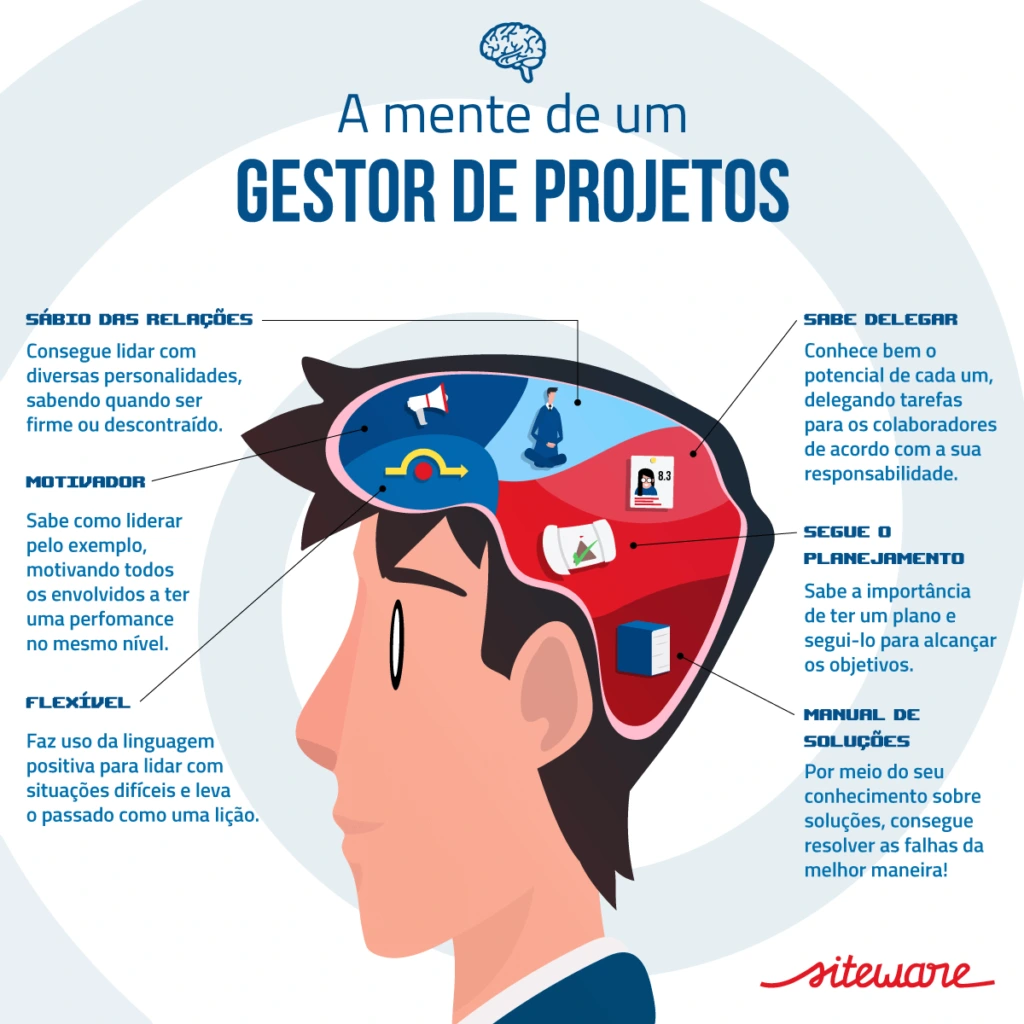
How should the mind of a good project manager work? See below:
4. Use a detailed statement of work
A common problem in project management is clarifying who is responsible for what. A detailed work document can remove all uncertainty and confusion.
In it, you should formalize which level of work must be done by which group or individual. That way, everyone will have a clear understanding of the level of effort involved.
To create this accountability in your project, use detailed statements of work or a responsibility matrix, and get all stakeholders to agree.
5. Create a detailed work plan
Formalizing your project’s work plan is essential to meet deadlines and reach goals. Without a detailed work plan, you leave room for delays and other complications.
This is where you detail your scope: all delivery dates, meeting dates, who is involved in certain tasks, who the approvers and owners will be, and so on.
6. Document everything involved in project management
As a project manager, have you ever seen a task go undelivered for a few days, or worse, a few weeks? Why did it happen? What led to it? How can you keep it from happening again?
To answer these questions, you need to rely on evidence collected while running your project management.
That is why it is essential to document everything that happens during the execution of your plan: project stages, impasses, changes of plan, task dependencies and more.
This also keeps all the necessary data safe and supports better decision making.
In a project audit, for example, this needs to be clear.
7. Ask for feedback
In a work environment, your team should be open to feedback. This culture helps identify points that can be improved and also recognize each person’s strengths.
As a project manager, your job is to ensure the project succeeds. Asking for feedback is a great way to increase the chances of success and improve your management skills.
If your company already has an established feedback culture, do not forget to give that feedback to your team members.
If you need help, improve your feedback practice with our material right now!

8. Communicate the impact of project add-ons
Sometimes saying “yes” to every new project or task that comes up is tempting. But that is an easy way to overload yourself with projects, which makes it impossible to practice agile management methodologies.
So whenever you get a new request within your project, it is your responsibility to show how it will affect your schedule or budget.
In that case, saying “no,” even if only temporarily, may be quite necessary, if only to avoid affecting the short, medium and long-term results of the objectives already set.
9. Manage new agreements
New suggestions usually mean a change to the original scope of the project. If that happens, it is good practice to have everyone sign a new agreement document.
This way, the various stakeholders will have a clear understanding of the new scope of work and its impact on the project overall. The documented agreement also prevents disruption if deadlines need to be reset.
In addition, project management means noticing when a change of course is necessary. That can happen because of an unexpected change or a planning error that was not identified earlier.
10. Hold a closing meeting
Once your project is complete, it is time to reflect and see how you can optimize your next projects for success. A closing meeting is a perfect opportunity to bring all members together for discussion.
In this meeting, you can discuss the lessons learned as the project progressed, understanding the difficulties and which factors may have delayed the execution of the plan.
And remember: continuous optimization of how you manage work can save time and money on future projects.
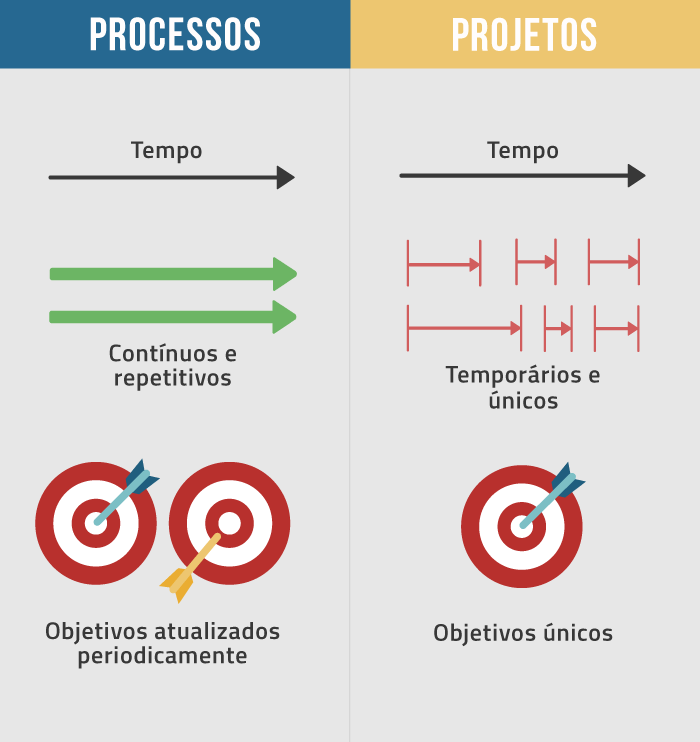
See the difference between processes and projects:
7 main methods in project management
Project management has been adopted across many areas of companies. The goal of successful project management is to deliver a quality result within the established deadline, cost and resources.
There are many project management methodologies that can help you manage projects. Here are the 7 main ones:
1. Agile method
The agile methodopens in a new tab is a project management approach focused on fast deliveries, adaptability and constant collaboration. Unlike traditional methods, which follow a rigid sequence of steps (such as the waterfall model), Agile works with short development cycles, called sprints or iterations.
This model is widely used by development teams, which need constant adjustments until the project matches the plan. Waiting for the project to finish before making changes can cause a series of problems and delays.
The central idea is that the project is built incrementally, with frequent feedback from the customer or users, which allows quick adjustments along the way. This reduces risks, increases stakeholder satisfaction and produces deliveries with more value in less time.
2. Traditional project management (Waterfall)
Waterfall is a linear, sequential project management method. The project is divided into well-defined phases, and each phase must be completed before the next one begins. Picture a “waterfall,” where the water goes down step by step. That is how this model works.
Building a construction, for example, is usually handled with more traditional project management, because improvisation and changes of course are not welcome and everything must be finished before the next stage starts.
This approach values detailed planning at the start of the project and follows a rigid schedule. Changes during execution are difficult (and often unwanted), because the entire project has already been designed in advance.
3. PRINCE2 (Projects IN Controlled Environments)
PRINCE2 stands for Projects IN Controlled Environments and is a structured project management methodology created by the British government and widely used in the public and private sectors, mainly in Europe.
Unlike Agile or Waterfall, PRINCE2 does not focus on the type of deliverable (the final product), but on the process of managing the project as a whole, with a focus on control, governance and continuous business justification.
PRINCE2 is based on 7 principles that must be present in every project:
- Continued business justification: the project only continues if there is proven value;
- Learn from experience: use lessons learned from previous projects;
- Defined roles and responsibilities: everyone knows their role;
- Manage by stages: the project is divided into phases with formal checkpoints;
- Manage by exception: senior management only gets involved when something deviates from the plan;
- Focus on products: the project deliverable is the center of management;
- Tailor to suit the project: the methodology can (and should) be adapted to the context.
4. Lean Project Management
Lean Project Management is an approach based on the principles of Lean Manufacturing (which originated in the Toyota Production System), applied to project management. Its main goal is to deliver more value with less waste, optimizing resources, time and effort throughout the project cycle.
This approach starts from the idea that every project can contain unnecessary activities, rework and inefficiencies. The role of the Lean manager is to identify and eliminate them systematically.
It is ideal for:
- Projects that need to be fast, efficient and low on resources.
- Lean teams working in dynamic environments.
- Organizations focused on a culture of continuous improvement.
- Sectors such as software development, startups, engineering, logistics and production.
5. Six Sigma
Six Sigma is a management methodology focused on improving process quality, with the goal of eliminating defects, reducing variation and increasing operational efficiency.
The name “Six Sigma” comes from statistics: in a six sigma process, the error rate is below 3.4 defects per million opportunities. In other words, it is a near-perfect standard of excellence.
The foundation of Six Sigma is the DMAIC cycleopens in a new tab, used to improve existing processes:
- Define: what are the project’s problems and goals?
- Measure: what is the current performance? Which metrics matter?
- Analyze: what are the causes of the problems?
- Improve: how do we solve and optimize the processes?
- Control: how do we make sure the improvements are sustained?
There is also DMADV (Define, Measure, Analyze, Design, Verify) for creating new processes or products with a focus on quality.
6. PMBOK (Project Management Body of Knowledge)
PMBOK stands for Project Management Body of Knowledge. It is a guide created by the PMI (which I mentioned earlier) that brings together standardized good practices, principles and processes for managing projects efficiently.
More than a method, the PMBOK is a comprehensive framework that can be adapted to different types of projects, sectors and approaches (including agile projects). It describes the “how to” of project management in a systematic and professional way.
7. Critical Path Method (CPM)
The Critical Path Method (CPM) is a technique used to plan, schedule and control a project’s activities. It identifies the longest sequence of dependent tasks, known as the critical path, which determines the total duration of the project.
In other words, if any activity on the critical path is delayed, the whole project is affected. That is why CPM is essential for managing deadlines more precisely and understanding which tasks are “critical” and which have flexibility.
The process involves:
- Listing all project activities.
- Identifying the dependencies between them (what must happen before each task).
- Estimating the duration of each activity.
- Building a network diagram (a chart that shows the sequence of tasks).
- Calculating the critical path, that is, the longest route (in time) with no slack.
Most-used software in project management
Now that you know the main methodologies, here are some of the main software tools used in project management:
1- Stratws
Stratwsopens in a new tab stands out for its Project Portfolio module, which can integrate all the fronts needed for robust project management. With Stratws, you can view, monitor and manage all your projects in one place.
In addition, integration with other BI systems and dashboardopens in a new tab customization put all the critical information one click away. The tool makes it easier to create and track action plans, turning project management into a simpler and more efficient task.
2- Asana
Another excellent project management software is Asanaopens in a new tab (in Portuguese). Known for its intuitive interface, Asana lets teams collaborate in real time, stay organized and meet deadlines with ease. It is ideal for anyone looking for a solution that promotes transparency and smooth communication among all project members.
3- Trello
Trelloopens in a new tab also deserves a mention. With its system of cards and boards, Trello makes it easy to see the progress of each task, promoting visual and interactive project management. It is a great choice for teams that appreciate simplicity without giving up functionality.
4- Jira
For those looking for a tool focused on agile methodologies, Atlassian’s Jira is a powerful option. Jira is widely used by software development teams, but its flexibility makes it suitable for any type of project. It offers advanced features for sprint management, issue tracking and detailed reports.
Benefits of project management
The benefits of project management can be significant for an organization. Developing and implementing efficient processes to handle project management challenges can help ensure project success, improve organizational performance and result in benefits such as tightening the budget, meeting deadlines or helping reach goals.
1- Standardized documents and reports
Project management also improves internal communicationopens in a new tab (in Portuguese), because it uses standardized documents and reports, such as project reference documents, which describe the main characteristics and provide important guidance.
Good documentation can help minimize decision-makingopens in a new tab problems and help increase productivityopens in a new tab (in Portuguese). These documents are also useful for making sure all team members are aligned with the purpose and objectives of the project, as well as for tracking project progress and evaluating performance.
2- Optimized resource allocation
Project management also makes it possible to optimize resource allocation, since project leaders can monitor performance and identify and manage project priorities. These factors help maximize the use of resources, making sure stakeholders are aligned and can work effectively and efficiently.
3- Better products and services
Finally, project management helps organizations deliver better quality products and services, with a focus on achieving business objectives. It helps measure results accurately, supports the decision-making process and makes it easy to manage the project life cycle, becoming a critical tool for organizational success.
With all these benefits, it is easy to see the importance of project management for any company or area.
Read also: Meet the 7 best business management software tools for TOP leaders
What does a project manager do?
A project manager plays a fundamental role in the successful running of a project, from its start to its completion.
The project manager’s role involves a variety of responsibilities aimed at making sure the project is executed effectively, efficiently and within the established parameters.
Some of the routine tasks include:
1- Defining project objectives, scopes, schedules and budgets;
2- Assigning responsibilities within teams;
3- Taking the right action, when needed, to keep the project on track;
4- Identifying potential risks in projects;
5- Making important decisions.
Next steps
Did these tips help you reflect on project development? Then here is one more: the best way to put all of this into practice is through project management software, which helps you see the status of your whole plan, manage processes and monitor the full progress of the schedule.
With a business management system you connect your performance indicators and centralize them to make decision making easier and keep improving your performance.
One management software that stands out in the market is Stratwsopens in a new tab, which gives you more time to plan, manage and engage your team around a culture of results.

FAQ: project management
What is the best project management methodology to start with?
It depends on the type of project, the team's maturity and the industry. Predictable, linear projects fit traditional methods such as Waterfall. More dynamic, iterative projects may benefit more from Agile or Lean.
What is the practical difference between Agile and Waterfall?
Agile is iterative, flexible and allows changes during the project. Waterfall is sequential and requires full planning before execution starts. Agile focuses on adaptation, while Waterfall focuses on control.
Do I need a tool to do project management?
It is not mandatory, but it is highly recommended. Tools such as Stratws, Asana, Trello and Jira help you see progress, assign responsibilities, keep deadlines and generate reports. They increase efficiency and team communication.
What is the PMI and why is it important?
The PMI (Project Management Institute) is an organization that defines global project management standards, such as the PMBOK guide. It also offers globally recognized certifications, such as the PMP (Project Management Professional), which add value to the careers of those who work in the field.
What does a project manager do day to day?
The project manager plans, organizes and monitors execution, making sure scope, deadline, budget and quality are met. They are also responsible for managing risks, teams and strategic decisions throughout the project cycle.

About the author
Equipe Siteware
Content produced and reviewed by the Siteware team, curated by internal experts in strategic management and corporate performance.