
Management Methods
How to manage your tasks
Lost in your tasks and not sure where to start? Learn task management methods!

In any company, new demands come up all the time. That is why knowing how to handle task management, such as what to prioritize and how to structure the execution of activities, can be the difference between an overloaded team and one that delivers results consistently.
Whether you are in leadership of a team, in project management or just in your own day to day, the lack of an efficient method for handling tasks can lead to disorganization, rework and the feeling of always putting out fires. And this is a real problem: according to a productivity survey by Deloitteopens in a new tab (in Portuguese), professionals spend on average 41% of their time on low-priority activities, leaving little room for strategic initiatives.
But how do you make sure the right tasks are done at the right time, without overloading the team or losing focus on what really matters?
In this article, I help you with how to carry out the best task management, the best tools, methods and practices for different organizations and their respective sizes. Keep reading and check it out!
What is task management?
Task management is the process of planning, organizing, prioritizing and tracking activities within a workflow, making sure deliverables are completed efficiently and on time.
It can be applied both to an individual routine and to team managementopens in a new tab and projects, helping turn chaotic to-do lists into a structured system that makes execution easier.
In practice, task management involves defining what needs to be done, in what order and by whom, reducing mental overload and improving productivity.
Without good management, it is common for demands to pile up, deadlines to be missed and the team to be constantly reacting to problems instead of working strategically.
Key fundamentals for managing tasks
Good task management goes far beyond simply listing what needs to be done. To make sure activities are completed efficiently and the team works productively, it is essential to follow a few basic principles.
I present them below:
1- Clarity in defining tasks
The first step to effective task management is making sure each activity is clearly defined, especially for whoever will carry it out. Generic or poorly worded tasks can cause doubts, rework and even delays.
If a task is not well defined, it can end up creating more confusion than results.
2- Strategic prioritization of activities
With the number of demands that come up day to day, knowing what to do first is essential so you do not waste time on secondary tasks while critical activities are left for later. Some popular techniques for prioritizing in task managementopens in a new tab (in Portuguese) include:
- Eisenhower Matrixopens in a new tab: sorts tasks into urgent and important to determine which should be done, delegated or postponed.
- GUT Matrixopens in a new tab: taking severity, urgency and time into account, you prioritize which tasks should come first in the day and the week.
- Pareto Principleopens in a new tab: identifies which 20% of tasks generate 80% of results and so directs your effort to the most important ones.
3- Continuous monitoring and follow-up
As important as planning tasks is tracking their progress. Efficient task management includes periodic reviews to make sure activities are progressing as expected.
It is important to stress here that this follow-up is not meant to micromanage tasks. Quite the opposite: the leader’s view should be to make sure employees are carrying them out with all the necessary tools and to support them if needed.
Some good practices include so-called dailies, which are daily meetings at the start of the day to align the whole team on whether everyone knows what needs to be done, with a description of the main tasks. In other management models, you can also apply weekly check-ins.
Effective methods for more organized task management
Task management can be done in several ways, and choosing the best method depends on the type of work, the volume of demands and the profile of the team or professional.
Some methods are more visual, others structure activities more systematically, and there are also those that focus on time management. Whatever the format, they all share the same goal: helping organize tasks better to ensure productivity and efficiency.
Below, I present some that can help you. Check them out:
1- Kanban
The Kanban methodopens in a new tab is a visual approach to organizing tasks and tracking their progress. It works through a system of columns that represent different stages of the workflow. The most common format includes three basic columns: “To Do,” “In Progress” and “Done.”
As tasks advance, they are moved from one column to another, making progress visible and intuitive.
Kanban is widely used by teams looking for stronger task management that work with multiple simultaneous demands, because it helps identify bottlenecks and distribute responsibilities better.
In technology companies, for example, this method is widely applied to manage software development sprints. However, it can be useful in any context where tasks need to be organized visually and dynamically.
2- Eisenhower Matrix
Often, the problem is not the volume of tasks but the difficulty of deciding what should be done first. The Eisenhower Matrixopens in a new tab helps solve this by sorting activities by urgency and importance.
This method divides tasks into four categories: those that must be done immediately, those that need to be planned for later, those that can be delegated and those that can be eliminated.
For managers and leaders, this approach is especially useful because it allows a more strategic analysis of demands. Instead of getting lost in a reactive routine focused only on what is urgent, the matrix helps prioritize activities that truly contribute to business growth.

3- GTD (Getting Things Done)
Created by David Allen, the GTD method is based on the idea that the mind was not made to store all tasks and commitments, but to process them.
So the system proposes that all demands be recorded in a trusted place and organized into specific categories, allowing tasks to be processed more efficiently.
GTD is structured in five main steps: capture all information and tasks, clarify what needs to be done with each one, organize activities into lists by context and priority, periodically review those lists to keep everything up to date and, finally, carry out the tasks according to the established plan.
This method is ideal for those who handle a large volume of information and need to keep a clear system so they do not miss deadlines or important commitments.
It can be applied using digital tools, such as task management apps, or even in a physical notebook or planner.
4- Pomodoro Technique
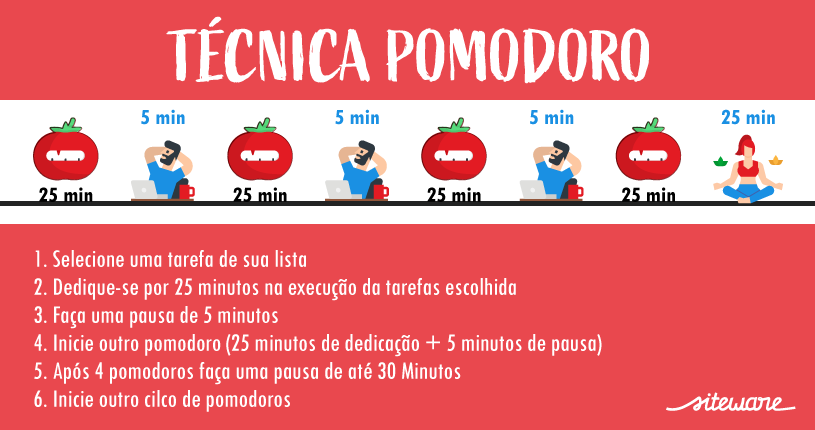
Procrastination and lack of focus are common challenges in carrying out tasks. To deal with them, the Pomodoro Techniqueopens in a new tab proposes a model based on periods of concentrated work interspersed with short breaks.
The idea is simple: set a fixed time to dedicate to a task, usually 25 minutes, followed by a short five-minute break. After completing four cycles of this pattern, the break is a little longer, allowing more effective rest.
This approach is particularly useful for professionals who work with creativity or activities that demand high concentration. Besides helping maintain focus, the technique also prevents mental fatigue and improves time use.
Stratws: a strategic tool for task management
Good task management is essential to ensure productivity, organization and an efficient workflow. However, having the right tool makes all the difference when structuring processes and tracking the progress of activities.
Stratwsopens in a new tab is a platform built to help companies and professionals improve their management, offering a range of features that make planning, prioritizing and carrying out tasks easier.
One of the main advantages of Stratws is the ability to integrate different methodologies within a single system. The platform includes features such as Kanban, giving a clear view of the workflow, and the GUT Matrix, which supports strategic task prioritization based on severity, urgency and tendency.
It even includes Pomodoro, helping users keep focus and productivity through work cycles interspersed with breaks.
In addition, Stratws offers interactive dashboardsopens in a new tab, performance indicators and integrations with other corporate tools, making sure all tasks are aligned with the company’s strategic objectives.


About the author
Equipe Siteware
Content produced and reviewed by the Siteware team, curated by internal experts in strategic management and corporate performance.