
People Management
How to manage a team: 7 key tips to boost your employees
See the most important tips on how to manage a team and learn what to do to achieve better results with your employees and your team.

Is your team getting the job done? Are you looking for effective ways to get your team to work together and deliver results? The truth is that leaders in small, mid-sized and large companies face a common challenge: running efficient team management.
This practice is about drawing out the best in employees and turning it into positive results for the company. It is through this kind of management that efforts are aligned toward common goals.
Engaged employeesopens in a new tab, motivated and committed, contribute to the company’s productivity. However, you need to know how to manage them.
Check out 7 key tips on how to manage teams and achieve better results.
Read also: 6 apps for team management you need!opens in a new tab
What is team management?
Team management is the process by which a leader or manager guides, coordinates and leads a group of individuals to reach common goals and objectives. Unlike people management, which has a broader scope and covers the whole organization, team management focuses on specific groups of professionals, whether a department, a project or a business unit.
At the core of team management is the ability to harmonize individual skills and competencies to create a cohesive, productive unit. This involves understanding each member’s strengths and weaknesses, promoting collaboration, setting clear goals and providing continuous feedback.

For leaders and managers, team management involves a series of responsibilities, such as delegating tasks, mediating conflicts, motivating the team, ensuring effective communication and providing the tools and resources the team needs to succeed.
In addition, effective team management also requires the ability to adapt to change, whether a change in the organization’s goals, in team dynamics or in the business environment.
Why is team management important for companies?
Team management is fundamental for companies because, at its core, every organization is made up of teams of individuals working together toward common goals. Effective team management ensures that these groups of professionals are more than just the sum of their individual parts.
When a team is well managed, it operates cohesively, with each member contributing their unique skills and competencies to achieve superior results.
In addition, in today’s business environment, marked by rapid change and growing complexity, a company’s ability to adapt and innovate is crucial. Well-managed teams are more agile, creative and resilient, able to face challenges, find innovative solutions and seize new opportunities.
Team management also plays a vital role in talent retention. Professionals value work environments where they feel valued, understood and challenged. A leader or manager who knows how to motivate, give feedback and develop their team creates a positive work environment, which in turn reduces turnover and attracts high-quality talent.
7 tips on how to manage a team
Good team management is essential for the harmony and productivity of all employees. However, it is not always an easy task. It is the leader’s role to unite all members around a purpose. In addition, you need human-centered management, one that understands employees beyond their professional side.
Effective communication is also part of a good team manager’s routine. The leader is responsible for making sure all team members work together.
Although working from home is a challenge for team management, it is essential not to leave this topic aside. For that reason, see 6 tips on how to manage a team:
1, Share the company’s Mission, Vision and Values
For effective team management, there must be integration and a sense of belonging among members. In this sense, a good way to achieve that is by sharing the organization’s Mission, Vision and Valuesopens in a new tab.
- The Mission is the reason the company exists;
- The Vision is where the company wants to be in the long term;
- The Values are the non-negotiable principles the company will not give up.
Having this triad well defined will serve as a compass for employees to carry out their activities.
2, Promote dialogue and the use of creativity
There is no way to manage teams without promoting dialogue among all members, including the leader. You need to show employees that the workplace is indeed a place for them to express themselves, exchange ideas and feel welcome.
When they feel free to say what they think, creativity flows. That way, excellent ideas can emerge. So encourage everyone to participate and try to keep employees from staying immersed in their own bubbles.
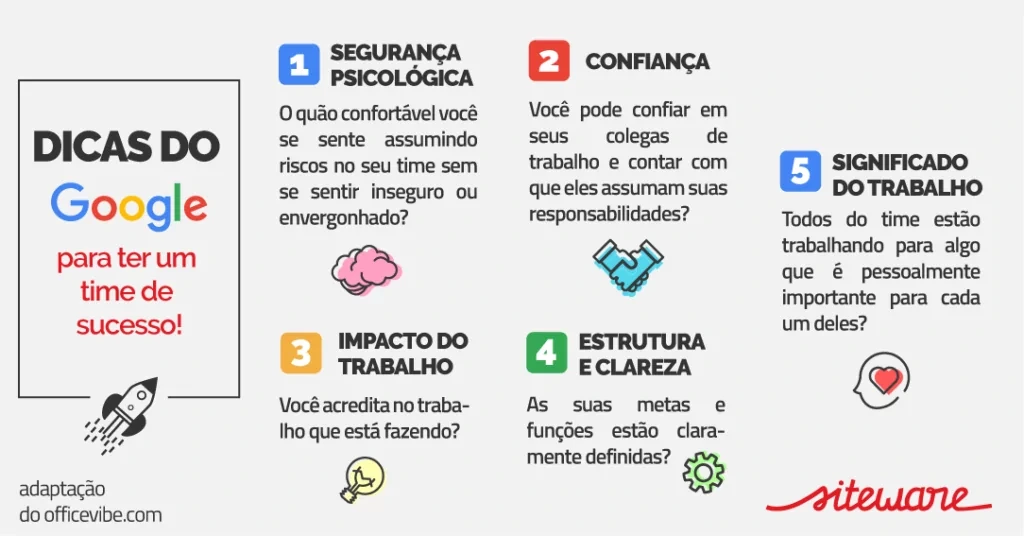
See some tips from Google for building a successful team:
3, Understand employees’ skills
To let your company flow organically and naturally, you need to understand each employee’s specific skills. This matters so you can assign people to tasks that fit each one’s aptitudes.
Sometimes an employee in customer serviceopens in a new tab (in Portuguese) could be put to better use in the marketing department, for example.
Most employers think that when an employee applies for a given position, they can only do that specific job. This is a mistake.
Try to spend time with each employee, one at a time. That way, you can discover their preferences and which tasks they could stand out in. Assigning the right roles will have a significant impact on the team’s productivity levels.
See a real success example: How meritocracy was the success factor at BRMallsopens in a new tab
4, Keep communication effective
Any successful business person with any number of employees will tell you that communication can make or break your company.
When everyone is on the same page, when they understand the work and what is expected of them, that is where true business success lies.
One of a manager’s main responsibilities is to make sure communication works smoothly every day. Make sure your chain of command is clearly defined.
Since it is your responsibility to determine how your employees communicate, you need to make sure the tools and platforms the company uses meet your communication criteria.
Platforms such as Intraboom and Slack create opportunities for communication, tasks, file sharing and important bulletins you need to share with your employees. Keep your team used to communicating with you and with each other.
5, Give feedback
Try to meet with your team periodically to take stock of the results already achieved and those still to be reached. This is an important moment to align certain points, show where the team is going wrong and also give praise when there is progress.
Give constructive criticism and be open to hearing what employees have to say. Remember that feedback should be a two-way street.
Want some tips on how to give feedback? Then check out this video (in Portuguese):
Read also: Do you know how to congratulate a work team? Find out now!opens in a new tab
6, Set an example for employees
Our last tip on how to manage teams is perhaps the most important of all. As a leader, you need to be an example to your employees. They need to look at you and feel confidence, credibility and inspiration.
Keeping the team motivated is also important, see here some ways to do it:
See also: 25 leadership techniques: be a great leader for your companyopens in a new tab
7- Use technology to your advantage
We live in the age of technology. Leaders who do not use tools to support team management may be missing interesting data and lose the chance to promote their team members.
In this scenario, Stratws’s Talent Management module can help manage teams by providing automated analyses and insights for employees’ individual development, using artificial intelligence. It also allows performance reviews, the creation of Individual Development Plans (IDPs) and the sharing of feedback.
Through technology and the automation of many tasks for leaders, it also helps save time by automatically summarizing review comments, identifying critical points for your team members’ development. It also promotes a feedback culture and competency development through 1:1 meetings.
What skills do I need to manage a team well?
Managing a team is not an easy task. Beyond hard skills, such as broad knowledge of the area being led, the leader must have many soft skills. These, in turn, include those interpersonal abilities that are hard to measure. Communication, leadership and flexibility are some of the main soft skills the market looks for.
But to manage a team well, what skills do I need? Here are some necessary abilities:
- Having excellent communication;
- Being flexible;
- Being well organized;
- Knowing how to pass knowledge on to others;
- Among others.
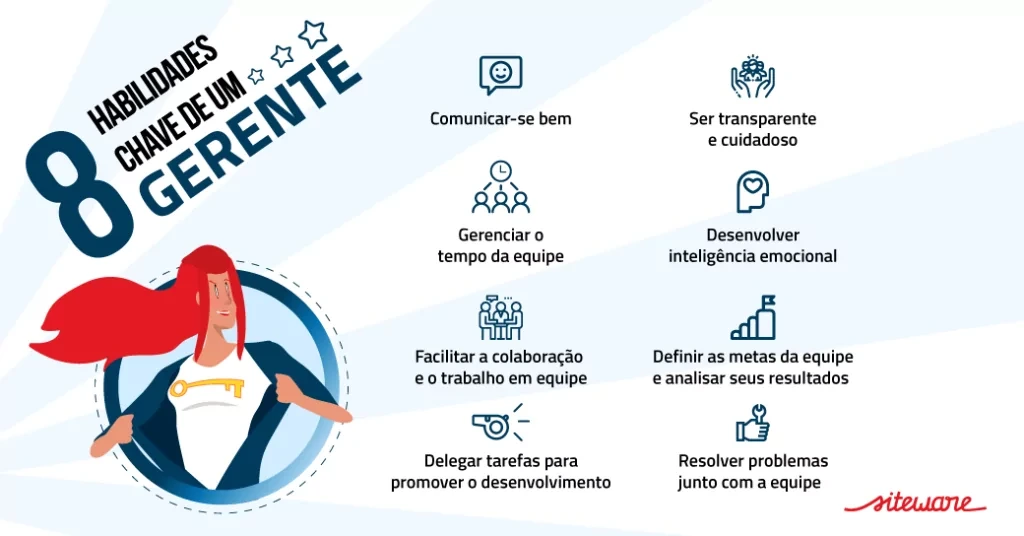
See this infographic with 8 key skills of a manager:
Cultivating diversity and inclusion in the workplace
Diversity refers to the presence of differences within a team, including, but not limited to, race, gender, age, ethnicity, sexual orientation, physical and mental abilities, and cultural background. Inclusion, on the other hand, is the practice of making sure everyone feels valued and integrated, regardless of their differences.
So good team management is about creating an environment where diversity is not only accepted but also welcomed and celebrated.
In addition, diversity and inclusion in the workplace are more than just HR policies; they are fundamental strategies that enrich organizational culture, drive innovation and contribute to business success.
Cultivating a diverse and inclusive workplace means creating a space where differences are valued and all team members feel respected and able to contribute fully.
Read also: How to build a qualified multidisciplinary team?opens in a new tab
Team management and technology
Did you know that, with the help of technology, team management can get much easier?
With human resources software you can identify, retain and develop talent through automated competency review cycles.
A good people management system gives HR more autonomy, since it allows processes to be automated and encourages a feedback culture through smart talent management.
And HR management software that helps with this is Stratwsopens in a new tab. With it, you plan, organize and improve the work routine of the whole team, helping employees focus on a results culture.
With our software you can give feedback, track corporate and individual indicators, manage projects and bring more clarity to the whole organization’s strategy.

About the author
Equipe Siteware
Content produced and reviewed by the Siteware team, curated by internal experts in strategic management and corporate performance.