
Management Methodologies
Optimize processes with the Kanban method
Learn what the Kanban method is, its three types, benefits and a 7-step guide to apply it in your company and improve processes.
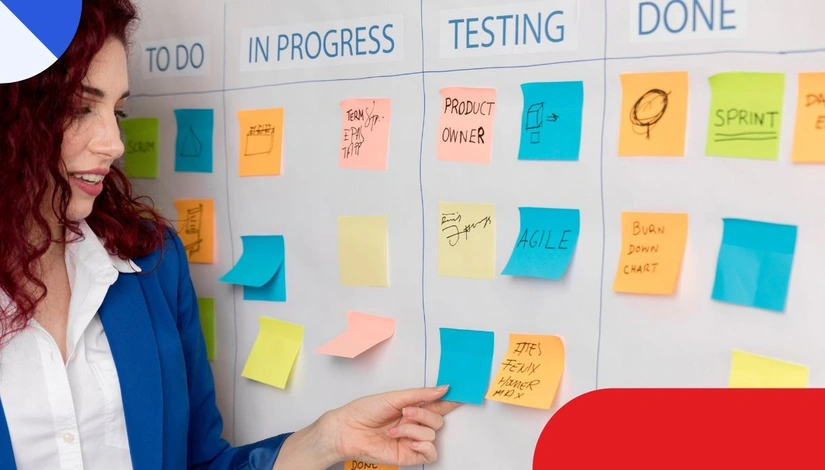
Popularly known as the “little cards tool,” the Kanban method gives leaders and team members a clearer view of what is happening, how the team’s routine is going and what the priorities are for that day. Thanks to its many benefits, it has become one of the favorite methods, widely applied in companies and teams looking to improve their processes.
To give you an idea, according to a survey by The State of Agileopens in a new tab, the adoption of agile methodologies grew by approximately 86% in 2021 compared to the previous year. Today, a few years later, more and more companies of different sizes are dragging cards and checking off tasks.
Maybe your company already has a great flow of tasks and activities, but what is being done is not generating value, senior leadership cannot see what is being executed and it seems that nothing is getting done. In that case, your work is being done in vain.
But don’t worry: the Kanban method has helped many people, and I am sure it can generate value for you too. Keep reading and find out everything about these cards!

What is the Kanban system?
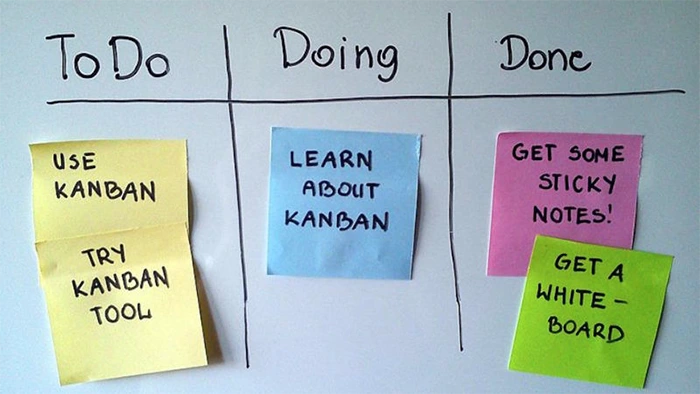
The Kanban system is a visual workflow management method that helps organize and optimize processes, ensuring efficiency and minimizing waste. By default, it uses a board divided into three columns that represent different stages of a process, such as “To Do,” “In Progress” and “Done.”
The basic idea here is that the people involved in a project can see what needs to be done, what is being done and what has already been completed.
However, it is important to point out that this three-column system is the “standard basic” version. Many companies and teams can add columns according to the needs of the group.
Want an example? An area that needs the manager’s approval to finish a deliverable can include an approval column. This helps not only the leader see easily what needs to be done, but also guides the team members who need that item approved before starting another.
This way, each task is represented by a card, which is moved between columns as the work progresses. This lets the team see the status of each task, identify bottlenecks and keep the workflow continuous and balanced.
The main concepts of the Kanban method:
Any team that uses Kanban needs to understand a few concepts of the method. They are:
- Kanban board: Kanban uses a visual board to represent the workflow. The board is divided into columns that represent the different stages or steps of the process, and each task or work item is represented by cards or sticky notes that move across the board as they progress through the process. Although the traditional Kanban board has three columns, it can be adapted to the team’s needs.
- Work in progress limits (WIP): a key feature of Kanban is imposing WIP limits on some columns of the board, such as the execution column. This helps prevent overloading the work in progress (since one person cannot execute 5 tasks at the same time, for example).
- Pull system: Kanban operates with a pull system, where work is pulled from the previous stage of the process only when there is capacity to accommodate it in the next stage. This avoids oversizing tasks and promotes a more balanced workflow.
- Visual management: Kanban relies heavily on the visual management of tasks. Kanban boards and colored cards represent essential information about the status of the work, making it easily visible to all team members.
- Continuous improvement: the Kanban method promotes continuous improvement of the process. Team members are encouraged to identify problems and bottlenecks as they arise and to work together to implement improvements.
Want to learn about agile methodologies beyond Kanban? Watch our video, in which we explain what the main agile methodologies are and how to apply them:
What does kanban mean? Where and how did it originate?
Kanban originated in Japan in the 1940s. It was developed by Toyota as part of its lean manufacturing practices. This is because, after World War II, Toyota faced major challenges to recover and compete with American automakers.
So it looked for ways to improve efficiency and reduce waste in order to survive in the market while looking for ways to grow.
Taiichi Ohno, an industrial engineer at Toyota, was one of the main people responsible for developing the Toyota Production System (TPS). Ohno was inspired by supermarkets in the United States, where customers took products from the shelves as needed, and employees restocked the shelves according to demand.
This observation led Ohno to create a similar system on Toyota’s production line, where parts and components were replenished only when there was a real need.
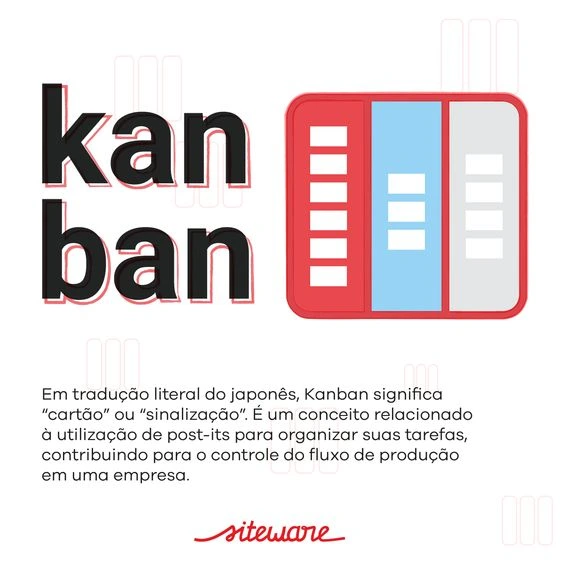
Thus, the term “kanban” means “card” or “signal” in Japanese. In production, these cards were used to signal the need to replenish materials and components. Each workstation on the production line had a set of kanban cards that indicated when more parts were needed.
When a station used the last parts of a batch, the corresponding card was sent to the supplier or to the previous station, signaling that more parts were needed. This system helped control the production flow, avoiding excess inventory and ensuring that production happened only when there was demand.
Where can Kanban be applied?
Although it emerged in industry, Kanban is now used in many areas, so we can consider that it can be applied in any workplace that has a flow. Below are some examples:
- Software development: software development teams are very familiar with the agile methodology, and use Kanban to make sprint management more visual, tracking the progress of the work, identifying bottlenecks and improving collaboration among team members.
- Project management: Kanban helps organize and monitor projects, allowing managers to see the status of each task, prioritize activities and make sure the work is carried out in an orderly way.
- Marketing: marketing teams can use Kanban to plan and track campaigns, manage content and coordinate activities among different team members, making sure all efforts are aligned with the campaign’s goals.
- Logistics and supply chain: Kanban helps manage the flow of materials and products, making sure inventories are kept at ideal levels and that items are delivered at the right time.
What is the difference between Kanban and Scrum?
Although they are widely used (even in a complementary way), Kanban and Scrum are quite different views. Kanban, for example, is a method. Scrum is what we call a framework. Not sure what that means? Let me explain:
Scrum is a structured framework based on work cycles called “sprints.” A sprint is a fixed period, usually between one and four weeks, during which a defined amount of work must be completed. At the start of each sprint, the team plans which tasks will be carried out, and at the end there is a review to assess progress and adjust the plan for the next sprint.
Scrum is widely used in large projects, such as by development teams. The idea is that at the end of each sprint, they present the progress of the project, generating value for the project’s requester and aligning expectations. In other words, without that negative surprise at the end of a large project.
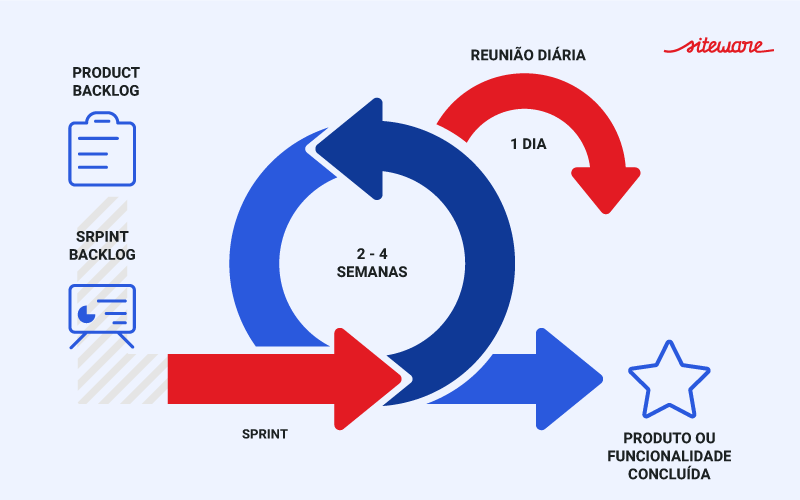
This way, Kanban can be incorporated as a method to visualize which tasks are being pulled by the team and which have already been finished over the sprints, for example.
Since Scrum is much more complex, you can read more about it in our article on the topic (page in Portuguese).
What are the three types of Kanban?
Although the Kanban method is closely associated with an application that is 100% adaptable to different scenarios, there are three very common types:
1- Production Kanban (or manufacturing Kanban)
This is the original type of Kanban, developed as part of the Toyota Production System (TPS) in the manufacturing industry, which I mentioned earlier. Production Kanban is used to manage the production flow in a factory or assembly line.
It involves using cards or visual signals to control the flow of parts and materials, making sure that only the necessary quantity of products is produced, avoiding excess inventory and reducing waste.
Each Kanban card represents a given item or quantity of items, and when a card is removed from a container or storage location, it signals the need to replenish that item.
2- Task Kanban (or Project Kanban)
Task Kanban is an adaptation of the Kanban method to manage workflows in project environments, software development, task management and other areas where work is done in stages. Today, it is the type most applied by companies of different sizes.
For this, instead of physical parts, the “tasks” or work units are represented by cards or notes on a visual board. Each card represents a task or work item to be carried out, and the visual board shows columns that represent the different stages of the process (for example, “To Do,” “In Progress” and “Done”).
Team members move the cards across the board as they work on the tasks, following Kanban principles such as limiting work in progress and keeping the flow steady.
3- E-Kanban
With the modernization and digitization of company processes, kanban has also gone digital. Today, you can count on management software (page in Portuguese) that supports organizations with a kanban board, promoting better visual management in companies that need to work with employees in different parts of the world, working online and asynchronously.
How to apply Kanban in your company?
Below is a step-by-step guide I put together to help you implement the kanban method in your company:
1- Understand the basic concepts of Kanban
To start, it is essential to understand what the Kanban method is. In this case, training for both leaders and team members will be important so that everyone is “speaking the same language.”
Many companies start by training their leaders, and the leaders themselves help the team members. However, this does not have to be a rule, since you can hire a consultancy to help everyone at the same time, for example.
2- Define the current process
Getting hands-on, before creating your Kanban board, you need to understand how tasks currently flow in your company.
Analyze the current process, identifying the steps a task goes through from start to completion. This is essential to create a board that reflects the real workflow.
You can, for example, write the steps down on paper or use a spreadsheet to map the process visually and identify possible bottlenecks that may be delaying task delivery.
3- Create the Kanban board
With the process defined, it is time to set up the Kanban board. Choose a place visible to everyone on the team, such as an office wall, or opt for a digital software tool if you prefer an online solution.
Start by drawing columns that represent the steps of your workflow. At first, keep it simple, with columns such as “To Do,” “In Progress” and “Done.”
Later, you can add intermediate columns to refine the process even further. What matters is that the board is clear and easy for the whole team to understand.
4- Create and move the cards
Now, each task or work item should be represented by a card. These cards need to have essential information, such as the task description, who is responsible for it and the deadline for completion.
You can use the logic of the RACI Matrix (page in Portuguese) to define this information.
At first, you can create cards for existing tasks and place them in the column that matches the current stage of the work.
As new tasks come up, they should be added to the “To Do” column and, as the work progresses, move the cards across the appropriate columns. This movement helps visualize the progress of the work and makes it easier to identify possible obstacles.
5- Set WIP (Work in Progress) limits
One of the fundamental principles of Kanban is limiting the amount of work in progress (WIP) to improve the team’s focus and efficiency. To implement this, define how many tasks can be in each column at the same time.
If your company is using the board in the traditional model, WIP will be applied only to the middle column, which tracks what is being executed.
For example, you can decide that the “In Progress” column can hold up to three tasks at a time per person. This limit forces the team to finish tasks before starting new ones, preventing work from piling up and the process from becoming congested.
Over time, you can adjust these limits as the team adapts to the method.
6- Monitor and adjust the workflow
With a more complex board and new columns added, if necessary, it is important to monitor the workflow regularly. Observe how tasks move across the board and identify whether there is any column where cards tend to pile up.
This buildup can indicate a bottleneck in the process.
Hold short, frequent meetings with the team to review progress and discuss possible improvements. During these meetings, you can identify necessary adjustments, such as changing WIP limits or adding new columns to better reflect the workflow.
This improvement flow is continuous and focuses on making sure Kanban adapts to the reality of the company.
7- Implement continuous improvements
Kanban is an approach that encourages continuous improvement (page in Portuguese). This means the process is never “finished.” As you gather information about the workflow, use these insights to optimize processes, adjust WIP limits and improve efficiency.
For example, if you notice that a certain step always takes longer than the others, you can investigate the causes and look for solutions to speed up that point.
Adopt a mindset of constant learning and continuous adjustment, keeping the Kanban board as a dynamic tool that evolves along with the needs of the team and the company.
What are the advantages of using Kanban?
The Kanban method offers several advantages in different contexts, whether in manufacturing, software development, project management or other areas where workflow matters. Some of the main advantages of using Kanban in a company’s routine include:
1- Greater workflow control
Kanban provides a clear, visual view of the workflow, allowing all team members to understand where tasks are in the process. This makes it easier to identify bottlenecks and take action to improve the workflow.
In addition, by limiting work in progress, Kanban helps avoid task overload and allows the team to keep a greater focus on the quality of the work rather than on quantity.
2- Flexibility
Kanban is highly adaptable and can be applied in different contexts and work environments. It does not impose a rigid structure, allowing teams to customize the method according to their specific needs.
3- Continuous improvement
Kanban encourages a culture of continuous improvement, where teams are constantly looking for ways to improve the work process. Team members are encouraged to identify problems and implement solutions proactively.
4- Increased productivity
By eliminating waste and improving efficiency, Kanban can lead to increased productivity and faster delivery of value to customers.
Another point is that Kanban’s visual approach makes communication among team members easier, since everyone can see what is happening in the work process clearly and transparently.
5- Waste reduction
Kanban was created precisely at Toyota, when it needed help eliminating the waste of resources such as time and materials, by making sure that only the necessary work is done. As a result, applying the method helps reduce unnecessary inventory, avoids rework and saves resources.
Next steps
What if you could use software that, besides managing teams, brought all your company’s performance data to you quickly so you can analyze and share it?
And more: with tools for meeting management, individual performance analysis, project management and others.
With Stratws you can align strategy and execution, engaging the team and delivering concrete results for the business.
This happens because the data you need is found quickly, making it easier to make decisions and define what needs to be done.
This way, the team is quickly informed about the tasks that need to be carried out and, after that, their performance is tracked with the help of KPIs.
This way, if things are not on the right track, changes can be made quickly.

About the author
Equipe Siteware
Content produced and reviewed by the Siteware team, curated by internal experts in strategic management and corporate performance.