
Strategy and Goals
Strategic planning: how to build one for your company
Learn how to build an effective strategic plan for your company. See the steps, tools and methodologies that turn strategy into results.

Statistically, the lack of a structured strategic plan is one of the main reasons businesses in Brazil close early. According to the latest data from the survey Demografia das Empresas e Estatísticas de Empreendedorismoopens in a new tab (in Portuguese), published by the Brazilian Institute of Geography and Statistics (IBGE) in December 2024, 62.7% of organizations shut down before completing five years of operation.
The purpose of a plan is to set a long-term vision, ensuring the sustainability and growth of the business through a set of well-defined tactical goals.
That is why, in this article, we explain what strategic planning is, what real impact it has on an organization’s results and the practical path to structure it well.
What is strategic planning?
Strategic planning is the structured process of connecting a company’s vision of the future to its daily execution. Far more than a formal document, it works as the practical roadmap that guides decision-making and aligns every level of the company toward the same objectives.
In practice, this methodology covers the creation, organization and deployment of tactics aimed at continuous growth. To keep the strategy from staying on paper, planning requires clearly defined goals, well-chosen performance indicators (KPIs) and workable action plans.
That way, managers can track progress in real time, correct course quickly and make sure the effort of every employee or department contributes to the business’s overall result.
Download our e-book now and unlock your strategic planning:
 Download the e-book
When should you do strategic planning?
How often you plan depends on the maturity of the business and the goals of leadership. Historically, companies projected five-year horizons or more. Today, with how fast markets move, shorter cycles (one to two years, or even semiannual reviews) have become the standard in high-performing organizations.
Looking at the corporate calendar, the movement picks up between September and October, when many companies are already setting guidelines for the following year.
However, when you are losing competitiveness against rivals or urgently need to correct operational course, the recommendation is to start the alignment right away.
Starting early also gives a tactical advantage. Preparing this roadmap ahead of time lets you break down viable objectives, apply action plansopens in a new tab effectively and engage all employees in pursuing the proposed results.
What are the 3 essential questions for strategic planning?
Structuring an efficient management model depends on alignment around three central questions.
The famous saying that, for someone who does not know the destination, any road will do, illustrates the mistake of running a business without clear guidelines.
Accepting any direction, without the support of a strong organizational culture and well-designed goals, compromises the sustainability of the operation.
A strategy is only truly executed when these three questions have precise answers:
- Where is the company today? This is the current diagnosis of the business, with a deep understanding of its position against competitors and the reality of the market.
- Where does the organization want to go? It defines the vision of the future and the specific objectives set for a given time horizon, covering periods of one, two or five years.
- How do we get there? It covers the practical execution plan, detailing the resources needed, the performance indicators and the actions essential to reach the proposed goals.
What are the differences between strategic, tactical and operational planning?
A company’s organizational structure has very well-defined roles and responsibilities, from the board to operations. To ensure end-to-end alignment, each level requires its own planning model.
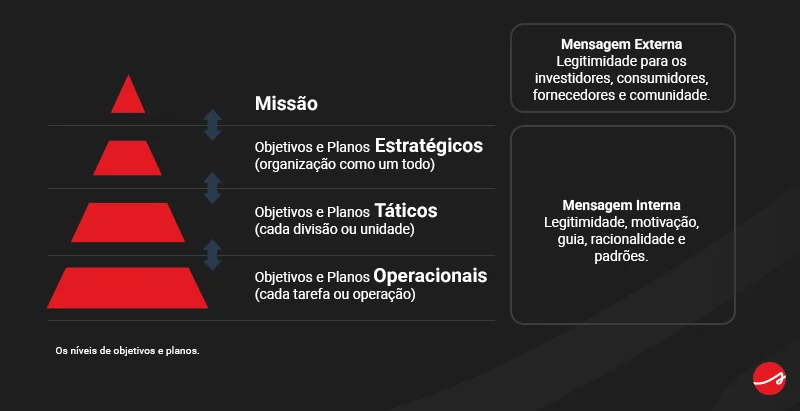
Strategic planning centralizes the general guidelines and sets the vision of the future for the whole company. Defined by senior leadership, the method focuses on the long term, projecting goalsopens in a new tab for periods of three to ten years, and directs the business’s main objective.
Tactical planning, in turn, breaks that global vision down into specific processes or departments. Led by middle management, the model translates the macro strategy into medium-term goals, guiding the actions of each department over one to three years.
Finally, operational planning focuses on day-to-day execution. Coordinators and technical leaders define the routines, tasks and short-term activities (usually between three and six months) for the team. It is the practical materialization of the work needed to reach each area’s goals.
The central point is how interdependent these three levels are. Without a clear long-term map, the organization loses the ability to align tactical and operational execution, creating a huge effort with no financial impact.
Comparison of planning levels:
| Type of planning | Focus and scope | Responsible leadership | Timeframe and duration |
|---|---|---|---|
| Strategic planning | Global view of the organization, analysis of internal and external factors, opportunities and threats. | Senior management (C-Level and Board) | Long term (3 to 10 years) |
| Tactical planning | Specific processes, departmental guidance and area goals. | Middle management (Managers and area leaders) | Medium term (1 to 3 years) |
| Operational planning | Day-to-day execution, practical operations, routines and tasks. | Coordinators, technical leaders and the whole team | Short term (3 to 6 months) |
Read also: Everything about managing strategic, tactical and operational indicators in companies
How to do strategic planning
Building a long-term roadmap varies with each organization’s operational reality. Still, there is a structured methodology, validated by the market, to write this document with precision.
Below, we detail the essential steps to build an efficient strategic planning model focused on high performance:
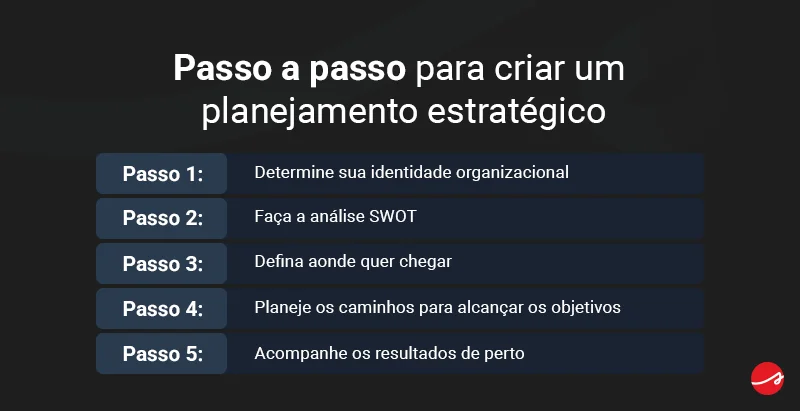
Step 1: Define your organizational identity
The first stage is to define the company’s mission, vision and values. With these three pillars in place, the company understands its reason for existing, its expectations for the future and the guidelines of its own growth.
The central goal is to consolidate the brand’s positioning and how it solves customers’ pain points. From that solid base, leadership gains the structural clarity to set goals consistent with the corporate purpose.
Step 2: Run a SWOT analysis
The SWOT matrixopens in a new tab works as an analytical tool to support decision-making. Applying the method splits the analysis into two vital fronts: assessing the internal environment maps the operation’s strengths and weaknesses, while looking at the external market identifies latent opportunities and threats.
With this mapping complete, the organization recognizes its competitive differentiators and gathers the essential inputs to structure the next steps of the plan.
Step 3: Define where you want to go
The third phase brings the strategy to life. With the diagnosis in hand, leadership must set the main corporate objective for the coming years.
At this point, adopting the Balanced Scorecard (BSC)opens in a new tab stands out as the market’s best practice for organizing the company’s vision. The model supports goal deployment through four perspectives: financial, customers, internal processes and learning.
Step 4: Plan the paths to reach the objectives
Executing the strategy requires building tactical action plans. Leadership needs to define the scope of the projects, the direct owners and the final delivery deadlines.
Established methodologies, such as the 5W2Hopens in a new tab matrix, guide how these tasks are structured. Answering its seven basic questions helps work around operational bottlenecks and supports full delivery of the proposed goals.
Step 5: Track results closely
Corporate performance management depends on continuous control and monitoring. The pace of the market demands constant adjustments to the planned route.
For that reason, defining precise performance indicators is mandatory to measure how effective the actions taken are. Leadership should track the numbers routinely, assigning clear responsibilities to employees.
To consolidate corporate governance and avoid data fragmented across manual spreadsheets, adopting a management platform such as Stratws delivers a major competitive edge.
The solution centralizes action plans and automates KPI tracking in a single secure ecosystem, backed by international SOC 2 compliance.
5 precautions when developing strategic planning
When structuring strategic planning, leaders often face operational challenges that can undermine the effectiveness of the proposed goals.
To shield the operation from these risks, here are the most common mistakes when designing the company’s strategy:
1. Misalignment with the company’s reality
The primary mistake is creating a document that does not reflect the organization’s productive capacity and current context. Ignoring the real scenario leads to unattainable goals and makes the project obsolete from day one. The recommendation is to use the SMART methodologyopens in a new tab to ensure indicators that are mathematically applicable and realistic.
2. Lack of flexibility and adaptation
The business environment demands quick responses. A rigid strategic roadmap that cannot absorb adjustments during execution loses its validity within a few months. Management must actively work to reduce internal resistance, making sure the team keeps up with the changes the market imposes.
3. Underestimating follow-up and execution
Structuring the document is only the first stage. Many operations fail because of a lack of continuous monitoring, including the assignment of owners, deadlines and performance metrics.
Without a review routine, it is impossible to correct course quickly. The ideal is to adopt a digital ecosystem that centralizes the view of the plan, allowing senior leadership to track KPIs automatically and in real time.
4. No involvement of stakeholders
Building goals in isolation, without alignment with area leaders and frontline executors, results in low engagement. Setting objectives needs to include clear communication with all stakeholders, avoiding frustration and ensuring the team’s genuine commitment to deliverables.
5. Lack of a clear corporate vision
Skipping the initial diagnostic steps leaves the company without a defined direction. Without an objective direction, execution makes the whole corporate effort ineffective. On top of that, organizational culture directly affects the adoption of the new strategy; ignoring current values creates insurmountable barriers in daily operations. gives a realistic view of the software’s benefits and features in practical situations.
Watch the video (in Portuguese):
What is the purpose of strategic planning?
Mastering the details that make strategic planning indispensable is what sets high-performing companies apart.
The practical purpose of this methodology shows up on four fronts:
1. Organize and structure the action plan
The methodology works as the foundation for corporate success. It brings together the company’s global vision and defines macro guidelines. From those general guidelines, leadership details specific goals and tactical tasks for each department, aligning the board’s decisions with the team’s daily execution.
2. Define the brand’s market positioning
Building the plan requires in-depth research that ends in the definition of corporate identity. Setting the mission, vision and values creates a guiding thread for every action taken, communicating the essence of the brand to internal and external audiences.
See some examples:
- Coca-Cola
- Mission focused on satisfying the consumer;
- Vision oriented to leadership and sustainable innovation;
- Values anchored in diversity and responsibility.
- Google
- Mission focused on organizing the world’s information;
- Vision focused on a smarter future supported by technology;
- Values based on ethics and innovation.
3. Optimize resources
Tactical management matters for allocating budgets intelligently and reducing costs. Mapping ahead of time avoids waste of capital and productive time. By identifying which financial and human resources are needed to hit each goal, team efficiency reaches its peak.
4. Improve decision-making
When leaders or executors have doubts about how to run complex projects, the strategic document acts as the definitive guide. By laying out the strengths, weaknesses, opportunities and threats of the scenario, the tool makes management decisions faster, more precise and based purely on data.
How to choose management software for strategic planning
Adopting the right technology is an important milestone for companies focused on raising their own level of governance. An excellent system should provide features that make it easier to define, execute and monitor operations.
To make the right choice, evaluate the following technical criteria:
1. Essential features
A robust platform needs to cover every phase of management. The focus should be on solutions that deliver an integrated view of the business, breaking away from the logic of isolated modules. This includes project portfolio management, KPI tracking and precise goal deployment.
2. Ease of use
Interface fluidity determines the success of the rollout in the company. Intuitive systems do away with exhausting training and ensure a high adoption rate across all departments. Organic employee engagement maximizes return on investment (ROI).
3. Centralized view
The right technology should overcome the operational limits of manual controls in scattered spreadsheets. Centralizing the data history and standardizing reports avoids information fragmentation and ensures productivity in results presentation meetings.
4. Security and compliance differentiator
For companies, data privacy demands absolute rigor. Prioritize platforms that comply with international standards, with certifications such as SOC 2.
5. Technical and advisory support
The corporate partnership must go beyond supplying licenses. Specialized support and continuous follow-up ensure a smooth implementation, helping the technical team get the most out of the features they contracted to drive the business.
6. Market reputation and success stories
Look into the vendor’s track record and its active customer base. Solutions used by major players such as Vale, Globo, Volkswagen and Cielo vouch for the tool’s technical reliability and show its ability to support highly complex operations, as is the case with Stratws.
Take the chance to check out some of Siteware’s success stories!
How to build a strategic planning culture in the company
Consolidating a strategic planning culture requires leadership to set a clear vision of the future and actively involve employees in creating the corporate plan.
Deploying measurable goals, together with transparent communication, secures the engagement of the whole operation around the planned map. However, keeping that roadmap aligned requires continuous leadership developmentopens in a new tab (in Portuguese) and the use of digital ecosystems able to integrate departments.
To root strategic planning in the company’s DNA, execution of the plan must drive daily routines, moving past the idea of a document validated only once a year. Standardizing governance routines speeds up tactical course corrections and continuous improvement.
On top of that, structuring variable compensation policies rewards goal achievement, helping retain talent focused on the business’s high performance.
The 8 Cs of planning
Building high-performance strategic planning requires the 8 Cs methodology: knowledge, confidence, control, collaboration, courage, competence, communication and commitment.
Here is each pillar in detail:
1. Knowledge
Knowledge is the basis of data-driven decision-making. It includes command of the market, competitor moves, trends and internal capabilities. Targeted research and analysis of strengths and weaknesses form the foundation for charting realistic routes.
2. Confidence
Confidence sustains the viability of the project. Leaders need to show assurance in their choices and in the team’s technical capability. This culture is built through transparency, creating a safe environment for the team to innovate and deliver results.
3. Control
Control covers continuous monitoring of strategic objectives. Defining precise performance indicators makes it easier to spot deviations, allowing quick corrections. Rigorous follow-up ensures the operation’s efficiency in real time.
4. Collaboration
Working together maximizes the strength of the corporate plan. Encouraging cooperation between departments promotes the smart exchange of resources, breaking down internal barriers and redundancies. This synergy raises innovation and speeds up large-scale projects.
5. Courage
Courage comes into play when making difficult decisions. In an executive context, it means staying willing to change course, take calculated risks and apply rigorous operational changes for long-term success and sustainability.
6. Competence
Competence reflects the technical skill required to execute the strategy. Investing in training raises the team’s management capacity. Well-prepared professionals at every level of the hierarchy ensure flawless, high-impact delivery.
7. Communication
Clear dialogue determines the success of the operation. The flow of information, progress updates and continuous feedback are indispensable. Transparent communication keeps the whole organization aligned on the same corporate priorities.
8. Commitment
Full dedication from all organizational levels matters for the project. Genuine engagement from leaders and their teams makes it easier to overcome obstacles. Commitment shapes a culture oriented to high performance and accountability for deliverables.
Book recommendations on business planning
Deepening your knowledge through well-regarded works broadens your business vision and provides new inputs to refine corporate management.
Here are some important reads on strategic planning:
1- “Playing to Win: How Strategy Really Works” by A.G. Lafley and Roger L. Martin
In the book Playing to Win: How Strategy Really Worksopens in a new tab, Lafley and Martin share valuable insights on how to develop and implement winning strategies. The book offers a clear, practical framework for defining and reaching strategic objectives.
2- “Good Strategy/Bad Strategy: The Difference and Why It Matters” by Richard Rumelt
In Good Strategy/Bad Strategy: The Difference and Why It Mattersopens in a new tab, Rumelt highlights the difference between a good and a bad strategy, offering practical examples and detailed analysis. He covers the essential elements of good planning and how to avoid common pitfalls.
3- “Blue Ocean Strategy: How to Create Uncontested Market Space and Make the Competition Irrelevant” by W. Chan Kim and Renée Mauborgne
Blue Ocean Strategy: How to Create Uncontested Market Space and Make the Competition Irrelevantopens in a new tab presents the idea of creating “blue oceans,” unexplored markets with no competition. Kim and Mauborgne provide tools and frameworks to identify and explore new strategic opportunities.
Make strategic planning easier to manage with technology
Technology acts as the bridge between strategic planning and operational reality. Having project management software ensures data governance and real-time visibility.
A business management system lets you centralize results in one place, eliminating fragmented control in manual spreadsheets.
Stratwsopens in a new tab consolidates management in a secure ecosystem, attested by international SOC 2 compliance. The platform helps leadership develop highly effective action plans through results-focused features:
- integration of established methodologies such as BSC, OKR and the SWOT matrix;
- automated KPI tracking, encouraging visual management and a high-performance culture;
- standardization of governance routines, meeting management and corporate risk management.
Connect data-driven decision-making to the business routine. Visit our website and get to know Stratws’s features to take your strategic planning off paper!
Frequently asked questions
1. What are the main components of effective strategic planning?
The main components include: a clear vision, the company's mission, values, SWOT analysis (Strengths, Weaknesses, Opportunities and Threats), strategic objectives, action plans, performance indicators and a process of continuous review and adjustment.
2. How do you make sure strategic planning is implemented successfully?
Communicate plans and objectives clearly, involve the team in the process, assign clear responsibilities, monitor progress regularly through KPIs and be ready to make adjustments as needed.
3. When should strategic planning be reviewed?
Strategic planning should be reviewed regularly to make sure it stays relevant and aligned with market conditions. Reviews can be annual, semiannual or even quarterly, depending on how dynamic the business environment is.
4. What should you do when strategic planning is not delivering the expected results?
When the plan is not delivering the desired results, it is essential to reassess the strategies, identify the problem areas, understand the underlying causes and be willing to make strategic adjustments. This may involve changing objectives, strategies or action plans.
5. How does strategic planning affect organizational culture?
Strategic planning can shape organizational culture by setting a clear direction, promoting team alignment, encouraging collaboration and communication, and creating a shared sense of purpose and direction among professionals.
6. How do you measure the success of strategic planning?
The success of strategic planning can be measured by how well the established objectives are met, performance against the defined metrics and KPIs, and the organization's ability to adapt, grow and thrive in the market.

About the author
Equipe Siteware
Content produced and reviewed by the Siteware team, curated by internal experts in strategic management and corporate performance.