
Project Portfolio
What is a risk matrix: a step-by-step guide to implementing this tool in your organization
Can you build a risk management culture in your company? Learn what a risk matrix is, its types, when to use it and how to create one.

Mistakes happen in every kind of business, after all, a wrong choice or decision can have different negative impacts. However, the worst thing that can happen to a company is to persist in its mistakes or fail to implement strategies to avoid them. That is why it is so important to understand what a risk matrix is.
Had you heard of this term? It is one of the most important strategies in risk management. It is used to keep organizations from running into problems that could have been mapped in advance.
To help you, we prepared this complete guide so you can understand what a risk matrix is in practice. You will also see the benefits that make this method one of the most fundamental for good management in companiesopens in a new tab.

What is a risk matrix?
A risk matrix is a management tool that increases visibility into possible risks, with the goal of helping business managers in the decision-making process. This tool is also known as the Probability and Impact Matrix.
The risk matrix has been widely adopted by many companies because it is practical and easy to use.
It helps most organizations hold robust discussions, be more consistent in prioritizing the actions that can create risks and focus on what is truly a priority. It is part of a risk management process that should be implemented in any large company.
The great advantage of this methodology is that you can see risks presented in a chart that is easy to read.
In short, the risk matrix is mainly used to determine the “size” of a risk, and also whether that risk is under control or not.
It is important to understand that this tool considers two dimensions: it analyzes how severe and also how likely an undesirable event is. These two dimensions create the graphic matrix, which is used to classify the probability and impact of a risk.
After the risks are identified, the manager can create preventive measures and develop a strategic plan to keep those risks from actually happening.
See the image:
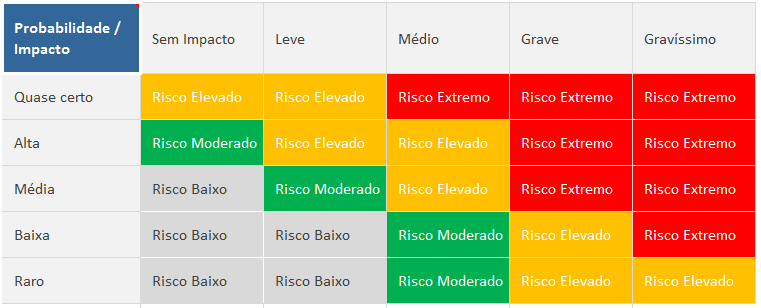
Source: Blog do Luzopens in a new tab (in Portuguese)
What are the types of risk matrix?
There are several types of risk matrices, each designed to meet different needs in risk assessment and management in organizations.
Choosing a specific matrix depends on the nature of the risks involved, the company’s industry and the specific goals of the risk assessment.
Below are some of the most common types of risk matrices:
1. Qualitative risk matrix
This is the most basic type of risk matrix. It uses descriptive categories to assess the likelihood of a risk occurring and its impact. Risks are usually classified as “Low,” “Medium” or “High,” which allows a simple analysis that is easy to understand.
This approach is useful for organizations that are starting their risk management processes or when quantitative data is limited.
2. Quantitative risk matrix
Unlike the qualitative approach, the quantitative risk matrix uses numerical data to assess both the probability and the impact of risks.
This can include financial estimates of the potential impact or the expected frequency of a risk occurring.
This approach allows a more precise analysis and is particularly useful in project management or financial scenarios, where the costs of risks need to be estimated more accurately.
3. Probability and impact (P-I) risk matrix
This is one of the most widely used formats, combining both qualitative and quantitative elements. Risks are plotted on a two-dimensional chart, with probability on the vertical axis and impact on the horizontal axis.
Each risk is then placed on the matrix based on its estimated probability of occurring and its potential impact, which makes it easier to prioritize risks.
4. Inherent and residual risk matrix
This type of matrix takes into account not only the risk in its original form (inherent risk) but also after control or mitigation measures are applied (residual risk).
This helps organizations assess the effectiveness of their risk management strategies and identify where additional measures are needed.
5. Scenario analysis risk matrix
Used to assess risks in specific scenarios, this matrix helps you understand how different events or future conditions could affect the organization.
It is particularly useful in strategic planning and in evaluating new business opportunities or significant changes in the operating environment.
When to use a risk matrix?
The risk matrix is an essential risk management tool, widely used by companies of all sizes and industries to identify, assess and prioritize risks based on their probability of occurring and their potential impact on the company’s objectives.
Its use is crucial at several stages and processes within organizations, especially at key moments when strategic and operational decisions must consider the range of risks involved.
Here are some scenarios where you can use the risk matrix within organizations:
1. Strategic planning
During strategic planningopens in a new tab, the risk matrix helps identify and assess the risks that can affect the company’s long-term objectives. This lets leadership develop more robust strategies, prepared to handle possible adversity.
2. Launching new products or services
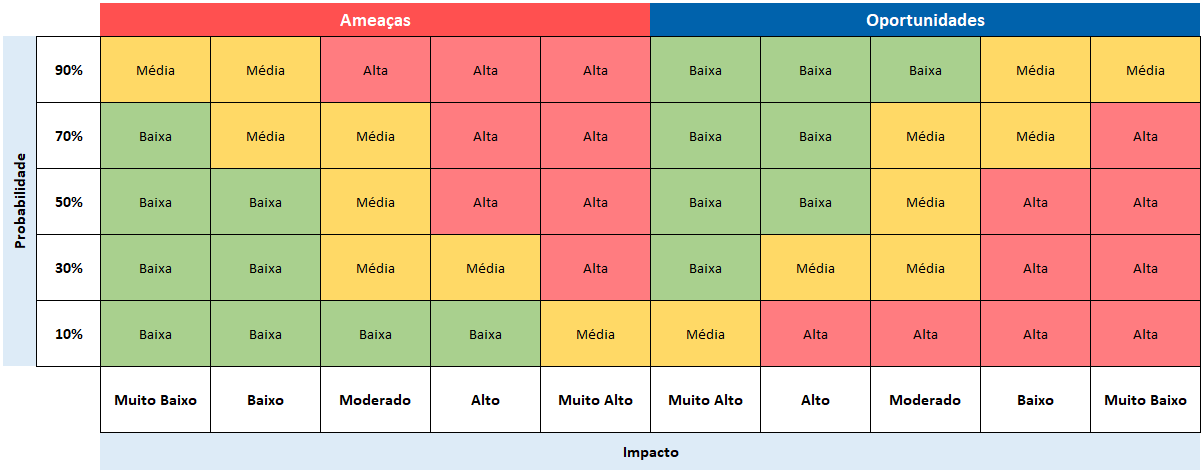
Before introducing new products or services to the market, it is essential to assess the associated risks, such as market acceptance, production failures or regulatory issues. The risk matrix, also called the Opportunity Matrix, helps map these risks and prepare adequate mitigation plans.
3. Expanding into new markets
When considering expansion into new geographic or demographic markets, companies should use the risk matrix to analyze the political, cultural, economic and compliance risks involved, ensuring a safer and more informed expansion.
Read also:
- TAM, SAM and SOM: what they are and how they workopens in a new tab
- 5 tools for risk analysis and management
4. Project management
In project management, the risk matrix is used to anticipate and manage risks that can affect the schedule, budget or quality of projects. This allows corrective actions to be put in place before risks materialize, which improves the chances of project success.
5. Organizational change
In periods of significant change, such as restructurings, mergers or acquisitions, the risk matrix helps assess risks to organizational culture, business continuity and the integration of systems and teams.
6. Supply chain management
To manage supply chain risks, such as supply disruptions or quality failures, the risk matrix can identify potential vulnerabilities and make it easier to develop contingency strategies.
How to build a risk matrix?
Once you understand what a risk matrix is, it is clear that you need to use probability and impact to define severity. So let’s get hands-on and build your matrix.
To start building it in practice, you need to follow two steps.
Step 1: Describe the probability and severity levels
To start, you need to understand what determines whether a given risk is high, medium or low, in both probability and severity.
Having this definition will make your future risk analyses much easier.
- Probability
- High
- More than 50% chance of happening;
- Occurs frequently in similar circumstances;
- Occurs several times during a project;
- Medium
- 10% to 50% chance of occurring;
- The event is known to occur, but not frequently;
- Low
- Less than 10% chance of occurring;
- Unlikely event, has not occurred in your company, but could happen;
- Was not mapped, but can happen;
- High
- Severity
- High
- Repair or replacement costs consume a large share of monthly profits;
- High chance of causing a serious or disabling injury to an employee;
- Causes a major stoppage in the company’s operations;
- Medium
- Repair or replacement costs consume a good share of monthly profits;
- Injury that requires medical help, with or without lost work time;
- Loss of a business function for a short period;
- Low
- Low repair cost;
- No injury, or a minor injury that requires first aid;
- Small pause in the company’s processes.
- High
There are more complex risk matrices. They include more gradations of severity and probability.
Step 2: Define a score
Once you understand what a risk matrix is and have described each level, the next step in building your matrix is to assign a probability and severity score to each of the actions you want to carry out in the company. This way you will find out what each risk can mean for the company and later build an action planopens in a new tab.
Once these criteria are set, defining the incidents, events or specific conditions that pose a risk to the business will be much easier.
But note: the risk matrix is relatively easy to build and understand. However, you need to be careful when assigning values. As with all planning efforts and risk management, managers are advised to know how to point out the areas of greatest risk.
Using the tool to manage the company will not only reduce the probability of the risk, but also the magnitude of its impact on operations.
It can also provide timely data that quantifies threats and makes it much easier for the organization to take action before problems appear.
Do you know the GUT Matrixopens in a new tab? It is similar to the risk matrix, but it has a different function: prioritizing actions. Watch this video from our YouTube channelopens in a new tab (in Portuguese) and see how to build and use one:
Why should every manager use the risk matrix?
Unfortunately, many companies still insist on operating without a formal risk assessment policy. It is common to find that no team directly assesses the impact of risks on the organization, and this directly affects the ability to define a quick action plan.
We are so used to taking unnecessary risks, in both personal and professional life, that the tendency is to ignore the smallest risks and only react when they occur.
That is why effective risk management makes a huge difference for companies that care about prevention.
Some of the advantages of using it are:
- It brings a general perception to risk assessment, helping all areas of an organization;
- For actions that do not yet have complete data and numbers, you can prepare for all of them in advance;
- The organization can adjust the risk criteria to match the circumstances of each business;
- It can take into account as many of the variables that exist in a company as possible.
Risk matrix example
Imagine a construction company that is about to start a large project to build a residential complex. The company recognizes that several risks are associated with this type of project, so it will work with the risk matrix.
Developing the risk matrix:
- Risk identification: the company begins by identifying the project’s potential risks. Some of these risks may include:
- Delays due to adverse weather;
- Exceeding the budget because of rising material costs;
- Safety risks at the construction site;
- Legal problems related to building regulations;
- Failures in construction quality.
- Risk assessment: next, the company assesses each risk in terms of probability and impact. For example:
- Weather delays may have high probability but medium impact;
- Exceeding the budget may have medium probability but high impact;
- Safety risks have low probability, thanks to strict safety measures, but high impact.
- Risk prioritization: based on the assessment, the company prioritizes the risks. Risks with high probability and high impact, such as exceeding the budget, go to the top of the list.
- Developing mitigation strategies: for each prioritized risk, the company develops mitigation strategies. For example:
- For weather delays, the builder can include additional time in the project schedule.
- To control the budget, the company can negotiate fixed-price contracts with suppliers.
- For safety risks, the company can also implement additional safety training and frequent inspections at the construction site.
- Monitoring and review: the builder sets up an ongoing process to monitor risks and review mitigation strategies. This includes regular project review meetings and updates to the risk matrix.
Which NR (Regulatory Standard) covers the risk matrix?
In Brazil, the Regulatory Standards (NRs) are a set of requirements and procedures related to occupational health and safety. Among the many NRs, none is dedicated exclusively to the “risk matrix” as an isolated topic.
However, the concept of risk assessment and management runs through several NRs, given its fundamental importance for safety in the workplace.
NR-9, the Environmental Risk Prevention Programopens in a new tab (PPRA) (in Portuguese), is one of the standards closest to the concept of a risk matrix, because it requires the identification, assessment and control of environmental risks that exist or may come to exist in the workplace, with the aim of preserving workers’ health and integrity.
Although it does not mention the “risk matrix” by name, NR-9 addresses the need for a systematic risk management process, which includes identifying risks, assessing their severity and implementing control measures.
In addition, NR-1, General Provisions and Occupational Risk Managementopens in a new tab (in Portuguese), updated to include Occupational Risk Management (GRO), reinforces the importance of risk management in the workplace. The GRO requires organizations to implement a continuous, systematic process to identify, assess, prevent, reduce or eliminate occupational risks.
Next steps
Risk matrices can be, and usually are, fundamental for organizations as a whole. After all, defining the level of risks helps both managers and analysts understand the severity of their actions and how those actions can affect the company.
I hope this helped you understand what a risk matrix is. Our goal here is to help your company cultivate effective risk management, so that management is organized and planned.
Want to know another matrix that can help you manage your business safely? Click the link below and download our free spreadsheet:

Frequently asked questions
What is a risk matrix and how does it work?
A risk matrix is a management tool used to visualize and classify risks based on two main criteria: the probability of occurrence and the impact they would cause. It aims to make reading and decision making easier.
How do you implement a risk matrix?
1. Identify the risks involved in processes or projects. 2. Assess the probability of each risk occurring. 3. Classify the impact (severity) each risk can cause. 4. Build the matrix, crossing probability x impact. 5. Prioritize actions based on the most critical risks. 6. Monitor and review the matrix periodically.
Who should use a risk matrix?
A risk matrix can be used by project managers, compliance professionals, planning teams, occupational safety, IT, healthcare, engineering and others. Any sector that needs to deal with uncertainty can benefit from the tool.
In which areas can a risk matrix be applied?
Project management, occupational safety, strategic planning, quality management and information security.

About the author
Equipe Siteware
Content produced and reviewed by the Siteware team, curated by internal experts in strategic management and corporate performance.