
Strategy and Goals
What is strategic management and why it matters
Learn what strategic management is, how the process works in business and the benefits it brings, plus 5 tools to apply it in your company.

Survival. That is the biggest goal of strategic management in companies today. The market is more competitive and dynamic every day. Every day we run into new barriers and new competitors.
That is why we need to know how to handle adversity, change and new trendsopens in a new tab (in Portuguese). In other words, be prepared!
But what exactly is strategic management in business? What is its concept? Do you know how to apply it properly to your company? Find out right now!
What is strategic management and its concepts
Before we get to the concept of strategic management in companies, and to fully understand what business strategic management is, we need to go back to where the term “strategy” comes from.
The word comes from the Greek strategos, which can be translated as “the art of the general.” That’s right: strategy comes from the military field, from the general’s art of overcoming opponents during war.
It was only after World War II that the term “strategy” was brought into the business world, becoming part of the set of skills of managers, whose goal is to lead their team (army) to success, beating the competition.
So the business strategy of an organization is comparable to a military strategy.
From this historical milestone, many scholars began to define the term “strategic management” in the corporate setting. Each had a different worldview, but the definitions always share quite similar elements.
See what some authors say about what strategic management is:
The authors’ views
According to Igor Ansoff’s book Estratégia Empresarial (Corporate Strategy), strategic management in companies is the decision-making process that guides the organization’s actions over time. It considers the organization’s relationship with the environment it operates in. To be effective, it must be planned, implemented and measured. Its goal is to steer the organization’s behavior toward its objectives.
For Ahlstrand and Mintzberg in Strategy Safari: A Guided Tour Through the Wilds of Strategic Management, the strategic management process is tied not only to rational analysis, but also to creativity and social change.
For the author, it is about managing the changes the company is subject to so as to preserve its culture while pursuing competitive advantage.
For Porter, in Competitive Strategy: Techniques for Analyzing Industries and Competitors, strategic management is the pursuit of a favorable position in the market. That is, competitiveness!
Finally, for Drucker, as presented in the book Introdução à Administração (Introduction to Management), strategic management in companies is turning your business idea into real value for all of the organization’s stakeholders through an action plan with objectives and goals that lead the company to profitability, competitiveness and survival in the market.
We could keep listing concepts of strategic management in companies.
After all, it has been one of the most debated topics in the corporate world in recent decades. However, we believe that from these definitions you have already formed your own idea of strategic management.
So let’s move on to the several faces of this process, which is vital to the success of your business. See some of the main elements of strategic management and how to apply them in your company.
Business strategic management
Business strategic management covers the administration of the entire company. It treats the company as a complex set of areas and activities whose role is to lead the business to achieve its well-defined strategic objectives.
In an increasingly dynamic and competitive environment, the ability to manage business resources well in order to maximize results is extremely important, since, as access to new technologies and management models grows, standing out from competitors gets harder.
Another factor that makes business strategic management indispensable is the constant change in the market and in economic cycles. Crises come up all the time, and periods of economic recovery are also becoming more frequent.
So companies need flexibility and intelligence to make the most of each moment, with its pros and cons, and keep operations going without losing competitiveness.
To manage a company well, the leader must be able to use available resources strategically, assess the risksopens in a new tab (in Portuguese) inherent to the business and reduce uncertainty with integrated systems thinkingopens in a new tab.
One way to reach excellence in business management is to adopt a management model that guides the company’s actions, such as the BSC, the Balanced Scorecardopens in a new tab, created by Kaplan and Norton in The Strategy-Focused Organization.
In this approach, the company is run along four fronts:
- Financial perspective: focus on improving the profitability and returns of the business, with well-grounded financial management;
- Customer perspective: focus on customer satisfaction and the new business it generates;
- Internal business perspective: focus on process performance and the capacity to innovate;
- Learning and growth perspective: focus on continuously improving the company’s infrastructure, including tangible and intangible assets such as team qualification.
By managing these four perspectives in an integrated way, understanding the impact of each on the whole, you can build long-term business strategic management. Results must be monitored constantly to ensure maximum performance in the market.
This is how a company’s strategic vision is created, and it should guide every decisionopens in a new tab (in Portuguese).
People management and human resources
The changes in the world of work brought many changes to how people management and human resources are understood.
We moved from a mechanistic view, in which workers were seen as mere resources to be optimized and replaced when necessary, to a completely different reading: people as the real competitive differentiator of organizations.
This new reality is the result of many studies and of pressure for better quality of life and recognition of workers. But it also comes from a new stance by companies toward managing their intellectual capital.
Some authors define strategic people management as a full understanding of the human being in the workplace, involving disciplines that range from strategic business management to psychology and sociology. Boxall, in The Strategic HRM Debate and the Resource-Based View of the Firm, sees this new landscape as the company’s ability to generate cooperation, coordination and innovation, always seeking to outperform competitors in these three areas.
From an organizational point of view, managing people strategically is essential to reach goals and to keep internal motivation upopens in a new tab. It also strengthens organizational culture and helps retain talent.
For that reason, strategic people management should not be seen as an activity that belongs only to the people management and human resources department. It is a task for the whole organization, especially its leaders.
Done well, it brings the benefits of business strategic management closer to employees.
The leader’s role in corporate strategic management
It is through effective leadership that the professionals involved with the organization are inspired and motivated, acting cooperatively.
As Hanashiro puts it in an excerpt from Gestão do Fator Humano: Uma Visão Baseada em Stakeholders (Human Factor Management: A Stakeholder-Based View), the people management strategy is based on retaining employees and reaching maximum efficiency in the company through a win-win relationship.
Also read: Learn the 5 main trends in people managementopens in a new tab
If you want to go deeper into strategic people management in business, watch this video (in Portuguese):
See more: Strategic people management in organizations: learn how to implement it correctly
Cost and sales management
For a long time, cost management was focused only on cutting production costs, in order to keep prices low and gain competitiveness in the market.
However, as technology advances by leaps and bounds, competing only on price, or focusing only on this aspect of the business to stay in market leadership, has become insufficient.
Martins, in Contabilidade de Custos (Cost Accounting), points out that strategic cost management affects the company’s entire production chain. Therefore, it affects business strategic management as a whole.
This progress is due to the fact that managing costs can make production processes more efficient and thereby raise the profitability of the business. When we talk about costs, we mean all the amounts added to the product or service in question.
Correct cost management also shapes the sales price, helping the company understand the real value added by its solutions.
As a result, the sales cycle is faster and more efficient, since products and services that are more competitive financially are great arguments for converting customers.
Note also that strategic cost management cannot focus only on the production process, that is, on the solutions offered to the end consumer. It must contribute to internal improvement, through process optimization and waste reduction.
Because it is a subject that involves the whole company, strategic cost management should be known by everyone, not only by senior management. In this sense, it is essential to make your team aware and turn it into an ally in innovation and organizational change.
Information management
The technological changes that began with the Microelectronics Revolution, in the mid-1960s, and the constant advance of information and communication technologies since then, have contributed a lot to strategic management in companies.
Just compare decision-making as it was twenty years ago and as it is today: before, managers’ gut feeling spoke louder, as did market experience.
Today, the rules are set by knowledge, or by the company’s ability to collect, store, process and interpret the huge amount of data generated every day.
Being able to analyze both the internal business environment and the external one, tied to the market and the economy, is no longer an option for any company. It is an obligation, since you have to anticipate events and trends to stay competitive.
As Oliveira puts it in Sistemas de Informação Gerenciais: Estratégias, Táticas, Operacionais (Management Information Systems: Strategic, Tactical, Operational), qualified information supports the decision-making process, leading the company to reach its strategic objectives with greater effectiveness and precision. It also helps manage the variables that affect business activity so as to reduce uncertainty and boost expected results.
Information management is also responsible for generating value for the organization’s stakeholders, strengthening the sense of innovation and continuous improvementopens in a new tab (in Portuguese) through data that reveal the real needs of the market and how to meet them skillfully.
Information management can be made up of four major processes:
- Identifying information needs and requirements;
- Classifying and storing information;
- Processing and presenting the knowledge acquired;
- Applying knowledge to develop new solutions.
From this idea, we can conclude that information management is vital to business continuity, because it is through this process that the company gains business intelligence, learning to improve constantly.
As expected, for a company to have a business intelligence system, it needs the right technology, one capable of managing information quickly and securely.
Among the possible solutions is Big Data, that is, a set of technology solutions that make it possible to collect, store, process and interpret the data gathered according to the context the company operates in.
Read more: How to implement knowledge management in your company and stand out in the market in 6 steps
Besides information management, strategic organizational knowledge management is also very important, so watch this video (in Portuguese):
Marketing management
Marketing, or market communication, aims to build a relationship of trust among the company, customers and consumers. Seen this way, marketing is an essential activity for any organization and for business strategic management.
In general, we tend to think of marketing as a sales strategy, a way to make a certain audience notice your products and services in the market. However, it is much more than that.
Marketing is only strategic if it is aligned with the goals and targets of the business. It must help the company reach the expected results through segmented and personalized actions.
So it is responsible for building the brand in the market and creating positive perceptions of the company. It also strengthens ties with priority audiences and creates touchpoints that make dialogue with a qualified audience easier.
Marketing reduces sales effort, maximizing financial results by attracting and retaining customers. In this way, it optimizes the whole business strategic management process.
Every marketing objective must be connected to a larger, strategic objective that is vital to the company’s continuity. It must also be specific and measurable, since it is by tracking performance indicators that you arrive at more effective and profitable strategies for the organization.
The marketing plan, that is, the set of actions to be carried out, follows from a prior strategic mindset. It analyzes the company’s market context and then suggests actions that can improve its positioning.
Bringing together what we know about strategic marketing, we arrive at seven key items for building an effective marketing plan:
- Identifying the opportunity;
- Market analysis;
- Defining the product and/or service mix;
- Pricing and perceived value;
- Distribution channels;
- Communication mix to promote the company’s products and services;
- Monitoring and control of actions.
A company without good marketing planning is bound to disappear among so many competitors.
It also loses market position and sales opportunities. So never set your company’s marketing aside. It is what makes sure customers and consumers reach you.
That is why marketing cannot be missing from an organization’s business strategy.
Tools for strategic management in companies
If on one hand being an entrepreneur was easier 30 years ago, because competition was much lower, on the other, the management tools available left a lot to be desired.
Today we have a range of resources that help us make better decisions in any area of strategic management in companies, whether people management, marketing or finance.
To avoid filling your head with dozens of possible resources, we picked the tools that can be applied to any business area, making analysis and decision-making easier. See them below:
SWOT analysis
SWOT analysisopens in a new tab is a graphic model that helps assess the internal and external business environment. Basically, you compare your strengths and weaknesses, threats and opportunities.
The idea is to understand where your business stands out and where it “loses” to the competition. Only then do you look for alternatives to differentiate and increase competitiveness.

BCG matrix
The BCG matrix is a tool that lets you identify the most profitable products or services in your business. The idea is to bring an analytical look to your solution mix.
Download the automated, 100% free BCG matrix template that Siteware prepared for you:

It also helps keep a balance between market share and market growth potential of the products and services offered.
The layout of the BCG matrix is the same as the SWOT matrix. However, the x axis is market share and the y axis is market growth potential.
See BCG matrix examples in this post: 5 BCG matrix examples + step-by-step guide
Once the chart is built, you place your products and/or services in the four resulting quadrants. That gives you four decision options, according to the classification of each solution, to define business strategic management:
- Increase market share;
- Maintain market share;
- Get maximum return, taking advantage of time to market, and then end the operation;
- Discontinue the product or service because it is not profitable enough.
5W2H
Decision-making can become much easier if you simplify the problem, that is, ask the right questions. That is what 5W2Hopens in a new tab is for, a strategic management tool that can be very useful in many situations.
The acronym stands for 7 essential questions you should ask yourself to build a project or action plan:
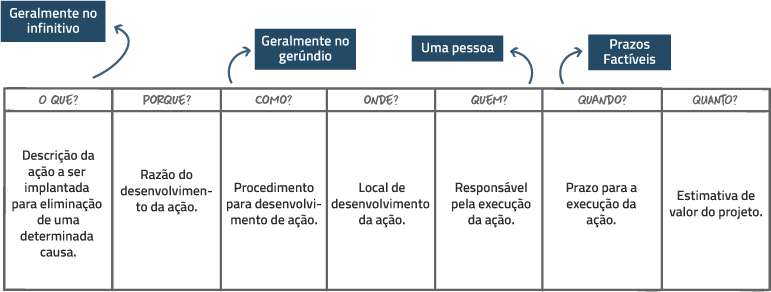
Always try to answer these questions objectively, leaving no room for double interpretation. That way, not only you but the whole team will know exactly what needs to be done and, as a result, get better results.
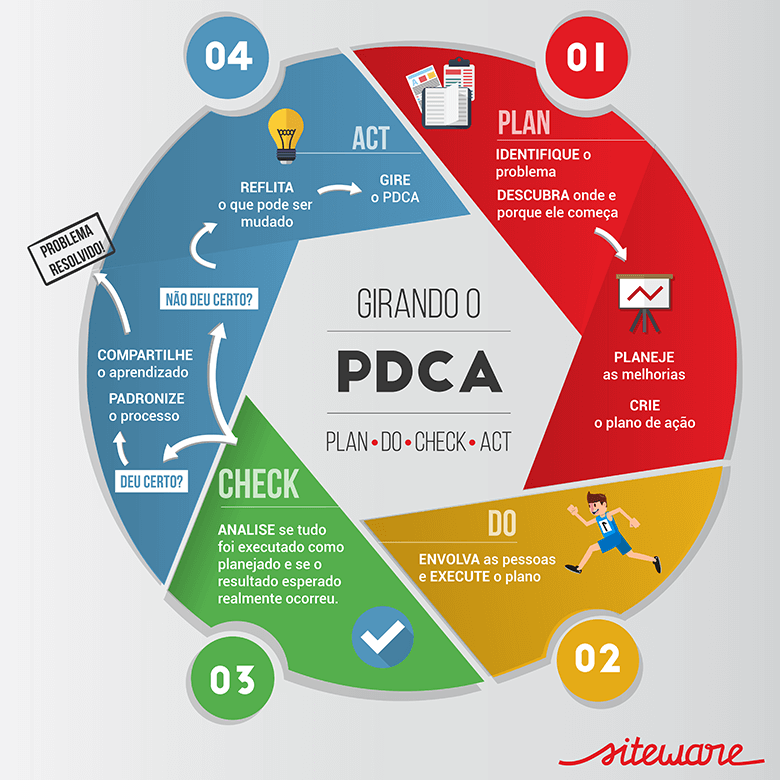
PDCA
PDCA is a great cycle for applying 5W2H. It works as a continuous improvement cycle inside the company, as you can see below:
See also: Learn 3 of the main business management tools to plan and monitor your businessopens in a new tab
If you are interested in learning more about strategic management tools in organizations, check out this video (in Portuguese):
Results analysis
With so much data and information to manage, you need tools that allow in-depth analysis without wasting time.
Tracking performance indicators, comparative reports to analyze the competition and your own history, goal monitoring and decision-making are some of the resources you need for efficient and precise management.
If you are wondering whether you will have to do all of this by hand, relax! There are systems that already offer this kind of solution for your company, online and fully automated, such as Stratwsopens in a new tab.
With it, you have no rework and don’t waste time drawing charts. Your only concern will be entering the data and analyzing the results and insights.
Why strategic management matters in companies
We have talked a lot about what strategic management in companies involves, but we haven’t covered an essential piece of knowledge to get you thinking more about the subject: the importance of strategic vision for the success of your business.
Obviously, you want your business to grow and thrive, which demands a long-term view. That is, setting goals and objectives to be reached over time. But if you don’t plan how to get there, it will be much harder to reach the results you expect.
That is where strategic management comes in, because it directs the company’s actions toward success. It helps promote the necessary changes and overcome obstacles. It also reduces risks and gives a full understanding of the business’s mission and vision.
It is through strategic management that you make the people who work in the company aware of their responsibilities.
It reflects in higher productivity and, consequently, in the competitiveness of the business. It also helps with the proper use of resources, waste reduction and maximizing the return of every action the business takes.
So strategic management is what you should rely on to promote continuous improvement of your business, in addition to ensuring the company’s survival over time.
Technology as an ally in strategic management
Strategic management is important for all companies. And technology can be a great ally of this type of management today.
With strategic management software, such as Stratwsopens in a new tab, you can track indicators, run management methodologies, build your strategic plan and much more. All in one place, which can be accessed from anywhere in the world at any time.
Stratwsopens in a new tab is corporate performance management software that can help analyze performance indicators for the business, projects, people, every sector and product, so you can assess accurately and make the best decisions.
Also, see a few more advantages of this software, which is already used by more than 180 thousand employees at a thousand companies:
- Create and track KPIs for processes, projects and people;
- Work on process management;
- Share information quickly and transparently;
- Use meritocracy and visual management to motivate and manage teams;
- Apply the main strategic planning methodologies such as BSC, OKR and SWOTopens in a new tab;
- Integrate people, operations and strategy;
- Find improvement opportunities;
- Handle meeting management and project management;
- Manage risks and analyze scenarios;
- Make information exchange and communication between departments easier;
- Focus on the pursuit of the results your company wants to achieve**.**

About the author
Equipe Siteware
Content produced and reviewed by the Siteware team, curated by internal experts in strategic management and corporate performance.