
People Management
The 9 types of performance reviews to use with your team
Learn the 9 types of performance reviews, how to apply each model in your company and develop your employees more effectively.

To build an effective Individual Development Plan (IDP) for a company’s employees, leaders, HR and other managers need to know the different types of performance reviews. They help identify the hard and soft skills to recognize and improve during the review cycle.
There are different ways to evaluate employee performance, and it is important to understand the purpose of each one in order to help people develop.
Interested? Keep reading to see what a performance review is, what the types are and how to apply one in your company!
With that in mind, Siteware also prepared a complete practical kit with an e-book and different types of templates. Click here and download it now:

Also read:
- The 10 features a talent management system needs to have
- HR software: learn the types and how to choose the best one
What is a performance review?
A performance review is a model for measuring and assessing employee performance over a specific period. In other words, it is a process for the company to evaluate how an employee is doing in their job, considering productivity-related criteria such as the quality of the tasks performed, goal attainment and collaboration with coworkers.
The whole performance review process is guided by HR, but the review itself is carried out by the employee and by leadership.
The main goal is to identify strengths and areas for improvement, providing a development planopens in a new tab (in Portuguese) that can help the employee grow professionally and the company reach its goals more effectively.
This way, the employee understands how they will be evaluated, and the process becomes far more transparent.
It is important to note that a performance review is part of a cycle, the so-called competency cycle. The employee is evaluated, an individual development plan is built to strengthen what is needed, and later the employee is evaluated again. Normally, the performance review cycle happens at least twice a year.
Can you use Artificial Intelligence in performance reviews?
As technology advances, there are already solutions that use AI to build a more robust and strategic performance review.
Stratwsopens in a new tab, for example, is one of them. In it, AI can identify the main points of attention in the reviews, flagging positive comments, neutral comments and points of attention.
In addition, based on the AI analysis, you can ask for support in developing the Individual Development Plan (IDP), taking the previous analysis into account. This way, the leader not only has an extra layer of intelligence in the analysis, but also gets help with the action plan for developing their team members.
What are the types of performance reviews?
There are different types of performance reviews in use. Each HR professional or team manager should identify which one best fits the company’s reality and culture.
A widely used model in organizations is the 360-degree review, for example. However, there are other options that, combined, give employees and leaders a new view of development points.
Below, we list the main types of performance reviews a company can use to improve People Management. Take a look (video in Portuguese)!
1. Self-assessment
Self-assessment, also known as the individual performance review, is widely used.
It is carried out in two stages. First, the employee answers a questionnaire to reflect on their own performance and identify their strengths and weaknesses. Then, together with their manager, they discuss what can be done to improve performance, based on the employee’s perception.
With self-assessment, the professional does an in-depth analysis of their behavior and the results they have achieved. This type of review helps employees know themselves better, and that helps them understand what they can do to grow as professionals.
At the same time, the manager learns how they can and should support the team, especially by seeing the employees’ own view and understanding how each person interprets their own weaknesses.
2. Team performance review
If self-assessment is about understanding oneself, team assessment is about the manager’s view of the employees. Although it is one of the most widely used types of performance review (even together with self-assessment), this model tends to cause some friction, especially in more complex environments.
That is because, when applied on its own, the employee usually has little voice and ends up “just being judged.” For that reason it is used together with self-assessment, forming the 180° review that I will cover later.
However, even though it can cause some friction, evaluating performance as a group makes it possible to make adjustments to:
- align members of the same team;
- improve the workflow;
- improve relationships and communication among employees;
- increase the chances of reaching goals.
This model is quite interesting because trust between peers and team members can grow, especially if the leader has an excellent understanding of their team.
3. 9 Box Matrix
Among the types of performance review presented so far, the 9 Box Matrixopens in a new tab is a visual tool that serves as a basis for building a merit-based model in companies.
The 9 Box Matrix is normally used after a 180° review, for example, and the employee is placed in one of the nine quadrants, helping the leader identify each person’s performance.
This way, with this tool, the manager tends to run reviews better and make important decisions about employees, such as promotions, training and even terminations.
That is because it helps develop team members’ capabilities, considering competence, behaviors, results and abilities. Because it is simple and practical, its results are relevant for any type of company, boosting its performance.
See below a model of how to build the 9 Box Matrix:
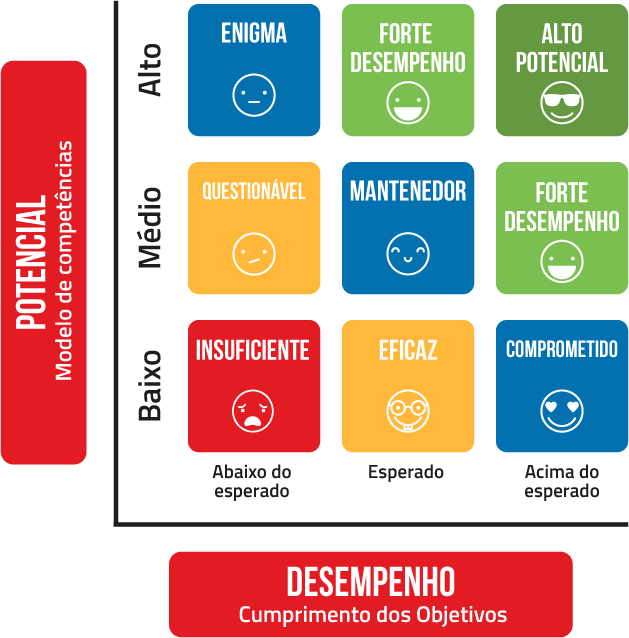
Through the 9 Box review (also called the Nine Box), the manager, and also the person being evaluated, get a visual representation of their current performance in the role they hold.
This model is quite interesting because it lets the leader see graphically the possibility of promotions and create action plansopens in a new tab to improve the performance of their team members.
Download our 9 Box Matrix template by clicking hereopens in a new tab (in Portuguese) and make the process easier with a customized model**!**
4. Graphic rating scale
Of all the types of performance review, this is perhaps the simplest and most traditional.
In the graphic rating scale method, you create a form in columns, organized as follows:
- in the first column, you list the variables to be evaluated according to what the company wants to assess, including: punctuality, attendance, teamwork, creativity and so on.
- in the following columns, you enter the values for each variable, such as: poor, fair, average, good or excellent and, if you prefer, scores from 0 to 5.
The main advantage of the graphic rating scale is that it is very easy to do. However, it is limited and does not allow for a more in-depth appraisal.
Some companies even leave a blank space for the employee to write and comment on each of the variables, which helps the leader understand each person’s criteria.
For that reason, it is usually used together with other methods, such as 360 degrees.
5. 360 degrees
The 360-degree review is considered one of the most complete, since everyone involved in the work routine is invited to take part in the process.
Leaders, team members, the employee themselves and even customers and suppliers take part in the review. At the end of the process, the evaluators’ assessments are compared with the employee’s own, generating very valuable feedback.
The logic is, as the name says, to get a 360° view of the employee’s performance. After all, a biased view often happens, both from the person being evaluated and from other people.
In this case, with multiple views, you can build an average, or even an evaluation guide, understanding that different people will have different views of what can and should be improved.
6. Forced choice
Forced choice is another interesting item on our list of types of performance review. To put it into practice, develop a form with several strategic statements that can define the employee’s behavior. For example:
- often delivers late;
- does not get along with coworkers;
- keeps their schedule well;
- is a proactive professional.
Then, next to each statement, the evaluator must mark a “+” (for those that are close to the employee’s profile) or a “-” (for those far from the employee’s profile).
To avoid misinterpretation and obtain reliable data, the statements must be written clearly and objectively.
This model is quite effective when there are specific points the manager wants to measure within the team, thus limiting the answers given. Therefore, this review is quite effective for more specific goals, but ideally it should be paired with another one.
This will give a broad and specific view of what is being evaluated.
7. Competency-based performance review
The competency-based review goes beyond performance. It considers three basic factors: KSA.
- K, Knowledge: cognitive aptitudes, “knowing something.”
- S, Skills: psychomotor mastery, “knowing how to do.”
- A, Attitude: motivating factor, “wanting to do.”
In this evaluation method, the questionnaire must consider the employee’s technical and behavioral competencies.
At first, the person being evaluated answers the questions as a kind of self-assessment, pointing out which competencies they already have, which are in development and which need to be developed.
Afterward, the leader gives their point of view on the employee’s answers and, together, they draw up an action plan to improve whatever is needed.
8. Goals and results
This performance review method takes a quantitative approach. Here, the results the employee achieved in a given period are considered.
The purpose is to identify whether the person being evaluated met the company’s expectations. And because it is based on numbers, this review is safer and more accurate.
Examples of factors to be evaluated:
- absenteeism;
- sales conversion;
- customer satisfaction;
- retention.
The goals and results review can also be applied to the team as a whole, in order to find out who the most and least productive employees are.
9. Leader performance review
The last item on the list of types of performance review is often forgotten by some companies. Just like employees, leaders also need to be evaluated.
After all, they are responsible for leading the team to success. When their performance is poor, it tends to be reflected in their team members.
That is why they also need to go through a review process and receive feedback on their performance. In this case, the review comes from employees and superiors, giving an overall view of their performance.
This way, the leader can better understand whether they and their team are on the right track and which aspects can be improved.
So, which types of performance review are the most suitable for your business model?
You can apply internal review questionnaires through automated survey platforms, with much more speed and the ability to analyze results in real time.
In fact, you can also do the opposite: ask your employees to evaluate the company, using a questionnaire created specifically for that, such as eNPS.
Which performance review model should you choose?
It is a fact that running performance reviews and performance management matters for any company, regardless of size and number of employees. But which model should you choose among so many options on the market?
In the previous sections, we listed the 9 most popular types of performance review. There are several others, and there is no formula that determines the worst or the best. HR professionals need to know the company cultureopens in a new tab and know which option will bring the most benefits to the analysis.
However, you do not need to stick to just one of the methods. As mentioned earlier, within a single review cycle, you can apply different models, which will enrich the data and make the analysis easier.
The logic is to understand that each type of performance review provides views with strengths and weaknesses. Therefore, the best approach is to find a set of reviews that gives the manager a complete picture.
If the Human Resources department is still young and has less knowledge of the culture, the 360-degree performance review may be the best option. Although it is a slower and more complex method to run, it allows every employee to be evaluated by people at different hierarchical levels, enabling a universal analysis of their performance.
For a more specific angle, on the other hand, the competency-based performance review approach may be more interesting. In it, the employee and their leader can identify the strengths and improvement points in their performance and, from there, define a development plan.
What comes after the performance review?
The performance review itself is only the first step in the employee development journey. That is because, after it is done, there are other important points that Human Resourcesopens in a new tab and leadership should handle together, such as:
1. Calibration Committee
The Performance Review Calibration Committee is a group within an organization responsible for reviewing and adjusting employee performance reviews to make sure they are fair and consistent.
This committee brings together managers, HR and leaders to discuss and align the reviews, identifying discrepancies and ensuring that review standards are applied equitably across the company. The goal is to avoid bias and ensure that rewards, promotions and career development are based on accurate and impartial reviews by different professionals.
2. Performance review feedback session
After the Calibration Committee comes the performance review feedback session. This is the process in which the employee receives feedback from their direct leader, with information and alignment on their performance review. This feedback session gives the person insights into their achievements, strengths, areas for improvement and future goals.
The goal is to promote a professional development conversation, open communication between employee and leader, and the identification of growth opportunities so they can build an Individual Development Plan together.
In a 180° review, for example, the employee has room here to present their point of view on the leader’s evaluation, just as they can explain why a score was a little higher than expected in a self-assessment.
3. IDP follow-up after the performance review
There is no standard timing, but during the competency cycle, it is essential for leader and team member to sit down a few times to follow up on the IDP they built during the feedback session.
This helps ensure that the employee is developing and the manager is nearby in case they need help. This follow-up can happen during one-on-ones, for example.
How to run a performance review?
Now that you know what a performance review is and how each of the different models works, see below a step-by-step guide to implementing a performance review cycle in your company.
1. Define objectives and purpose
Before anything else, clearly define why you are implementing the performance review. The goal can be to improve employee performance, identify potential leaders, align expectations or something else. Clarity on this point will guide the whole process.
Once the objectives are defined, it will be easier to identify exactly what will be evaluated and to avoid vague, loose questions during the process.
2. Select the performance review model
Considering the different types of performance review you have already explored, choose the model best suited to the company’s culture and needs. It can be 360 degrees, competency-based review, self-assessment, among others.
Remember that you can use more than one model, in order to make the review even more robust.
3. Build the schedule
Since it is a cycle, determine when the reviews will take place. They can be annual, semiannual, quarterly or even monthly, depending on the organization’s needs.
It is also important to set the deadline for each stage, such as employee responses, the calibration committee, the feedback session and the building of IDPs, for example.

4. Communicate with the team
Present the schedule to all employees for the performance review process that will be implemented. Communicate the objectives, the benefits, the dates and how everything will work.
5. Train the evaluators
Run training sessions for managers or anyone who will act as an evaluator. They must understand the review criteria well, avoid bias and be prepared to give feedback that is truly constructive.
Techniques such as nonviolent communication, and working with software that can track each employee’s individual indicators, can make this review more complete.
6. Develop the review forms
Create forms or use performance review software to record the reviews. Make sure the questions are clear, objective and relevant to what you want to evaluate, avoiding ambiguity, for example.
7. Carry out the reviews
Start the review cycle according to the established schedule. Ensure a suitable environment where the person being evaluated feels comfortable discussing their performance. As mentioned earlier, there is software that can run and optimize the whole performance review process, sending notifications to make sure everyone is aligned, for example.
If the company does not have a solution, it can use spreadsheets and forms, such as Google’s.
8. Analyze the results
Compile and analyze the data collected. Identify trends and improvement points, and highlight exceptional performance. This is usually done in partnership with HR and the so-called calibration committee.
9. Constructive feedback
Organize feedback sessions. In them, each employee should learn how they did, what their strengths and areas for improvement are, in an analysis with their direct leader. The feedback should be clear, objective and, above all, constructive.
10. Build development plans
Based on the feedback, work together with employees to create individualized development plans. This can include training, mentoring or even changes in the scope of work.
Normally, IDPs should end together with the performance review cycle and will serve as the basis for the next performance review, which will use insights from the previous cycle to guide the next steps.
11. Monitoring and follow-up
The performance review cycle does not end with the feedback. It is essential to track employees’ progress and provide ongoing support.
At this stage, it is essential for leader and team member to meet regularly to follow up on the IDP. This follow-up can happen during a one-on-one, for example.
This way, at the end of the cycle, gather feedback on the review process itself. See what worked and what can be improved, adjusting for the next cycles.

What are the main goals of a performance review?
Among the goals of a performance review, it gives the leader and their team member the chance to discuss their individual behaviors with some frequency, thus focusing on people development and talent retention.
At the same time, it gives the manager a clear, strategic view of each employee’s strengths and weaknesses. This shows what needs to be improved so that the department can perform even better.
In addition, another goal of the performance review is to build a history for each employee that can be used as a basis for defining bonuses and salary adjustments, as well as to support possible terminations and even role changes.
In other words, if the employee knows how they are being evaluated and which improvement points are needed to earn a bonus or promotion, everything is clear, both for performance management and for the team.
This, of course, keeps a person’s professional growth from being a subjective matter within the company.
Not to mention that these performance reviews bring more engagement to the activities being carried out. They also help align employees’ goals with the organizational culture.
As a consequence, the organization itself achieves a lower turnover rate, preventing strain on the team and maintaining maximum credibility with customers.
Advantages of running an effective performance review
Through a well-designed and well-executed performance review cycle, you can identify which employees are best prepared and which need to work on essential points for their professional development.
This enables strategic performance management, aimed at the growth of both the professional and the company.
In addition, the performance review helps verify the effectiveness of hiring methods. If an employee is well evaluated, it means the selection processes are well aligned.
As we have seen, the performance review is one of the most effective tools in talent management for measuring employee performance. It is also a great technique for better structuring the variable compensation process in the organization.
Next steps
To track the results of your reviews on an ongoing basis, Siteware developed Stratws, a business management software with specific solutions, including for managing individual performance.
With it, you get a complete system that automates:
- connected tracking of corporate performance;
- performance monitoring;
- centralization of strategic, tactical and operational indicators;
- among other features.
To see Stratws’ talent management tool in practice, talk to an expert in talent management.


About the author
Equipe Siteware
Content produced and reviewed by the Siteware team, curated by internal experts in strategic management and corporate performance.