
People Management
9 Box Matrix: how the methodology helps retain talent
Learn how the 9 Box methodology helps HR assess employee performance and potential, and how to build an effective matrix step by step.

The 9 Box matrix is a tool designed to support and strengthen companies’ talent management. Have you heard of it?
Well, the name literally means nine boxes and refers to the number of squares it uses to represent the performance and potential of each employee in the company.
It is also a widely used basis for building a model of meritocracy. In other words, one where promotions go to the people who truly deserve them.
Either way, this tool makes individual assessments easier and even supports important decisions, such as future leaders. Interested?
Keep reading to learn what the 9 Box matrix is, how it works and how to apply it in your company!

What is the 9 Box matrix?
The 9 box matrix is a management tool widely used to assess and develop talent within organizations. It offers a visual method to analyze employees’ performance and potential, making it easier to make talent management decisions such as promotions, development, succession and other HR interventions.
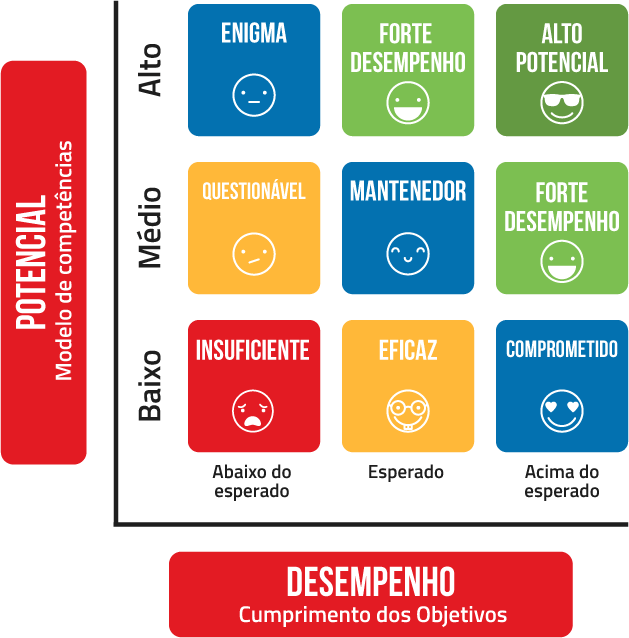
The matrix is divided into nine boxes, arranged in a 3×3 layout, with nine quadrants. Like any matrix, it is split along two dimensions: performance and potential.
Performance assesses how well an employee is meeting their current responsibilities within the organization. It is usually measured by criteria such as quality of work, goal achievement, technical skills, among others.
Potential, in turn, refers to the employee’s ability to grow and take on greater responsibilities in the future. This includes the ability to lead, adaptability, learning capacity and ambition.
That way, the matrix divides the nine quadrants so it is easy to quickly see where employees stand on the potential and performance criteria, according to leaders’ views.
Who created the 9 box matrix?
The 9 box matrix was created by McKinsey & Company in the 1970s. This tool was developed as part of a model to assess and review talent within organizations, and is particularly useful in management and succession planning processes.
The original model was designed to help companies identify leaders and potential leaders at different levels of performance and potential, supporting strategic decisions about talent development, promotion and retention.
What does each quadrant of the Nine box mean?
The matrix is typically divided into three columns (Low, Medium, High) and three rows (Low, Medium, High), resulting in nine quadrants. Each quadrant helps identify where employees fit in terms of their current performance and their growth potential.
Low performance
- Low/Low (Quadrant 1): The “insufficient” quadrant covers employees with low performance and low potential. They may be struggling to fulfill their duties or may not be a good fit for their current or future positions.
- Medium/Low (Quadrant 2): The “effective” quadrant covers employees who are performing moderately well but have low potential to take on greater responsibilities. They may be doing fine in their current roles but are not considered for promotions or leadership roles.
- High/Low (Quadrant 3): The “committed” quadrant has employees who perform highly in their current roles but have low potential for advancement. They are valuable in their current positions but may not be suited to roles that require different skills or more responsibility.
Medium performance
- Low/Medium (Quadrant 4): The “questionable” quadrant has employees performing below expectations but with medium potential to improve and grow. They can benefit significantly from targeted development and training.
- Medium/Medium (Quadrant 5): The “maintainer” quadrant has solid employees who perform well in their roles and have potential to grow even more. They are often considered for additional development.
- High/Medium (Quadrant 6): The “strong performance” quadrant has high-performing employees with moderate potential to take on more responsibilities. They are effective in their current roles and can be prepared for promotions or new challenges.
High performance
- Low/High (Quadrant 7): The “enigma” has employees who are currently underperforming but have high potential. They may be in roles that do not match their skills or may need guidance and support to reach their full potential.
- Medium/High (Quadrant 8): The “strong superior performance” has employees with good performance and high potential. They are well positioned to move quickly within the organization and can be targets for intensive development.
- High/High (Quadrant 9): The “high potential” quadrant has the emerging leaders or stars of the organization. They not only perform their roles exceptionally well but also show great potential to advance further and take on senior leadership positions.
How does the 9 Box matrix work?
The 9 Box matrix is mainly used in succession planning and employee development processes. It helps managers identify which employees are ready for promotions, which need development and which may not be a good fit for the company in the long term.
It also helps make sure talent is recognized and properly nurtured, supporting effective planning for the organization’s future.
The person responsible for the individual analysis places each employee’s name in one of the nine squares, considering their performance in the current role and their potential to improve and be promoted.
With the matrix ready, it becomes easier to identify the people with potential to move up in the grid and in the organization, while also seeing those who are not meeting expectations.
That way, leaders can understand each team member’s progress and create an individual development plan (IDP) to change the situation or, if necessary, plan the departure of some employees.
Read also: What is an assessment and how can your HR apply it?
How does the 9 Box relate to performance reviews?
Performance reviews provide the data needed to place employees on the matrix’s horizontal axis, which represents current performance. These reviews usually include job success metrics, feedback from supervisors, self-assessments and, sometimes, feedback from peers and direct reports. They help determine whether an employee’s performance is low, medium or high.
Learn more: Learn about the 9 types of performance reviewopens in a new tab
While a performance review focuses more on the past and present, the 9 Box matrix also looks to the future by assessing an employee’s potential to grow and take on more responsibilities. This potential assessment is more subjective and can be based on observations, leadership feedback and the employee’s perceived capacity for future development.
So, combining performance reviews with the 9 Box matrix helps managers identify not only how employees are doing now, but also where they could go within the organization. This lets managers plan career development, training, promotions and transfers more strategically.
Why use the 9 Box matrix?
With the 9 Box matrix, you can assess professionals’ performance and potential, considering aspects such as competence, behaviors, results and capabilities.
In addition, using this tool is a way to find your company’s true talent, focusing on new leaders for the organization’s succession planning and on people management.
This function relies on the analysis of performance indicators previously reviewed.
This tool is fundamental because it helps develop and measure each employee’s performance qualitatively, which is usually a laborious process.
Used well, it makes it easier to analyze and grow people in the organization. Its functionality and simplicity of use promote:
- short-term results;
- support for teamwork;
- help with dialogue between leaders;
- development of criteria and expectations;
- room for discussing performance;
- creation of individual development plans;
- identification of individual needs for team development.
Now that you know what it is and why it matters, keep reading and learn how the 9 Box matrix works in practice!
How to build a 9 Box
You can use the tool with performance management software, with specific programs, or build your own matrix in spreadsheets.
Keep in mind, however, that digital solutions deliver a more automated view that is easy to customize.
Still, if this is your first contact with a matrix, it can be practical to build it in a spreadsheet or use a ready-made one. In the video below (in Portuguese), you can see in practice how to create the tool:
Step by step to make your 9 Box matrix
Implementing the 9 Box matrix as a performance review model in the company does not take much effort, but it does take planning. Check out the details below:
Take the chance to download this 9 Box matrix templateopens in a new tab and implement this process in your business without headaches!
Step 1: Define the evaluation criteria
Set clear criteria to assess employees’ performance and potential. Performance can be measured by goals achieved, quality of work, among others. Potential can be assessed by leadershipopens in a new tab skills, learning capacity, etc.
In this scenario, it is ideal to have methods and parameters that are fair and well defined by the organization. That is why it will be essential here to use another performance review, such as 360° or 180°, self-assessments, manager reviews or peer feedback, for example
Step 2: Prepare the assessment tool
Create a matrix in a spreadsheet or HR software. Divide the matrix into nine quadrants, with performance on the horizontal axis and potential on the vertical axis.
You can use the template mentioned earlier to speed up your process.
Step 4: Place employees on the matrix
Based on the assessments, place each employee in one of the matrix’s nine quadrants. For example, an employee with high performance and high potential would be placed in the top right quadrant.
Next, analyze the distribution of employees on the matrix. This will help identify talent, areas that need development and employees who may be facing challenges.
Step 5: Give feedback
The manager needs to show the employee how the leader sees them. Many companies choose not to show the exact position on the 9 Box matrix, but this can vary a lot depending on the goal of the performance review.
The point is that the employee needs feedback to understand whether they are on the right track and to align plans for their individual development plan in the next competency cycle.
Step 6: Plan development actions
Develop specific action plans for each professional. For example, in the 9 Box matrix, high-potential employees can receive leadership training, while those with low performance may need additional training, role reassignment or courses to improve their hard and soft skills.
Step 7: Monitor progress and adjust
Monitor employees’ progress over time and adjust development plans as needed. The 9 Box matrix should be a dynamic tool, adapting to changes in the organization and in employees’ performance.
During the competency cycle, run periodic assessments to update the matrix. This helps keep the tool relevant and aligned with the organization’s goals.
This follow-up can also happen through one on one meetings between leader and team member.
How can the 9 box matrix be complemented by other assessment and development tools?
The 9 box matrix is a powerful tool for talent assessment and management, but its real potential is often unlocked when it is used together with other assessment and development tools. This complementarity offers a more holistic and effective approach to talent management.
Here are some tools to use alongside your 9 box:
- 360-degree performance reviews: these reviews, which collect feedback from peers, direct reports, supervisors and, sometimes, customers, provide a complete view of an individual’s performance. The information gathered can help place an employee more accurately on the matrix.
- Individual Development Plans (IDPs): once an employee is placed in a specific box of the matrix, the IDP can be used to address areas for improvement or development, helping move the person to a more favorable box in the future.
- Succession plans: the 9 box matrix can identify high-potential, high-performing employees who are suited to future leadership roles. These insights can be built into a succession plan, ensuring there is a talent pipeline ready for key positions.
- Training and education programs: identifying where an employee sits on the matrix can help determine which training or education programs best suit their development.
- Continuous feedback and check-ins: instead of waiting for annual reviews, regular check-ins with employees can offer more immediate and up-to-date insights into their performance and potential, allowing more frequent adjustments to the matrix.

How to apply the 9 Box in your company
To implement this tool, it is important that leaders with experience in performance reviews lead the rollout of the matrix.
Those responsible must understand how it is built and applied, and employees need to be well informed so they clearly understand how the assessment works and why the tool is being used.
So, do not forget to communicate well with the whole team. It is also important to have defined criteria to assess each category and to set standards that employees must reach.
That way, you and your team avoid subjective judgments and assessments. Criteria prevent unfairness, increase accuracy and make the team accept the process with less fear or disagreement. What matters is being objective and transparent.
And remember, there is no point using this method without giving feedback! It is a key piece of development.
How often to assess varies from company to company, but it is important to keep a routine to follow employees’ development according to the feedback leaders give.
Next steps
So, did you enjoy learning what the 9 Box matrix is and how to apply it? Know that this and other performance review tools contribute to the strategic handling of succession and to the career plans of the professionals in your company.
If you want to recognize your organization’s talent and ensure successful promotions, count on the help of technology. Talent management software, with visual resources and performance indicator tracking, helps increase your business results and employee development.
Stratwsopens in a new tab, from Siteware, includes the 9 Box Matrix in its features, giving full visibility of performance potential. To see the tool in practice, talk to an expert in performance management.


About the author
Equipe Siteware
Content produced and reviewed by the Siteware team, curated by internal experts in strategic management and corporate performance.