
Management Methodologies
Brainstorming: how to do it, types, tips and examples
Learn what brainstorming is, the 6 types, the step-by-step process, 9 tips to run a session and practical examples to generate ideas in your company.

Two heads are better than one. That is the logic of brainstorming, a technique in which a group meets to find solutions to a problem through a storm of ideas.
To work, the session needs a goal, rules and a facilitator. When well run, it brings together different perspectives and produces solutions that one person alone would hardly reach.
In this article, you will see what brainstorming is, what it is for, how the technique came about, the rules and the 6 types, the step-by-step process and the 4 stages, 9 tips to run a session and practical examples.
What brainstorming is
The literal meaning of brainstorming is a “storm of ideas.” It is a creative method for generating ideas and solutions to problems in a group, and also for surfacing causes and possible solutions.
The goal is to stimulate participants’ creativity, encouraging them to think freely and share any idea, without fear of judgment or criticism. By bringing different perspectives together, the group reaches solutions that might not appear individually or in a conventional way.
Contrary to popular belief, brainstorming is not a chat in which ideas fall from the sky. All participants are encouraged to contribute as many ideas as possible, however “crazy” or impractical they may seem.
That is why the technique works best with a favorable environment, a script led by a facilitator and the process divided into stages.
What it is for and its benefits
Diversity of thought is essential in brainstorming. It explores angles that are usually left out of conventional problem solving and breaks linear, habitual thinking.
Brainstorming serves to:
- Stimulate creative thinking, in a safe space to think outside the box.
- Promote team collaboration and cohesion, by bringing together different areas and specialties.
- Identify solutions to complex problems, with a variety of perspectives and experiences.
- Develop products, services and strategies, exploring alternatives.
- Encourage participation and engagement, by valuing every voice.
- Speed up decision making, by bringing several options in a short time.
In management, a common use is surfacing causes and actions in the planning stage of the PDCA cycleopens in a new tab, when the team needs to understand why a problem happens and decide how to address it.
The benefits for the company go beyond generating ideas:
- It stimulates collective creativity, because everyone contributes, whatever their role or area.
- It strengthens collaboration, by bringing different departments together and breaking silos.
- It produces innovative solutions, because ideas that seem unusual can become viable solutions once refined.
- It speeds up idea generation, which helps in times of crisis.
- It develops critical thinking, in the analysis and selection of proposals.
- It reveals hidden opportunities and competitive differentiators.
How the technique came about
Brainstorming emerged in the 1940s, created by Alex Osborn, an American advertising executive and co-founder of the agency BBDO. Osborn was frustrated to see creative ideas blocked by early criticism and judgment in meetings.
In 1948, in the book Your Creative Power, he described the technique as a structured way to stimulate group creativity. For him, generating truly new ideas required separating idea production from the evaluation phase.
So he proposed splitting the session into two stages. The first is devoted only to producing ideas, and the second to analyzing and selecting proposals.
The technique spread fast and is now used in companies, schools and innovation projects, as a problem-solving tool and a way to stimulate collective creativity.
Brainstorming rules
To overcome the suppression of creativity he saw in companies, Osborn created rules that still apply today:
- Do not criticize or judge the ideas presented.
- Welcome bold, innovative and “out of the box” ideas.
- Prioritize the quantity of ideas generated.
- Build ideas from other ideas, improving them.
- Define the problem to solve clearly and objectively.
Types of brainstorming
The technique can be used in meetings, conferences, classes and action plans. There are six main types, which adapt to different goals:
| Type | When to use |
|---|---|
| Structured | When the group needs focus and ideas aligned with the goal |
| Unstructured | In early project phases or to break thinking patterns |
| Individual | When a person thinks better alone or gathering the group is not possible |
| Group | In problems that call for diverse experiences and perspectives |
| Reverse | To reveal causes and prevent problems |
| Speedstorming | When the team is stuck and needs ideas fast |
Structured brainstorming
It combines creativity with an organized, directed approach. The problem must be clear to everyone before the session starts, so the ideas are relevant and aligned with the goal.
There are rules from the start, such as discussion time, the minimum or maximum number of ideas and how they are shared. Tools such as mind map software or spreadsheets help organize and evaluate ideas.
After the session, a structured follow-up selects the ideas, develops each one and creates an action planopens in a new tab. That way, ideas become practical actions and are not lost.
Unstructured brainstorming
It favors creative freedom and spontaneity, with no rigid rules or predefined structure. It is useful in the early phases of projects and when you want to break thinking patterns and explore new territory.
The emphasis is on the flow of ideas. After the session, it is essential to compile, evaluate and refine what came up, to make sure the ideas are viable and aligned with the team’s goals.
Individual brainstorming
One person spends time generating ideas and solutions, without the direct influence of a group. They use their own creativity and knowledge to explore alternatives, with deeper and more autonomous reflection.
It suits people who prefer time and space to think before sharing, or when gathering the group is not feasible. It also works as a preliminary step to group brainstorming, in which each member generates ideas alone before the collective discussion.
Group brainstorming
It brings several people together to generate a broad range of ideas about a specific problem or an area to innovate. Participants share ideas freely and without judgment.
The dynamic has high energy, and one idea can trigger another. The method takes advantage of the diversity of experiences, knowledge and perspectives to see the problem from several angles.
Reverse brainstorming
It inverts the logic of the search for solutions. Participants think about how to create or worsen the problem, and only then invert the ideas. This counterintuitive view reveals unwanted scenarios and gives clues about root causesopens in a new tab and problem prevention.
By focusing on how to cause the problem, participants free themselves from inhibitions and discover aspects that stay hidden in a direct approach. The inversion leads to solutions to the original problem.
Speedstorming
It combines traditional brainstorming with limited time and a fast pace. The goal is to generate many ideas in a short time, forcing participants to think quickly and share without analyzing or criticizing.
It is useful when the team is stuck and needs a quick injection of ideas and perspectives.
How to do brainstorming step by step
Step 1: define the goal
Start with a clear question or a problem to solve. This keeps the team focused and directs efforts toward a common goal.
Step 2: choose the facilitator
The facilitator keeps the session organized, makes sure everyone has a voice and guides the group toward the goal.
Step 3: define the people and the place
Include people from different departments or areas of expertise, to bring a variety of perspectives. The ideal group has 5 to 8 participants.
Also choose a quiet environment that stimulates creativity, with inspiring visual elements or even an outdoor space.
Step 4: define the rules
Set clear rules, such as a ban on criticism during the idea generation phase, to create a safe environment. Adjust the rules to the type of brainstorming you chose.
A warm-up activity helps participants loosen up. It can be a quick game, a group exercise or a short meditation.
Step 5: let the ideas flow
Use techniques such as free writing or mind mapping to ease the flow of ideas, and encourage participants to build on their colleagues’ ideas.
After generation, organize the ideas into categories and vote on the most promising ones. A priority matrix, such as the GUT Matrixopens in a new tab, helps define which ideas to prioritize first.
Step 6: carry out an action plan
Pick the main ideas, detail them and discuss how to implement them in practice. Close the session with a clear action plan, with owners and deadlines for each task.
The 4 stages of brainstorming
So the process does not become tiring, limit the session to 50 minutes. If you cannot shorten it, split the stages across more than one meeting.
The script below is optional and increases people’s involvement and the chance of solving the problem.
The video below sums up the stages.
Stage 1: explaining the goal or problem
The coordinator explains to the group the goal or problem to analyze and hands over all the available information on the subject. Then an initial reflection is worthwhile on the factors that influence the problem and on the perspectives of cause and solution.
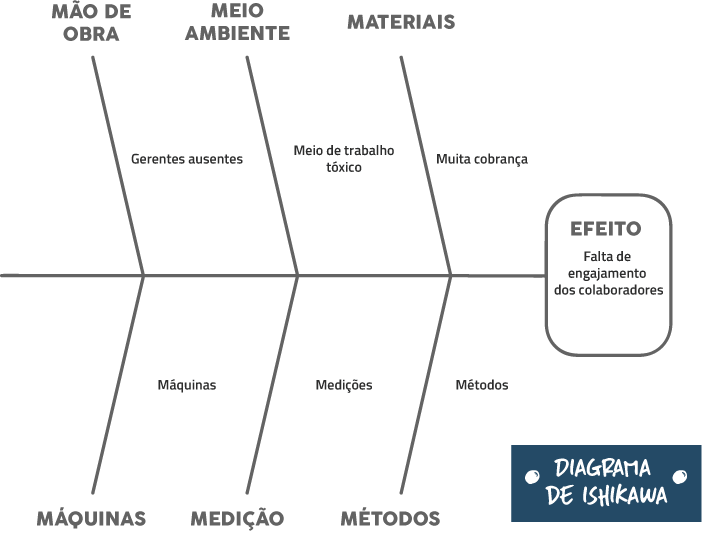
At this stage, the Ishikawa diagramopens in a new tab, known as the fishbone, helps lay out the causes. In the example below, the problem is the lack of employee engagement in a company.
Stage 2: determining the causes
Here the group points out the possible causes of the problem, in an organized and horizontal way, with the same chance to speak for everyone. The coordinator leads the reflection, the exchange of information and the clearing up of doubts about the importance of each cause.
In the example, participants receive sticky notes and write what they think influences the problem. The less interactive people express themselves just like the others, and the fear of judgment decreases.
Stage 3: ranking the causes
After reading the causes, participants assess the importance of each one. The 5 Whysopens in a new tab method helps dig deeper and find the root of the problems cited.
Sticky notes also work here. If two or more people wrote the same cause, it gains priority. The coordinator reads, organizes by relevance and classifies the problems that call for the most urgent solution.
Stage 4: creating the action plan
With the causes prioritized, it is time to create countermeasures. Ask which actions have the most impact, which are easiest and fastest and how much they cost. Sticky notes can be used again for participants to record what they believe is needed.
If there is wide variation in actions, the causes may not yet be identified, and it is worth going back to the previous stage. If not, the brainstorming is working and the countermeasures also need to be ranked.
For that, use the 5W2Hopens in a new tab, usually built as a table. It answers seven questions about each action: what, why, where, who, when, how and how much.
| Question | Example answer for team engagement |
|---|---|
| What? | Increase employee engagement. |
| Why? | Performance has dropped and turnover is higher than desired. |
| How? | By building an organizational culture that welcomes employees and encourages performance. |
| Where? | Across the whole organization. |
| Who? | CEO, managers and other leaders. |
| When? | From the date of the brainstorming. |
| How much? | Define how much the engagement actions cost the company. |
9 tips to run a brainstorming
These tips help the coordinator create an environment that makes creative thinking easier.
The video below reinforces how to run an effective session.
1. Prepare the session
Every brainstorming meeting needs preparation and a support script to organize how it runs. Include breaks to refresh the mind, which helps ideas flow.
2. Define the problem clearly
Participants need to know objectively which problem to solve. Without that, ideas get lost and turn into solutions for the wrong problem.
Write a good briefing and sum up the focus in a simple, clear question. That way, everyone understands the purpose of the meeting in the same way.
3. Accept all ideas
At this moment, judging, censoring or joking is off limits. Someone who feels reprimanded may hold back a good idea for fear of criticism. Everyone should feel free to say what they think.
4. Keep materials at hand
Participants need paper, pens, sticky notes, a whiteboard or a computer to record ideas almost as fast as they come up. That way, nothing is lost along the way.
5. Write legibly
There is no point in having good ideas if no one can read what was written afterward. Write legibly.
6. Use visual representations
Set aside a moment for participants to represent their ideas visually, with collages, cutouts, drawings, images and associations. This makes it easier to understand what each person means.
7. Focus on generating ideas, not implementing
During the storm, someone often starts thinking about how to implement an idea. This compromises the creative process, and the coordinator should avoid it.
The more ideas come up, the greater the chance of reaching a creative and innovative solution.
8. Set a time limit
A time limit pushes the group to produce more and keeps the focus on the problem from slipping.
9. Combine work and fun
Brainstorming does not have to be another tiring meeting. The more relaxed people are, the greater the chance they show the creativity they have.
Practical brainstorming examples
These four examples show how the technique works in common company situations.
Example 1: health call center
A healthcare services company misses 25% of the calls it receives. The problem is how to reduce that percentage.
With the teams together, the group can ask questions such as:
- At what time of day are most calls lost?
- Why are most lost calls concentrated in that period?
- Are the service teams distributed in proportion to the call volume of each period?
- Are the professionals trained for the role?
The answers point to possible failures and generate ideas to fix them.
Example 2: e-commerce product delivery
An e-commerce company cannot deliver all orders within the stated deadline. The group can ask:
- On average, how long are deliveries delayed?
- How is communication between the purchase and the department that makes the delivery?
- What is the current size of the fleet responsible for the orders?
The storm of ideas starts when the group answers these questions. If the fleet is insufficient, suggestions can include:
- Expand the fleet.
- Partner with outsourced delivery companies.
- Automate processes to streamline delivery.
Example 3: selling more than the competitor
The same product your company sells is selling more at a competitor. Some questions to stimulate ideas:
- What are the competitor’s marketing strategies?
- What strategies can increase sales, such as service, marketing and after-sales?
- How can you create product differentiators and capture the public’s attention?
- How can you improve the customer’s experience with the brand?
Example 4: attracting more customers
Attracting more customers is something companies always seek. Starting from that problem, the group can propose:
- Launch new products.
- Accept credit card payments.
- Run promotions.
- Create loyalty campaigns.
- Invest in local advertising.
- Invest in digital marketing.
- Allow online purchases with home delivery.
Mistakes that undermine brainstorming
In unsuccessful sessions, it is common to find mistakes that scatter the team or limit participants’ contribution. The most frequent is letting the dynamic be dominated by people who intimidate others or by fear of having one’s own ideas judged.
The facilitator should take care of organization and give attention to everyone’s opinion. For brainstorming to be efficient, create a comfortable and equal environment and follow the rules and stages of the script.
Brainstorming works when it brings together three things: a well-defined problem, rules that protect everyone’s participation and a clear close. That close is the action plan, with an owner and a deadline for each chosen idea.
Without it, the session produces good conversations and few results. So set aside the last minutes to prioritize the ideas and decide who does what, and return to the topic in the following meetings to track progress.
Frequently asked questions
What is brainstorming?
Brainstorming, or a “storm of ideas,” is a technique that stimulates creativity and collaboration. Different people contribute freely to solve a problem or develop a project, and the group gathers as many ideas as possible before selecting the most viable ones.
How do you run a brainstorming?
Define the problem, choose a facilitator, gather 5 to 8 people and set the rules. Let ideas flow without criticism, record everything, group and prioritize the ideas and finish with an action plan with owners and deadlines.
What are the principles of brainstorming?
The principles are to suspend judgment during idea generation, prioritize quantity, build on others' ideas and stay focused on the proposed problem. Any idea is valid in the generation phase, and evaluation comes later.
What are the types of brainstorming?
The six main types are structured, unstructured, individual, group, reverse and speedstorming. The choice depends on the goal of the session, the available time and the profile of the group.
How many people should take part?
The ideal is a group of 5 to 8 people, from different departments or areas of expertise. The variety of perspectives enriches the ideas, and a group of that size lets everyone have a voice.
How long should a brainstorming last?
Avoid going over 50 minutes, so the session does not become tiring. If you cannot shorten it, split the stages across more than one meeting and include breaks to refresh the mind.
What is the difference between brainstorming and the 5 Whys?
Brainstorming generates many ideas and possible causes in a group, without judgment. The 5 Whys dig into one cause, asking “why” in sequence until reaching the root. The two techniques complement each other.
Who leads a brainstorming?
A facilitator, or coordinator, keeps the session organized, makes sure everyone has a voice and guides the group toward the goal. They explain the problem, control the time and organize the ideas by relevance.

About the author
Equipe Siteware
Content produced and reviewed by the Siteware team, curated by internal experts in strategic management and corporate performance.