
Strategy and Goals
What are goals? [Complete guide] with everything you need to know
Learn what goals are, how they differ from objectives and tasks, and how to apply the SMART method to reach high performance.

In the corporate world, how well you set and meet goals can make the difference between an organization’s success and failure. After all, goals are what take strategic planningopens in a new tab off the page and point the whole team’s effort toward real results. No wonder that understanding what goals are, and how to track and reach them, has become a core organizational priority for most companies.
A recent study by the consulting firm Gartneropens in a new tab (2025) showed how much this practice matters: organizations that lack excellence in goal setting are 36% less likely to report high business performance.
Reinforcing that impact, data from Management Study Guideopens in a new tab indicated that, in 90% of the scenarios assessed, setting specific and challenging goals is the central factor driving higher levels of performance and productivity in a business.
Despite their critical importance, there is still a lot of confusion about what exactly goals mean and how they relate to other important concepts, such as objectives and tasks.
That is why this article brings everything you need to understand what goals are and how to work with them, starting from their definitions. Keep reading and check it out!
What are goals?
Goals are specific quantitative or qualitative milestones that an organization sets to reach within a given timeframe. They work as the practical breakdown of a larger objective, turning broad visions into measurable targets.
In short, while the objective defines the business’s strategic direction, the goal acts as the guide for day-to-day actions and validates the real progress of the operation.
For example, imagine that an organization’s strategic objective is to expand its sustainable business line. In that case, a clear and measurable goal could be “increase annual revenue from eco-friendly products by 20% every year until 2030.”
Read also: Goal tracking system: how to choose the best one for your company?
Differences between goals, objectives and tasks
Although they work together for the success of strategic planning, goals, objectives and tasks differ in scope, measurability and execution:
- Objectives: are the broadest, most general and long-term statements. They are strategic and inspiring, giving the overall direction of what needs to be achieved, and are less measurable.
- Goals: are specific, measurable results with a defined deadline. They break the macro objective into pieces, creating a clear path and guiding strategies toward the final objective.
- Tasks: are operational, practical and concrete actions. They are specific and, usually, short-term activities assigned to people or teams with a clear execution time, needed for the goals to be met.
In summary: the objective is the general, inspiring long-term vision; goals are the specific, time-bound results that guide the way; and tasks are the daily, practical work done to achieve the goals.
Read also: What is the difference between goals, performance indicators and objectives?
Why is it important to define what goals are?
Setting goals is essential to give the company direction and focus, as well as to motivate employees, measure progress, support decision-making and build self-confidence.
Let’s look at these benefits below.
1- Direction and focus
Goals provide a sense of direction and purpose. They help guide effort and energy toward what matters most, giving more clarity on the tasks the team needs to do to reach them.
In practice, they help make sure everyone works toward the same objectives, avoiding scattered effort and ensuring that resource management is done efficiently.
2- Motivation
Challenging but achievable goals motivate employees.
They encourage effort and dedication, especially when employees are involved in the goal-setting process and when there is recognition or a reward tied to reaching them.
3- Progress measurement
With a properly defined goal, managers can create customized performance indicators to see how far the company is advancing toward the result and, when needed, review strategies.
After all, goals let the company identify areas of success and recognize where improvements or adjustments are needed.
4- Decision-making
Goals are excellent tools for decision-makingopens in a new tab. When you understand where you want to get, it is easier for managers to set more precise strategies, making things clearer for everyone.
Overall, goals are an important component for the company to grow consistently over time in pursuit of better-aligned results.
What are the types of goals?
Setting goals in a corporate environment does not require a single methodological format. On the contrary, high-performance strategic management combines and adapts different approaches to keep goals aligned with the business’s long-term vision.
To structure your operation with precision, below we detail the six main types of business goals:
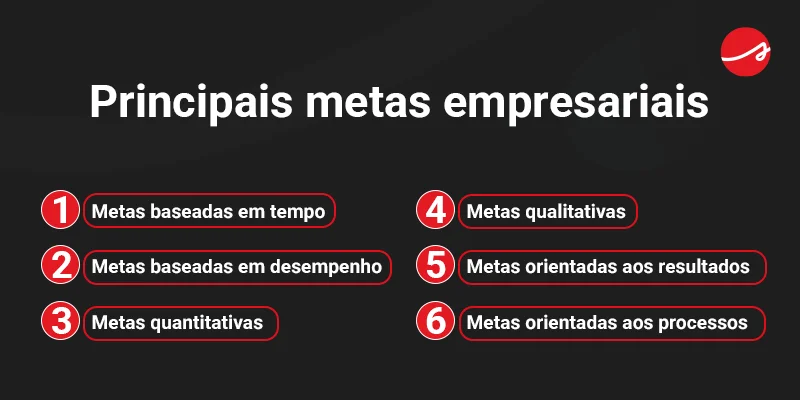
1- Time-based goals
How many times have you heard about the importance of breaking a larger objective into smaller parts? That is tied to creating time-based goals: short, medium and long term.
They guide managers and employees over time, showing what should be achieved in a semester, a year and so on.
- Short-term goals (up to one year): focus on operational, immediate results. Examples: increase sales by 5% in the first half of the year or reach scores above 8 in the NPS survey within a year.
- Medium-term goals (one to five years): target consolidation and structuring milestones. Examples: raise brand awareness in the digital environment within two years or expand sales operations to three new states within four years.
- Long-term goals (five to ten years or more): steer the future vision and business expansion. Examples: become the main reference in your market or open 100 new branches in the next decade.
2- Performance-based goals
Performance-focused goals are short-term and aim at the execution of specific, one-off tasks, such as employee performance reviewsopens in a new tab or finishing a project.
Here are other examples of this type of goal:
- Invest 25% more in automated management systems for all departments during the first quarter of the year.
- Increase new customer acquisition by 10% in 30 days.
- Finish developing a new product within two months.
3- Quantitative goals
As the name says, quantitative goals focus on quantity, that is, numbers and statistics.
In a practical scenario, such as launching a new digital channel, examples of this type of goal include: increasing user engagement on the platform by 50% or raising the sign-up conversion rate by 30% over six months.
4- Qualitative goals
On the other hand, qualitative goals are not as easy to measure as quantitative ones.
But it is not impossible. They focus on subjective aspects and, for that reason, need a realistic analysis of the brand’s situation.
A good example is users’ opinion and perception of the company’s newly launched e-commerce site.
5- Results-oriented goals
Although it may sound redundant, this model focuses strictly on the final deliverable and the impact generated. In practice, you define precisely “what” must be achieved, leaving the “how” (execution) to the team’s tactical planning.
Practical example: launch the new e-commerce platform by the end of the semester. Success, in this case, is judged exclusively by the successful completion of that milestone, regardless of the routines and daily tasks the technology team used to get there.
6- Process-oriented goals
Unlike results-based goals, process-oriented goals focus on a shorter timeframe, showing what must be done repeatedly to reach the desired objectives.
Here is an example: hold a weekly meeting with the IT and design teams to understand the progress of building the new e-commerce site until the website launch.
How to set a company’s goals?
The goal-setting process requires alignment between the long-term strategic vision and the organization’s ability to execute. To structure this flow in a logical, results-oriented way, planning should follow three fundamental steps:
- Define strategic objectives: the starting point is setting direction. Define broad, inspiring purposes aligned with the business mission. They will serve as the “north” for future measurements.
- Break them down into SMART goals: turn general guidelines into tangible results. Every corporate goal must be Specific, Measurable, Achievable, Relevant and Time-bound, making clear what will be delivered and how success will be measured.
- Create action plans: strategies require practical execution. Break goals down into specific tasks, organized in a logical sequence. Define resources, priorities, schedules and, above all, the people responsible for technical deliverables, making sure the plan gets off the page.
Read also: How to set and give examples of individual performance goals for your employees?opens in a new tab
SMART goals: how to create them?
The success of strategic planning or a corrective action plan depends fundamentally on how precisely goals and objectives are defined. To avoid guesswork and ensure governance of results, high-performance organizations rely on established market methodologies.
In this context, the SMARTopens in a new tab methodology is one of the most efficient and validated approaches for strategic management. The model sets five essential technical criteria to structure goals that are clear, measurable and aligned with the business vision.
Below, see how to apply this model to structure your operation’s objectives:
S, Specific
Generic goals lead to misaligned execution. A specific objective details what the organization expects to achieve, leaving no room for ambiguity.
In practice, the definition should clearly answer what will be done, who is responsible for execution and which operational requirements or constraints are involved.
M, Measurable
What is not measured is not managed. Every goal requires clear performance indicatorsopens in a new tab (KPIs) tied to it.
Measurement lets you track progress in real time, spot deviations quickly and show, with hard data, the exact moment the final result was reached.
A, Attainable
Although goals should be challenging to drive business growth, they need to be feasible.
Attainable planning takes into account operational reality and the resources actually available (budget, team capacity, technological maturity and time), avoiding wasted effort.
R, Relevant
To create value, the team’s effort needs to be connected to the company’s larger purposes.
A relevant goal aligns with the business’s long-term strategic vision, ensuring that reaching it brings a real, significant positive impact on overall corporate results.
T, Time-bound
Every deliverable needs a strict schedule. Setting a deadline creates a sense of urgency, focuses the team and makes it easier to prioritize the task portfolio.
The deadline ensures execution happens within the planned strategic cycle, keeping important initiatives from losing traction over the months.
SMART goal example
Applying the methodology’s five criteria to a business scenario, the goal would stop being generic (“sell more”) and take this structure: increase sales volume by 20%, reaching R$ 3 million in revenue, by the end of December 2026.
This SMART goal example is specific in what it seeks, measurable through transparent financial indicators, attainable (considering the operation’s sales history), relevant to the company’s expansion, and has a clear deadline to guide leaders.
Need to track your goals? Download our Goal Tracking Spreadsheet (in Portuguese)opens in a new tab and reach your results!
More goal examples for your business
To guide the structuring of your planning, we gathered the main examples of goals applied in the corporate environment. They serve as a base and can be adapted to the reality, size and industry of your company.
Check the examples for each scenario:
Strategic goals for HR
- Increase talent retention by 20% over one year;
- Reduce employee turnover by 50% within five years;
- Hire 20 more IT professionals in the next three years;
- Raise the productivity of all company teams by 10% within three months;
- Reach 90% employee satisfaction with the company within two years;
- Restructure processes and digitize the HR area by 2027;
- Implement performance reviews every semester within one year.
Strategic goals for company growth
- Open two new offices in Brazil (Rio de Janeiro and São Paulo) within two years;
- Raise the company’s market shareopens in a new tab by 30% by 2027;
- Start and finish building a factory by 2028;
- Increase website traffic to 500,000 visitors by December 2027;
- Reach a 27% conversion rate within one year.
Strategic goals to increase sales
- Reduce customer churn by 10% during the first quarter;
- Increase customer satisfaction, getting 90% of scores above 8 in the NPS survey;
- Raise customer retention and loyalty by 20% by the end of 2027;
- Enter a new market and double the customer base by December 2027;
- Reduce the product return rate by 5% within one year.
What to do to meet business goals?
Making sure goals are reached takes more than good planning: it demands governance, disciplined execution and continuous follow-up.
So that strategy does not get lost in the operational routine, we listed the main practices to lead your team to the expected results:
1- Set clear, measurable goals
As we saw in the SMART methodology, clarity is the first step to corporate success.
Make sure objectives are not only defined with technical rigor, but also deeply understood by everyone involved, keeping leadership’s expectations aligned with how teams execute.
2- Create an action plan
Strategy only happens in practice through execution. For each goal, develop a detailed action planopens in a new tab: break the central objective into operational steps, define the resources needed, set strict deadlines and delegate responsibilities.
This structure turns big ambitions into manageable tasks.
3- Measure progress
Tracking how performance indicators evolve is essential to avoid surprises at the end of the cycle.
Set up monitoring routines (such as results meetings and visual management dashboards) that let you assess the scenario in real time, identify bottlenecks and act quickly.
4- Communicate effectively
Team engagement depends on visibility into the business. Communicate goal progress in a continuous, unified way.
When employees understand exactly how their daily work affects the organization’s overall result, their level of commitment rises significantly.
5- Foster accountability
Build an environment where accountability and performance are core values.
Track individual and collective results in a constructive, data-based way. A culture geared toward high performance handles performance issues proactively and with a focus on continuous improvement.
6- Reward success
Recognition is an engine for productivity. Set up fair, transparent programs, such as variable compensation (profit sharing, corporate bonuses or commissions), tied to goal attainment.
Linking results to tangible incentives is one of the most efficient ways to motivate and retain talent.
7- Be open to change
Strategic execution is rarely a linear process free of obstacles. After all, scenarios change and surprises happen. Faced with operational deviations or below-expected results, managers should not cling rigidly to the initial plan.
Use data to trigger corrective action plans and recalculate the route, keeping the focus on the final objective.
Read also: How to set goals for your team? Check out 7 tips to use with your employees
Track your goals with Stratws
Reaching the organization’s objectives requires continuous follow-up and accurate data. To make sure strategy gets off the page and the company keeps growing, technology makes a difference.
By implementing a goal-setting and results-tracking system, leadership centralizes information, automates the calculation of performance indicators and gains real-time visibility.
In addition, by backing the operation with an individual performance review system, managers can quickly identify productivity deviations, support the team constructively and ensure full governance and transparency in calculating variable compensation.
This is exactly the integrated view that Stratwsopens in a new tab, Siteware’s corporate management platform, delivers to your business. The system connects strategy to execution in one place, letting you monitor indicators closely, standardize processes and keep the team 100% focused on reaching goals.
Take your operation to the level of high-performance management. Talk to an expert about Stratws and see in practice everything the platform can do!

About the author
Equipe Siteware
Content produced and reviewed by the Siteware team, curated by internal experts in strategic management and corporate performance.