
Strategy and Goals
Strategic Analysis: 5 Tools to Help You
Learn 5 strategic analysis tools to spot improvement opportunities in your company: SWOT, PESTEL, Porter's Five Forces, SOAR and Ansoff.

For companies and corporations that want to stand out in their markets, strategic analysis is an indispensable tool. It does not just light the way forward. It also identifies obstacles, opportunities and potential pitfalls that can appear along the journey.
Strategic analysis is not a new concept, but it has never been more relevant. In a landscape of fierce competition and high stakeholderopens in a new tab expectations, it is crucial to understand the organization’s internal and external environment in depth.
In this article, I introduce the world of strategic analysis, exploring its definition and the main types of analysis, and offer valuable tips for those who want to improve their analysis processes.
Keep reading and see for yourself!
What is strategic analysis?
Strategic analysis is a process that involves evaluating and interpreting information about an organization and its environment, with the goal of identifying opportunities, threats, strengths and weaknesses. This analysis is essential for building strategies that allow the organization to reach its goals and stay competitive in the market.
That is why strategic analysis is often carried out as part of strategic planningopens in a new tab. In a fast-changing business environment, companies need to know how they are positioned against the competition, what their competitive advantages are and where gaps or vulnerabilities exist.
Two important components of strategic analysis are usually the internal analysis and the external analysis. The first evaluates the organization’s resources, competencies and capabilities. This includes assessing the company’s strengths and weaknesses in areas such as finance, operations, human resources and marketing.
The external analysis, on the other hand, examines the external environment in which the organization operates. It involves identifying opportunities and threats in the market, assessing factors such as competition, market trends, technological developments, legal issues and socioeconomic conditions, among others.
Why strategic analysis matters for corporations
Among the main reasons why strategic analysis is crucial for corporations are:
1. Informed decision-making
Strategic analysis provides valuable information about the company’s internal and external environment. Based on these insights, leaders can make better-informed decisions, minimizing risks and seizing opportunities.
2. Identifying opportunities and threats
By analyzing the external environment, corporations can identify new market opportunities, emerging trends and possible threats, allowing them to adapt proactively to change.
3. Corporate self-knowledge
Internal analysis lets companies identify their strengths and weaknesses. This is vital to understand what the company does best, where it can improve and how it can leverage its strengths in the market.
4. Efficient resource allocation
With a clear understanding of their capabilities and the market environment, companies can allocate resources (financial, human and technological) more effectively, ensuring the maximum return on investment.
5. Competitive advantage
Strategic analysis also helps companies identify and cultivate their competitive advantages, allowing them to stand out in a saturated market and hold a position of leadershipopens in a new tab.
6. Long-term planning
Strategic analysis is essential for long-term planning. It helps companies picture the future, set clear goals and objectives and develop strategies to reach them.
7. Risk management
By identifying potential threats and vulnerabilities, corporations can develop contingency plans and risk mitigation strategies, protecting themselves against unexpected adversity.
What types of analysis are there?
Strategic analysis can be carried out with different methods, each with a specific purpose. Below, I present some of the most widely used and effective types for helping companies:
1- SWOT analysis
SWOT analysisopens in a new tab is one of the most popular and widely used tools in strategy and management. It provides a clear framework to evaluate an organization’s strengths, weaknesses, opportunities and threats.
It can be applied to an entire organization, a specific department, a product or even an individual project.
By identifying and evaluating strengths, weaknesses, opportunities and threats, organizations can build strategies that leverage their strengths, mitigate their weaknesses, capitalize on opportunities and defend against threats.
It is divided into 4 quadrants, each with a specific purpose for the analysis. They are:
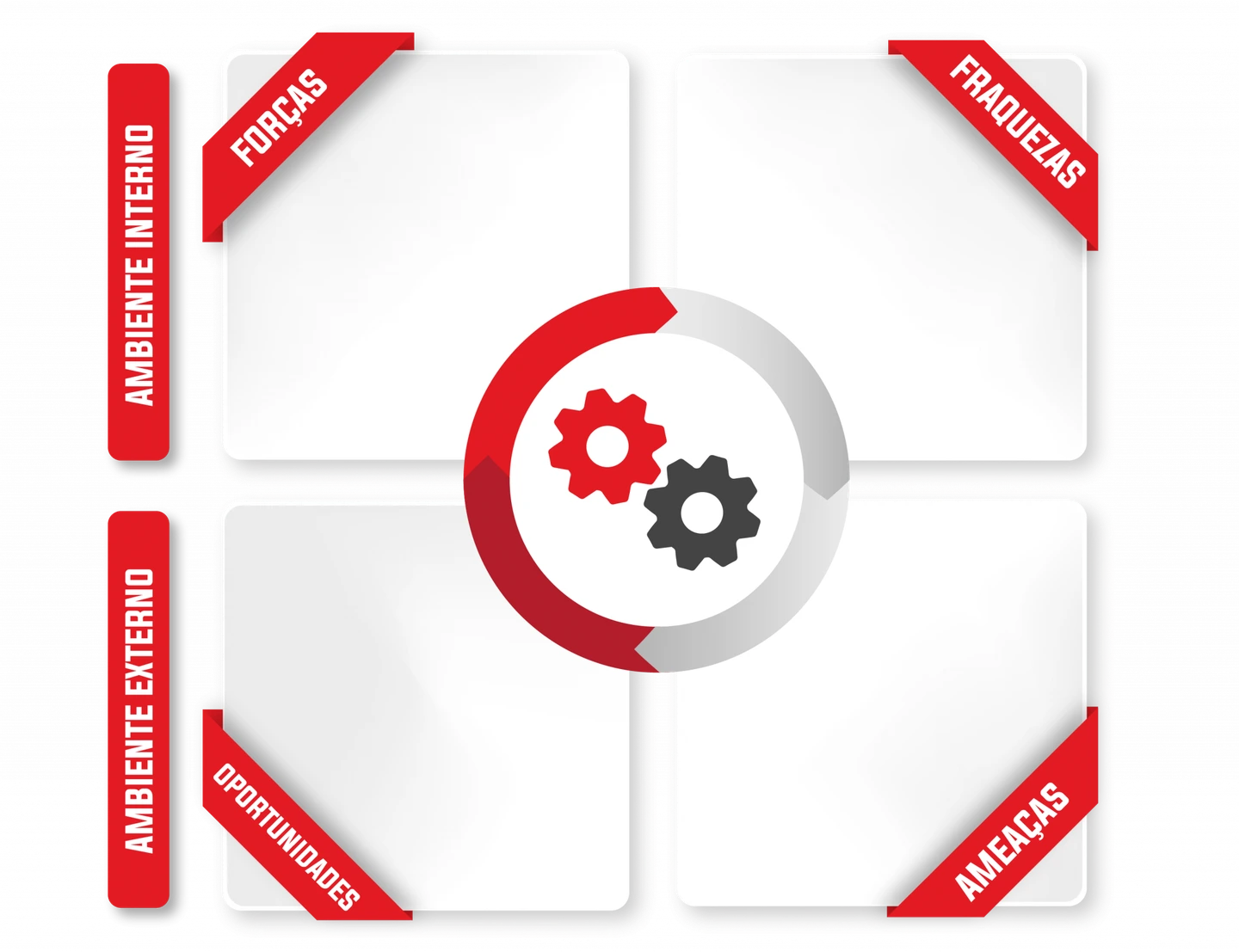
#1. S (Strengths)
These are the positive internal attributes of an organization that give it an advantage over competitors. They can include:
- Skilled human resources;
- Valuable intellectual property;
- Tangible assets, such as equipment and technology;
- A good reputation in the market;
- Unique competitive advantages.
#2. W (Weaknesses)
These are the internal attributes that put the organization at a disadvantage against competitors. They can involve:
- Lack of specific resources or capabilities;
- Inefficient internal processes;
- Lack of online presence or outdated technology;
- Dependence on a few customers;
- Lack of differentiation in the market.
#3. O (Opportunities)
These are the external circumstances the organization can exploit to gain an advantage. Opportunities can arise from:
- Changes in the market or in consumer demand;
- Introduction of new technologies;
- Regulatory or political changes;
- Expansion into new markets or segments;
- Strategic partnerships or alliances.
#4. T (Threats)
These are the external circumstances that can harm the organization’s performance. Threats can include:
- New competitors entering the market;
- Adverse changes in regulation;
- Economic or political risks;
- Changes in consumer preferences;
- Technological developments that make products or services obsolete.
2- PESTEL analysis
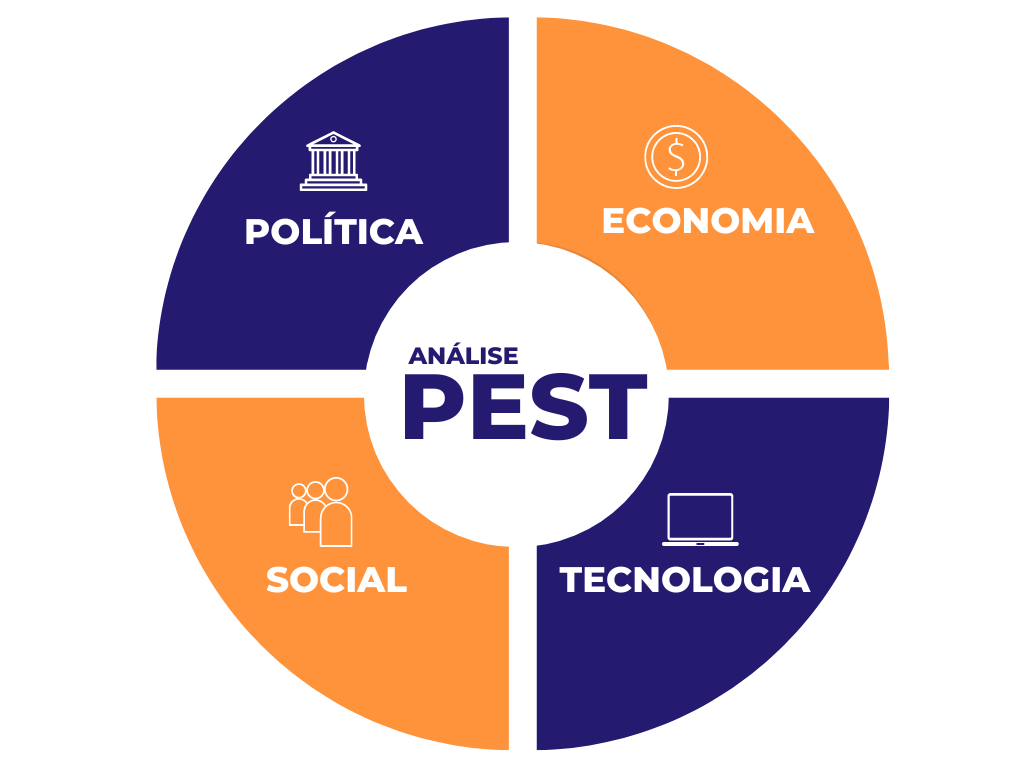
PESTEL analysis is a strategic tool that helps organizations identify and evaluate the macroenvironmental factors that can affect their operations and performance. Unlike SWOT analysis, which looks at both internal and external aspects, PESTEL focuses exclusively on the external environment.
This strategic analysis evaluates the following factors:
#1. P (Political)
Refers to the government and political influences that can affect an organization. They can include:
- Political stability of the country or region;
- Fiscal and monetary policies;
- Labor regulations and laws;
- International relations and sanctions;
- Foreign trade policies.
#2. E (Economic)
Evaluates the economic factors that can influence a company’s health and operations. They can involve:
- Economic growth rates;
- Inflation and deflation levels;
- Interest rates;
- Exchange rates;
- Unemployment and income levels.
#3. S (Sociocultural)
Examines the cultural and social aspects that can affect demand for an organization’s products or services. They can include:
- Demographics and age structure;
- Cultural attitudes and values;
- Lifestyle trends and consumer behavior;
- Education levels and social awareness.
#4. T (Technological)
Analyzes the technological advances and changes that can create opportunities or threats for a company. They can involve:
- Technological innovations and advances;
- Rate of adoption of new technologies;
- Research and development in the industry;
- Automation and digitalization.
#5. E (Environmental)
Evaluates the environmental factors that can influence a company’s operations. They can include:
- Climate change and its impacts;
- Environmental regulations and laws;
- Attitudes toward sustainability and environmental responsibility;
- Natural disasters and their frequency.
#6. L (Legal)
Refers to the laws and regulations that can affect the way a company operates. They can involve:
- Labor, health and safety legislation;
- Consumer protection laws;
- Competition and antitrust regulations;
- Intellectual property and patent laws.
The last two elements, environmental and legal, were added to this analysis later, in recognition that these two perspectives have become increasingly important to organizations. That is why you will often find only the PEST analysis out there.
3- Porter’s Five Forces
Porter’s Five Forcesopens in a new tab is a strategic model developed by Michael E. Porter in 1979. It is widely used to analyze the industry and the competitive environment in which an organization operates.
It helps companies understand the forces that shape competition within an industry and, in turn, identify their strengths and weaknesses relative to that competition.
Porter’s Five Forces are:
#1. Rivalry among existing competitors
This force analyzes the degree of competition among companies already established in the market. The intensity of rivalry is influenced by factors such as:
- Number and size of competitors;
- Industry growth;
- Fixed or storage costs;
- Product differentiation;
- Exit barriers.
#2. Threat of new entrants
Refers to how easily new companies can enter the market and become direct competitors. Factors that influence this threat include:
- Entry barriers (for example, initial capital required, access to distribution channels);
- Existing economies of scale;
- Product differentiation;
- Government policies and regulations.
#3. Threat of substitute products
This force analyzes the possibility that products or services from other industries will replace those of the industry in question. The threat of substitution is higher when:
- The price of substitutes is lower;
- Substitutes offer better performance or benefits;
- The cost for consumers to switch to substitutes is low.
#4. Bargaining power of suppliers
Evaluates the degree of control suppliers have over the prices and quality of the inputs they provide. Suppliers have greater bargaining power when:
- There are few suppliers but many buyers;
- The inputs are unique or differentiated;
- There are significant costs associated with switching suppliers;
- Suppliers can integrate forward (for example, a supplier that starts selling directly to the end consumer).
#5. Bargaining power of buyers
Refers to customers’ ability to influence prices and terms. Buyers have greater bargaining power when:
- There are few buyers but many sellers;
- Products are standardized or undifferentiated;
- Buyers are well informed about products and prices;
- There are low costs associated with switching suppliers;
- Buyers can integrate backward (for example, a retailer that starts making its own products).
4- SOAR
SOAR analysis is a model that focuses on strengths, opportunities, aspirations and results. It is a positive, forward-looking approach that differs from traditional SWOT analysis by emphasizing building on and leveraging an organization’s strengths, rather than focusing on overcoming weaknesses.
Strategic analysis is done by examining the following aspects:
#1. S (Strengths)
Similar to SWOT analysis, SOAR starts by identifying the organization’s strengths. This can include distinctive competencies, resources, talents, capabilities or any other internal attribute that gives the organization a competitive advantage.
#2. O (Opportunities)
Instead of looking only at the external environment, as in SWOT, SOAR considers both internal and external opportunities. This can involve new markets, emerging trends, potential partnerships or even internal opportunities to improve efficiency or innovate.
#3. A (Aspirations)
This is a distinctive feature of SOAR. Instead of focusing on “threats” or “weaknesses”, SOAR looks at what the organization aspires to become in the future. It asks: “Where do we want to be?” and “What does success look like for us?” This helps define a clear and inspiring vision for the future.
#4. R (Results)
Finally, SOAR focuses on the tangible results the organization wants to achieve. This can be in terms of financial goals, market impact, customer satisfaction or any other performance indicator. The emphasis is on measuring progress toward the aspirations and making sure the vision becomes reality.
5- Ansoff Matrix
The Ansoff Matrixopens in a new tab, also known as the Product-Market Growth Matrix, is a strategic tool that helps companies determine their growth strategies based on existing and new products, and on existing and new markets. It was developed by Igor Ansoff in 1957.
The Ansoff Matrix is useful for companies that are evaluating their growth options. By considering each of the four strategies, companies can assess the associated risks and determine which strategy best fits their goals and resources.
For example, while market penetration may be the least risky approach, diversification may offer the biggest rewards, but with significantly higher risks.
The matrix is divided into four categories, each representing a specific strategy:
1. Market penetration
This strategy involves gaining more market share with current products or services in current markets.
It can be achieved through marketing promotions, discounts, loyalty programs or any other tactic that encourages existing consumers to buy more, or new consumers to choose the brand over the competition.
2. Product development
Here, the company introduces new products or services to the existing market. This can be done through research and development, by acquiring another company that has the desired product, or by extending the existing product line.
3. Market development
This strategy involves introducing existing products or services to new markets or segments. It can be achieved through geographic expansion, by targeting new market niches or by using new distribution channels.
4. Diversification
Diversification involves introducing new products to new markets. It is the riskiest strategy, because the company enters unfamiliar territory on both fronts, product and market.
Diversification can be related (where there is some link to the existing business) or unrelated (where the company enters a completely new business).
Tips for carrying out your strategic analysis
To make sure your analysis is both accurate and strategic, it is essential to gather data from a variety of sources, including market research, customer feedback, competitor analysis and industry trends. This ensures a holistic view and reduces the risk of bias or gaps in the information.
It is also crucial to make sure the data you collect is recent and relevant, because the business environment changes quickly and outdated information can lead to inaccurate strategic decisions.
Including representatives from different departments or teams in the analysis can enrich the process, since each department can offer a unique perspective.
In addition, gathering insights from external stakeholders, such as customers, suppliers or consultants, can be valuable, because they can offer an outside perspective that may be overlooked internally.
It is also vital to avoid accepting information or assumptions without questioning them. Always ask “Why?” and look for evidence or justification for each point. Considering different future scenarios when building strategies helps prepare the organization for uncertainty and adapt quickly to unexpected changes.
Finally, the business environment is dynamic, so it is essential to review and update your strategic analysis regularly. Use strategic analysis as a learning tool.
If a strategy is not producing the expected results, go back to the analysis, identify where things may have gone wrong and adjust as needed.
After the analysis, what next?
Once the strategic analysis is complete, it is essential to turn the information and insights you gained into practical actions that steer the organization toward its goals. Below, I detail the strategic steps to take after the analysis, with emphasis on the first three:
1. Defining objectives and goals
Once you have a clear understanding of your organization’s current position and of the opportunities and challenges ahead, it is time to set clear objectives. Ideally, your goals follow the SMART pattern, which means they should be:
- Specific: detail exactly what you expect to achieve;
- Measurable: set clear criteria to measure progress toward the objective;
- Achievable: make sure the objectives are realistic, considering the resources and time available;
- Relevant: objectives must be aligned with the organization’s mission and vision;
- Time-bound: set a clear deadline for when the objective must be reached.
2. Developing the strategic plan
With the objectives clearly defined, the next step is to map out how to achieve them. This plan should:
- Identify strategies and tactics: determine which specific actions will help achieve each objective. For example, if an objective is to increase sales by 20%, a strategy might be to expand into a new market and a tactic might be to launch a marketing campaign aimed at that market;
- Assign responsibilities: designate specific teams or individuals for each task or action. Make sure they have the resources and authority needed to carry out their responsibilities;
- Set deadlines: For each action or task, set a clear deadline. This creates a sense of urgency and helps track progress.
3. Resource allocation
For the strategic plan to succeed, it is essential to make sure the right resources are available and used efficiently. This involves:
- Budget: estimate the costs of implementing the plan and make sure funds are available. This may involve reallocating resources from lower-priority areas;
- People: determine whether you have the team needed to implement the plan. This may involve hiring, training or reorganizing existing teams;
- Technology and infrastructure: assess whether the organization has the technology and infrastructure needed to support the plan. This may involve acquiring new tools or upgrading existing ones.
Next steps
Stratwsopens in a new tab is a robust corporate performance management software that is very easy for every level of the hierarchy to use. It makes data and information available transparently, helping track the performance of processes and teams.
The tool helps leaders and team members develop action plans that work within organizations, with functions such as:
- Creating and tracking KPIs for processes, projects and people;
- Sharing information quickly and transparently;
- Making it easier to exchange information and communicate across departments;
- Focusing on the results your company wants to achieve;
- Using meritocracy and visual management to motivate and manage teams;
- Applying the main strategic planning methodologies such as BSC, OKR and SWOT;
- Strengthening corporate governance;
- Managing risks and analyzing scenarios;
- Integrating people, operations and strategy;
- Finding improvement opportunities;
- Increasing productivity;
- Creating, tracking and sharing KPIs quickly and transparently;
- Managing meetings and the project portfolio.
This makes decision-making faster and more accurate, and it makes strategic planning much easier.
Revolutionize your company’s management with Stratws


About the author
Equipe Siteware
Content produced and reviewed by the Siteware team, curated by internal experts in strategic management and corporate performance.