
Project Portfolio
Scrum: what it is, what it is for, and 10 tools to try
Learn what Scrum is, how to manage projects and organize tasks with Scrum tools, and see 10 free options you can start using today.

Today, companies are increasingly driven by results in project management, and a good methodology for reaching them quickly is Scrum.
It is a very useful approach that comes from the Agile Manifesto, which is why some people say Scrum is even part of the agile methodology, with every process very well defined.
When a company applies this methodology, it usually gets more agile daily meetings, clearer presentation of the results from each stage of the process, and better synchronization among everyone involved.
So if you want to know what the Scrum method is and how to apply it to developing a product or software, this article is for you. Keep reading to learn more:
What is the Scrum method?
Scrum is a methodology derived from the Agile Manifesto, a movement to modernize the software development process. It is far from limited to software, though. It was originally created to manage and plan system development projects, but today it is part of teams with many different goals.
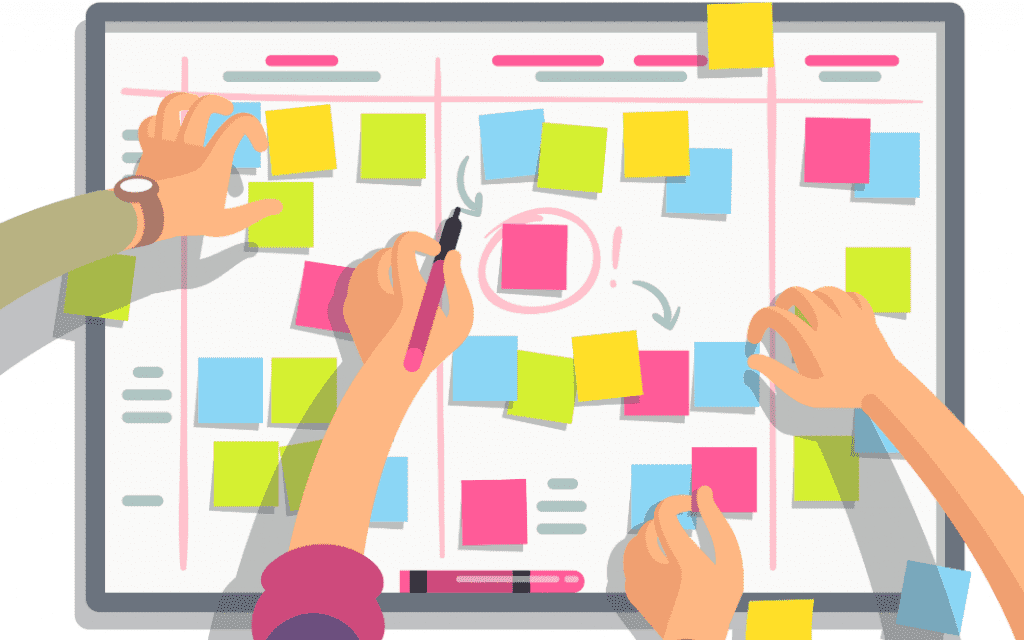
The Scrum methodology was conceived by Ken Schwaber and Jeff Sutherland in 1993, when they worked at Easel Corporation.
It is a standardized process structure, with its own set of roles and activities (a frameworkopens in a new tab (in Portuguese)), simple and practical to use for managing complex projects.
Grounded in empiricism, the body of knowledge gained through experience and practice, the Scrum agile methodology treats experience as a reliable guide.
In other words, decisions start from what has already been lived, and ideas come from observation and experiments. Everything that is built is tested with the help of an end user.
Only after making sure that a feature or innovation really meets customer needs does the team move on to the next step.
Little by little, these accurate incremental gains add up and become the ideal solution your customer wants, creating a perfect product.
Today, Scrum is no longer restricted only to software development teams. The methodology is so effective that it has been used in many areas and in every kind of company.
Product development in general is one of the fields that benefits most from Scrum tools.

What is the goal of Scrum?
Among the main goals of Scrum is to make it easier for everyone on the project to understand it and to make daily meetings shorter.
Many companies waste their employees’ valuable time in meetings that cover what is being done, what is already finished and what is stalled.
By creating a visual record of task progress, the meeting becomes quicker and more agile, and everyone can see the work much more clearly.
To meet its goals, it is normal for Scrum teams to be small (up to 10 people, for example), because that helps with agility and improves the productivity of the whole team. It is also common for the team to be multidisciplinary, able to solve different problems and bring different skills.
What is the difference between agile methodology and Scrum?
The main difference between agile methodology and Scrum is that the first aims to solve a problem as efficiently as possible in less time, while Scrum is used to organize a team to develop a product faster.
In short, Scrum is a free framework that makes it easy for companies to develop and maintain products in complex, dynamic environments.
Agile methodology, in turn, emerged in 2001 with the Agile Manifesto for Software Development, which has 4 values:
- Individuals and interactions over processes;
- Working software over comprehensive documentation;
- Customer collaboration over negotiation;
- Responding to change over following a plan.
In short, Agile is a mindset: to survive as an organization, a company needs flexibility, and Scrum is the quick response within that dynamic.
Scrum glossary
When applied in everyday business management, Scrum brings a set of technical terms. They may look complicated, but they are actually quite simple. You need to understand them to apply the methodology in your organization.
So we have gathered a few Scrum terms for you:
- Sprint: the cycle of each project. A cycle can last one week, two weeks or even a month, depending on the organization’s needs when applying Scrum.
- Daily Scrum: the daily project follow-up meeting. It matters because the whole team learns how everyone else’s tasks are progressing.
- Product Backlog: all the tasks that will be produced but have not entered execution yet. Until they start, they stay in the backlog.
- Sprint Planning Meeting: held at the start of each sprint to organize and prioritize the product backlog tasks that will be developed in that sprint.
- Sprint Review Meeting: at the end of each sprint, the team meets to identify what worked and what can be improved for the next sprint.
- Product Owner (PO): represents the interests of stakeholdersopens in a new tab and is responsible for maximizing the value of the product, managing the Product Backlog and setting feature priorities.
- Scrum Master (SM): the guardian of the Scrum process, responsible for making sure the team adopts and follows Scrum principles and practices, removing impediments and facilitating collaboration and team effectiveness.
- Definition of Done (DoD): the criteria a feature or task must meet to be considered “done” and potentially deliverable.
- Burndown Chart: a chart that shows the work remaining in the sprint over time, helping the team monitor progress and adjust its pace.
What are the stages of Scrum?
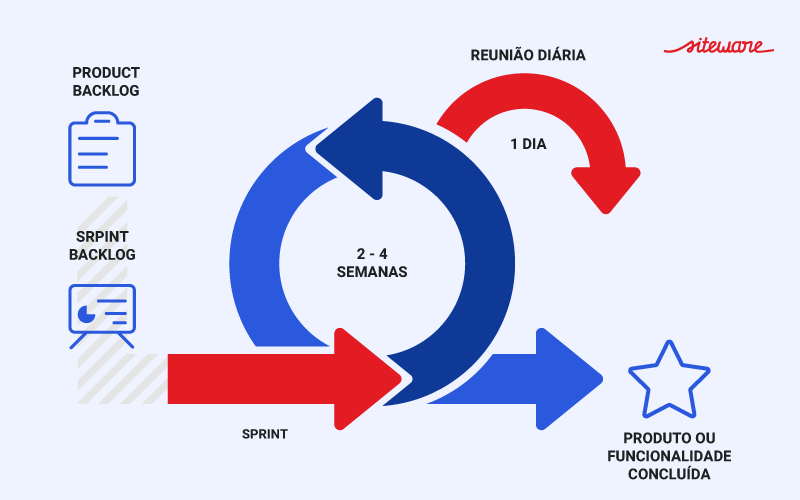
Scrum basically unfolds in three stages: planning, development and final delivery, and within each one there are phases that normally take place.
1- Planning
In the planning stage, all the initial requirements are described and stored in the Product Backlog. This is where the team comes to understand what the project will be in essence. A planning meeting is needed for that.
Next, the requirements are ordered and grouped into a Sprint Backlog. This is where the requirements are divided up, along with the role of each one in developing the product.
Then an initial effort estimate is made, and an initial architecture for developing the product is proposed so that work can begin.
2, Development
Once the proposal is approved, the software or any other product is developed in cycles, also known as sprints. The sprint is the phase where the action really begins. Each cycle can last from two weeks to a month.
During these cycles, short daily meetings of 15 minutes are held to track problems and task progress. Note that each sprint can follow activities similar to a traditional process.
That means requirements analysis, design, implementation and testing happen in each sprint before moving on to the next one.
3, Final delivery
Finally, the last stage is the final delivery, where integration and final testing are done and the user documentation is prepared. At this stage, the whole team meets to:
- analyze the project results;
- identify problems so they do not happen in future projects;
- demonstrate and hand over the final product.
Right after the customer approves, the project is closed. Note that there are few stages, since the purpose of Scrum is precisely to speed up the whole process.
See another agile methodology for managing teams and projects on our blog: Optimize processes with the Kanban methodologyopens in a new tab
Want to learn about other agile methodologies like Scrum? Watch our video (in Portuguese), where we cover the main ones and how to use them in your company:
The 3 pillars of the Scrum methodology
Scrum is supported by 3 pillars:
1- Transparency
All documents and other data that matter for the success of the project must be visible to everyone who is part of it.
2- Inspection
From time to time, an inspection is needed to check that the process is correct, meeting quality standards and on the right track.
In Scrum, inspection normally happens in the daily meeting (Daily Scrum).
Does your team know how to run a good meeting? To get effective results, you will need good planning. Read this e-book (in Portuguese)opens in a new tab to learn how to run a results meeting!
In these meetings, the people involved in the project share information and discuss topics such as:
- What is being done;
- What is planned next;
- They identify impediments;
- They set priorities according to what was discussed and agreed as a team.
3- Adaptation
It happens after the inspection.
Actions are immediately created and put into the process to improve it.
Any problem must be adjusted as quickly as possible so there are no failures and the end customer’s needs are met.
One very effective way to put this into practice is through Scrum tools.
Scrum examples in practice
Imagine a company is developing software and wants to apply the Scrum methodology. The first step is to define the 3 roles in the method:
- Product Owner;
- Scrum Master;
- Development Team.
The Product Owner holds the leadership authority over the final software and is the only one who can decide what will be done and in what priority order.
The PO must clearly communicate to everyone else what the project aims to achieve.
The Scrum Master helps the others understand and embrace Scrum values, principles and practices, acting as an arm of the PO to facilitate the whole development of the project.
Unlike the PO, the Scrum Master has no authority to control each team member. They act as a leader, not as a manager.
Finally, the development team needs to be defined with very clear roles, and the ideal is a team of at most 10 people to make self-management easier.
With everything defined, the software planning process begins. This is the first stage, and it is where each member’s functions need to be well delimited.
Once the project is approved, it moves to the execution stage, divided into several sprints with daily meetings. After completion, it finally reaches the end and is delivered to the customer to approve or not.
Scrum tools: how to manage your projects?
Now it is time to talk about Scrum tools. After all, hanging sticky notes on a wall is not really cutting it anymore, is it?
That is how Scrum projects were managedopens in a new tab at first, and in some places many people still like it that way.
However, important information can be lost at any moment when it is exposed in such a fragile way.
Project management is a task that requires planning.
And since we are living through digital transformationopens in a new tab (in Portuguese), the virtual version of the Scrum methodology makes it much easier and more practical to organize tasks and work as a team more efficiently.
To help professionals, many Scrum tools, free or paid, are available on the market.
10 free Scrum tools
Watch the video below from our YouTube channelopens in a new tab (in Portuguese) for a summary of the tools we present next!
Scrum tools are built to optimize processes and the management of teams and projects, bringing more speed, dynamism and productivity.
All the sites we researched offer free versions and paid plans.
Of course, free versions have limitations, but they are great options for teams that are just starting out and for companies that want to test which Scrum project management tools they want to use day to day.
1. Trello
Trelloopens in a new tab is a project management platform that uses boards, lists and cards to organize tasks and information. It is widely used to track personal and team projects, from individual tasks to complex projects. In its free version, Trello offers:
- Unlimited boards, lists, cards, members, checklists and attachments;
- One Power-Up per board (integrations with other tools);
- File attachments of up to 10MB from your computer, or links to any file from Google Drive, Dropbox, Box or OneDrive.
2. IceScrum
IceScrumopens in a new tab is an agile project management tool focused especially on agile development methodologies such as Scrum and Kanban. It aims to make team collaboration, traceability and task organization easier in software projects and other initiatives. In its free version, IceScrum offers:
- 1 team;
- 1 public project (stakeholders);
- 3 apps;
- 100MB of storage.
3. Scrumhalf
Scrumhalfopens in a new tab provides a full Scrum and Kanban view in a digital environment. The company offers software, consulting and mentoring focused on agile management for companies. In its free version, Scrumhalf offers:
- 1 project;
- 2 users;
- Drag-and-drop Kanban board;
- Dropbox integration;
- Reports.
4. PangoScrum
The PangoScrum version is free and offers:
- Product Backlog management;
- Sprint planning;
- Progress monitoring;
- Event scheduling.
5. Taiga
Taiga is a project management and agile development platform that aims to help teams collaborate, plan and track the progress of software projects and other initiatives. It is especially geared toward agile methodologies such as Scrum and Kanban. In its free version, Taiga offers:
- Up to 3 members in a private project;
- 1 private project;
- Unlimited public projects;
- Up to 300MB of storage in private projects.
6. Mingle
Mingle is a project management and agile development platform created by ThoughtWorks, a software consulting company. It is designed to help teams plan, track and collaborate on software projects and other initiatives, using agile approaches such as Scrum and Kanban. In its free version, Mingle offers:
- 5 free users;
- Chat;
- Source code integration;
- Progress reports, forecast charts and cycle time analysis, etc.
7. MeisterTask
MeisterTask is a task and project management platform that aims to help individuals and teams organize and track their activities effectively. It offers a visual, collaborative approach to task management, letting users create, track and complete tasks in an organized way. The basic plan is free and includes:
- Unlimited projects and tasks;
- Projects with unlimited members;
- Customizable project dashboards and panelsopens in a new tab;
- 2 integrations with your favorite apps;
- 20MB limit for file attachments;
- Mobile apps.
8. Asana
Asana is a project and task management platform that helps individuals and teams plan, organize and track their activities efficiently. It offers a visual, collaborative approach to task management, allowing users to work in a more productive and coordinated way. In its free version, Asana offers:
- Unlimited tasks, conversations and projects;
- Up to 15 team members;
- Basic dashboards;
- Basic search.
9. Wrike
Wrike is a collaborative work management platform that aims to help teams and organizations plan, track and run projects and tasks efficiently. It offers features for project management, team collaboration, task tracking and workflow automation. In its free version, Wrike offers:
- 5 free users;
- File sharing;
- Task management;
- Real-time updates;
- Integrations (Google Drive, Dropbox, Box, Microsoft Office 365, OneDrive and iCal);
- Android and iPhone apps;
- 2GB of storage.
10. YouTrack
YouTrack is a project management and issue tracking platform developed by JetBrains. It is a versatile tool that helps teams and developers organize tasks, manage projects and track issues efficiently.
YouTrack is particularly popular among software development teams, because it offers specific features for collaboration and technical issue tracking. In its free version for open projects, YouTrack offers:
- Up to 10 free users;
- 5GB of storage;
- Bug and issue tracking;
- Report generation (Burndown charts, QA, issue distribution reports, timeline reports, etc.).
Next steps
For successful companies, the ideal is to have a strategic planning system that helps increase, engage and boost results, with visual resources that improve the company’s strategic deployment.
This business management system allows integrated tracking of corporate performance, and the monitoring and centralization of all indicators, with a focus on decision-making.
On the market, software with all these characteristics is Stratwsopens in a new tab, which lets managers organize their work routine with better management and engagement of the whole team.
Stratwsopens in a new tab is software developed by Siteware that helps companies find improvement opportunities, improve their productivity and achieve great results.
Transform your company’s management with Stratws

Get some tips on project management by downloading our free e-book (in Portuguese): 10 best practices for project managementopens in a new tab
Frequently asked questions
What is Scrum?
Scrum is an agile project management methodology that organizes work into short cycles called sprints. Its focus is to deliver continuous, incremental value, which allows quick adjustments as changes or new needs come up.
What is the goal of Scrum?
The goal of Scrum is to increase the efficiency, collaboration and flexibility of teams, ensuring continuous deliveries aligned with the expectations of customers or stakeholders. It helps reduce waste, increase transparency and productivity, and improve the quality of deliveries.
What roles are played in the Scrum methodology?
1. Product Owner (PO): responsible for prioritizing the backlog and maximizing the value of the product;2. Scrum Master: makes sure the methodology is followed and removes obstacles;3. Development Team: a multidisciplinary team that carries out the tasks within the sprints;
When should you implement the Scrum methodology?
Scrum should be implemented when a company or team needs more agility, collaboration and ability to adapt in its projects.Technology, software development and innovation companies use Scrum the most, but the framework can also be applied in areas such as marketing, HR, education and strategic management.It is especially suited to scenarios where:1. Requirements can change often;2. Value needs to be delivered in short, incremental cycles;3. The work requires collaboration across different areas;4. The organization seeks more transparency and team engagement;5. There is a need for continuous process improvement.

About the author
Equipe Siteware
Content produced and reviewed by the Siteware team, curated by internal experts in strategic management and corporate performance.