
Strategy and Goals
KPI management: how to do it in 6 practical steps
Learn how to manage KPIs step by step, the main types of indicators, why they matter for your company's success, and more.

In recent years, most companies have realized they need to track indicators.
The idea is to identify goals to be tracked that, if met, will signal the organization’s success. That is why there is so much talk about KPI management.
According to Gart Capoteopens in a new tab, in his book “Guia para Formação de Analistas de Processos” (in Portuguese):
“Key performance indicators say what the organization needs to do to raise performance considerably. They should represent a set of measurements that translate the corporate performance needed for success”
So KPI management consists of defining these key performance indicators, tracking them, and making decisions and taking corrective action when needed.
This article aims to help you understand more about KPI culture and how to define and track KPIs in a company’s routine. Keep reading to learn more!
Also read: Performance indicator management: why and how to handle a deviation (in Portuguese)

What are KPIs?
KPIs, or Key Performance Indicators, are metrics used to evaluate the success of an organization, department, team or individual in reaching specific goals.
They are essential to performance management because they give an objective way to measure progress toward predefined goals.
Also, as the name says, they are KEY. In other words, there will be other indicators, but not all of them are important enough to be a KPI.
For example, imagine a manager says: “I have the impression that more customers are dropping out in the middle of the buying journey.”
A bit vague, isn’t it?
Now suppose that instead they said the churn rate for October was 40% higher than in September.
Besides sounding more “real,” the problem becomes clearer and solutions can be developed based on goals, numbers and analysis. That is exactly the role of indicators and, above all, of KPI management.
Naturally, they are, or should be, in practically every sector and activity of a company. After all, as the name suggests, they measure the performance of the activities, strategies and tools the company puts in place.
Depending on the goal and the industry, they can be categorized and named with different terms. That means there are countless types of KPIs.
See also: Infographic: Get out of the shocking statistic of 92% of companies that do not measure their results!opens in a new tab (in Portuguese)
What are operational KPIs?
Operational KPIs are specific metrics used to measure the performance and the efficiency of a company’s operational processes.
In other words, these are the success indicators for people working on the front line, such as analysts.
They are essential to understand how the organization is performing against its daily and short-term goals.
These indicators are used to monitor operational health, identify areas for improvement, optimize processes and make sure the company is running efficiently and effectively.
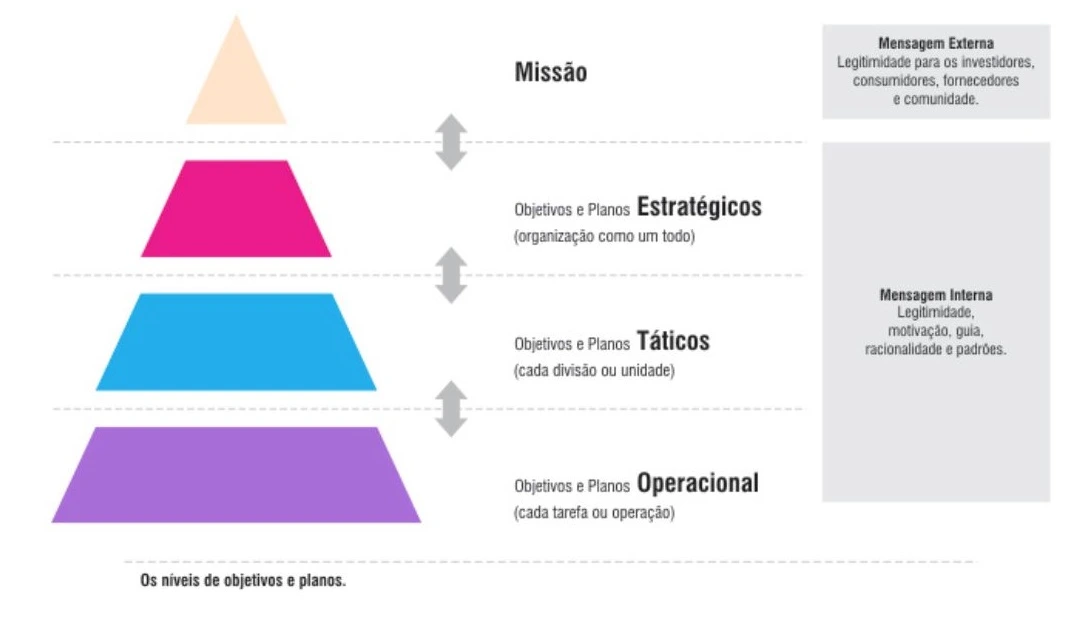
In this way, operational KPIs differ from strategic KPIs, which focus more on long-term goals and the company’s overall vision.
While strategic KPIs may focus on overall growth, market expansion or customer satisfaction at a higher level, operational KPIs deal with the day to day and operational efficiency.
What are the most important KPIs for companies?
Many different indicators can become an organization’s KPIs. Defining the most important ones, however, depends a lot on the company’s goal, business model and vision.
An organization that pays close attention to customers, for example, should consider: Net Promoter Score (NPS), Customer Satisfaction Score (CSAT), churn rate and so on.
The overall goal (defined in strategic planning) will also directly affect which indicators the organization tracks.
Still, among the wide range of possible goals, some indicators are quite commonly tracked. They are:
1- Internal process capacity KPIs
These are the key indicators of a company’s production potential. This type of indicator is very common in industry, for example. Some examples of internal process capacity KPIs include:
- daily production volume;
- number of service calls per period;
- production cost per customer, per product and so on;
- production journey time;
- delivery volume.
2- People management KPIs
This category includes indicators that evaluate employees’ productivity, performance and well-being. As we live in a time when HR is looking more and more at people management with a modern eye, the area has also started to have specific KPIs, such as:
- volume of complaints;
- turnover rate (turnover);
- cost of hiring, training and developing professionals;
- average time to fill positions;
- satisfaction index;
- productivity;
- number of absences;
- goals met.

3- Financial KPIs
Managing key performance indicators must also consider financial aspects, related to income, profit, prices and costs. These KPIs are extremely common and important for any company and cannot be left aside.
- profitability;
- average ticket;
- default rate;
- return on investment;
- LTV, lifetime value, or the total revenue a customer brings to the company over the length of the relationship.
It is worth noting that some types of KPIs can be included in different management areas. This is the case of CAC, or Customer Acquisition Cost, which is in the financial category but also in marketing, internal process analysis and others.

4- Marketing KPIs
Marketing KPIs are metrics used to evaluate the effectiveness and success of a company’s marketing activities. They help measure campaign performance, strategy efficiency and the return on marketing investment.
Some of them are:
- Cost per Lead (CPL): Measures the cost of generating a new lead for the business;
- Conversion rate: Represents the percentage of visitors who take the desired action (such as making a purchase, signing up for a newsletter or filling out a contact form) out of total visitors.
- ROMI: This KPI measures the financial return from specific marketing campaigns.
- Traffic: Refers to the number of visitors a website receives.
- Click-through rate (CTR): Measures the percentage of people who click a specific link out of the total number of people who see the link (such as in an ad, email or social media post).
5- Customer success KPIs
In performance metrics management, the customer should be the main focus. So it is essential to set indicators that measure their success and satisfaction with processes, services and products. Some examples are:
- Net Promoter Score (NPS): number of customers who are promoters of your brand, captured through direct surveys;
- churn rate, also known as abandonment rate, when the customer gives up on the purchase during their journey;
- Customer Satisfaction Score (CSAT): customer satisfaction index, also captured through in-person or online surveys;
- average service time, problem resolution time and wait time;
- number of open and closed opportunities.
Besides these, there are many others. In other words, to find out which KPIs are the most important for the company, you need to know and analyze your own processes and the business model you operate.
Whatever your choices, it is essential to define clearly which ones will be used. But why? What is the real importance of KPIs and of managing strategic results?
See also: Kit: Create, manage and analyze your indicatorsopens in a new tab (in Portuguese)
Why do KPIs matter?
Key performance indicators matter because they quantify the success of the strategies put in place. The idea is that there is a big goal for the company to reach. To reach it, however, you need to define success indicators. If all the indicators are met, the company will achieve its goal.
By putting the performance achieved in numbers, we can see more clearly how effective decision-making is. This makes it possible to identify which solutions and processes are reaching the expected goals and how close they are to the forecast returns.
By comparing indicators with goals and expectations and finding a gap between them, managers and the team can work to pinpoint the inefficiency and fix it as quickly as possible, reducing response time and raising the potential of every sector of the company.
But for that, it is essential to set well-defined KPI management processes, which takes us to the next topic. See a step-by-step guide to management below!
How to do KPI management in 6 steps
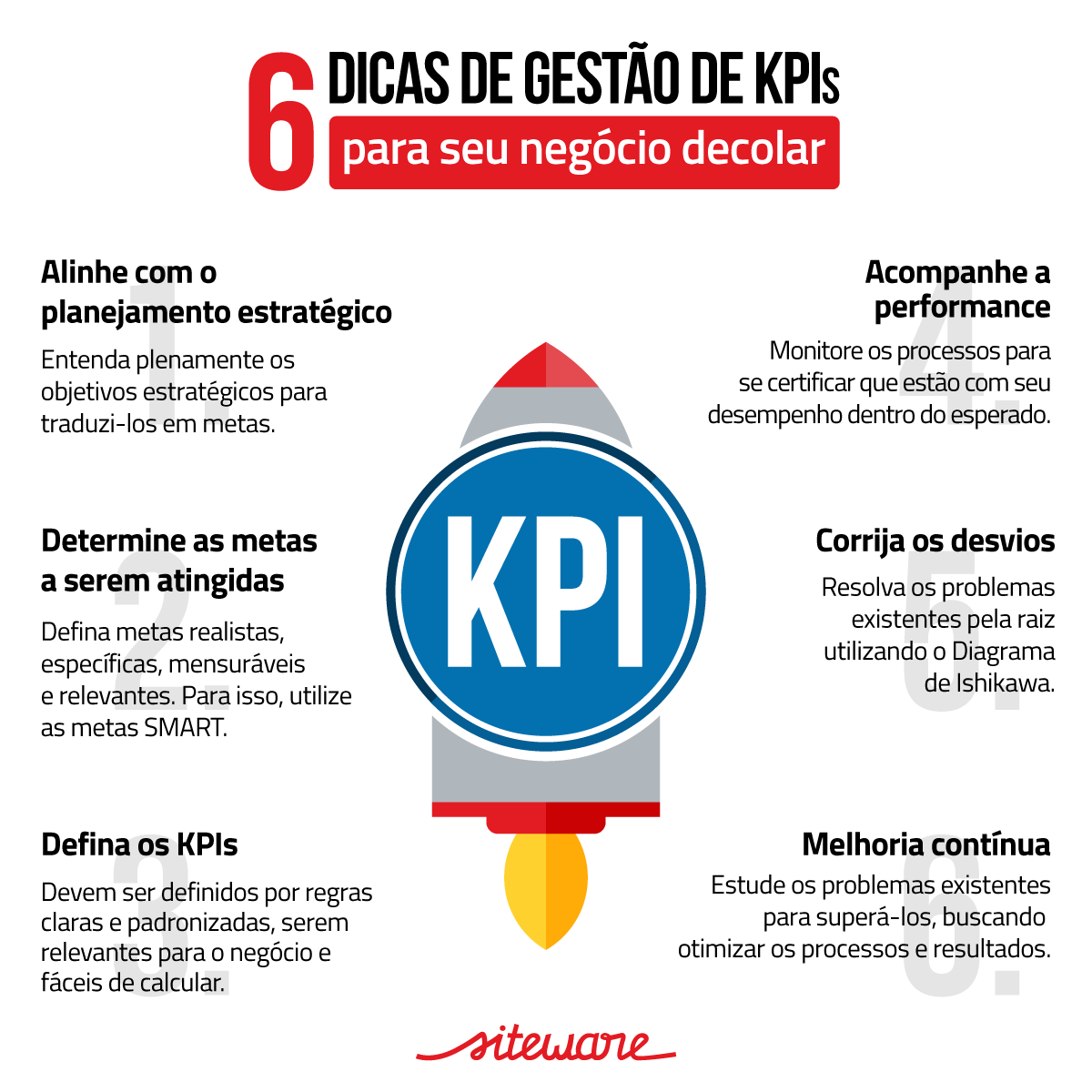
The step-by-step for KPI management can vary according to the business model and the company’s goals. It can also vary according to the method used to do the tracking, such as GPD (in Portuguese) or OKR. But in general, the steps should be:
- alignment with strategic planning;
- determining the goals to be met;
- defining the KPIs;
- performance tracking;
- correcting deviations;
- continuous improvement.
In the following sections we go deeper into these steps. Keep reading!
1- Alignment with strategic planning
Before defining individual or area indicators, every company must have already built a strategic planopens in a new tab. It guides the actions of your employees and defines how the chain of processes will add value to the products and services you offer the market.
This strategic plan sets the strategic objectives. In other words, what the company will focus on over a year or more. This is essential to guide the actions and, consequently, the KPIs used to measure success.

2- Determining the goals to be met
Based on the strategic objectives, you will need to define actions to reach them. These actions will be the starting point for defining your KPIs.
If the company expects to generate 10% more profit than last year (strategic objective), for example, marketing may need to generate 30% more opportunities than last year.
Each KPI must be clearly defined so that everyone in the organization understands what it means and how it is calculated. It must also be measurable, that is, you should be able to quantify performance using data.
KPIs must also be realistic and achievable so they do not demotivate the team. They also need to be relevant to the area or process they measure, contributing directly to the success of the strategic objectives.
Another important point is to define a clear methodology for data collection, including who will be responsible for collecting it, how often it will be collected and through which tools or systems.
Deepen your knowledge by reading more: SMART goals: 5 characteristics for defining a goal that works!opens in a new tab (in Portuguese)
3- Performance tracking
One of the main roles of KPI management is to monitor processes to make sure their performance is within what is expected.
A very common mistake in organizations is to define indicators but not manage KPIs throughout the year. This makes it hard to identify and track whether actions are generating results.
After all, it is not enough to define KPIs. It is crucial to measure and track them constantly, in order to detect deviations and failures and take the necessary measures in pursuit of high performance.
4- Correcting deviations
If a machine is running slowly and that is affecting a process performance indicator, you need to find the cause of the slowness.
A KPI below target is a red light coming on. KPI management involves knowing how to bring performance back to the desired level and the light back to green.
Also, correcting deviations aims to solve problems at their root, and a widely used methodology for this is the Ishikawa Diagram.
Learn to use this tool by reading this article: What is an Ishikawa Diagram and how to make one?opens in a new tab (in Portuguese)
5- Continuous improvement
Even when KPIs are being met, it is always possible to improve processes.
Part of KPI management is studying them continuously in search of bottlenecks, delays and waste that can be overcome. For that, you need to design new dynamics, which will be used to check whether the optimized process is really reaching higher performance levels.
Next steps
Want to go even deeper into KPI management? Download this infographic now: How to use KPIs to track results and engage your team?opens in a new tab (in Portuguese)
Siteware developed an indicators softwareopens in a new tab able to centralize all the performance management of your business, cascading strategy, connecting projects and running your action plans.
With a robust business management system, KPI management becomes much simpler and more effective, with connected, centralized, real-time tracking of all corporate processes.
That is exactly what Stratwsopens in a new tab provides for your company. It is a complete, intuitive business management software that will help you define and track KPIs.
Frequently asked questions
What are KPIs?
KPIs (Key Performance Indicators) are key indicators that measure the results of processes, teams or strategies against defined goals. They are used to track whether the company is on the right path and whether goals are being met.
Why is KPI management important?
KPI management is essential to turn data into strategic information, support decision-making and keep the company focused on results. When well structured, KPIs increase transparency, alignment between teams and the ability to react to problems or opportunities.
How to do KPI management?
1. Define the company's strategic objectives; 2. Choose suitable KPIs that reflect those objectives; 3. Set clear, measurable goals (SMART goals can help a lot here); 4. Monitor results continuously, through reports and dashboards; 5. Analyze deviations and trends to identify improvement opportunities; 6. Act and review periodically, adjusting processes and indicators when needed; 7. Rely on management software like Stratws to centralize KPIs, goals and action plans, ensuring continuous tracking and greater alignment between teams.
What are the characteristics of an effective KPI?
A good KPI must be: 1. Relevant: directly connected to strategic objectives; 2. Measurable: based on reliable data; 3. Clear: easy to understand and communicate; 4. Achievable: realistic, but challenging; 5. Comparable: must allow analysis over time; 6. Up to date: monitored frequently.

About the author
Equipe Siteware
Content produced and reviewed by the Siteware team, curated by internal experts in strategic management and corporate performance.