
Project Portfolio
How to build a successful project schedule in 7 steps
How do you build a project schedule? See the step-by-step guide and set the ideal tasks, resources and deadlines for your projects to succeed.

Every successful project starts with a good schedule, set by the manager and aligned with the whole team during the planning stage. Do you know how to build an effective project schedule?
The document is important for detailing tasks, responsibilities, deadlines and budgets, and it also allows close tracking of action plans.
There is so much information that the schedule proves extremely necessary throughout the project management life cycle.
In this article, you will see 7 essential steps for monitoring projects accurately and keeping the work on track.
What is a project schedule?
A project schedule can be defined as a document that describes all the tasks to be completed in a given project plan. It acts as a detailed map, outlining the path your team must follow to reach the stated objectives.
Understanding how to build a project schedule helps you give a clear view of all project stages, allowing managers and teams to see deadlines, distribute resources and coordinate effort effectively. It is a tool that guides and inspires action, keeping everyone involved aligned and motivated.
This way, with a well-structured schedule, the chaos of tight deadlines and mismatched expectations gives way to a harmonious orchestration of activities that leads to project success.
What items should a project schedule contain?
A well-built project schedule should contain some elements that are essential to ensure its effectiveness and clarity for everyone involved. Below, I list 10 that are usually basic for any schedule:
- Project objectives: every schedule should start with a clear definition of the objectives the project aims to achieve. This helps keep focus and ensures all activities are aligned with those objectives.
- Activities and tasks: the list of all the activities and tasks that need to be completed. These should be detailed enough for each team member to know what is expected of them.
- Task dependencies: it is crucial to identify and map dependencies between tasks, since one task may need another to be finished before it starts. Understanding these relationships is essential for project flow and for preventing delays.
- Deadlines: each task should have a planned start and end. These deadlines should be realistic, considering all relevant factors, such as dependencies and available resources.
- Allocated resources: includes information on who is responsible for each task and which resources (human, financial, technical) are allocated to carry them out.
- Milestones: key points in the project that indicate an important stage or the completion of a critical phase. Milestones are useful for assessing project progress.
- Review and evaluation dates: specific dates to review project progress and adjust the schedule as needed. These reviews are essential to keep the project on track.
- Potential risks: identification of possible risks that may affect the schedule and the mitigation measures associated with them.
- Budget: details on the available budget and how it will be distributed across the different phases of the project.
- Communication: a communication plan that describes how information will be shared among stakeholders and the project team.
How to build a project schedule in 7 steps
Before you start building your project schedule, it is essential to avoid common mistakes in the planning stage. One of them is not organizing processes and projects within the company.
The first step is to understand that projects are a group of unique tasks, carried out to reach a goal that will help the company. Processes, on the other hand, are actions carried out that will produce a recurring result.
See more in the infographic:
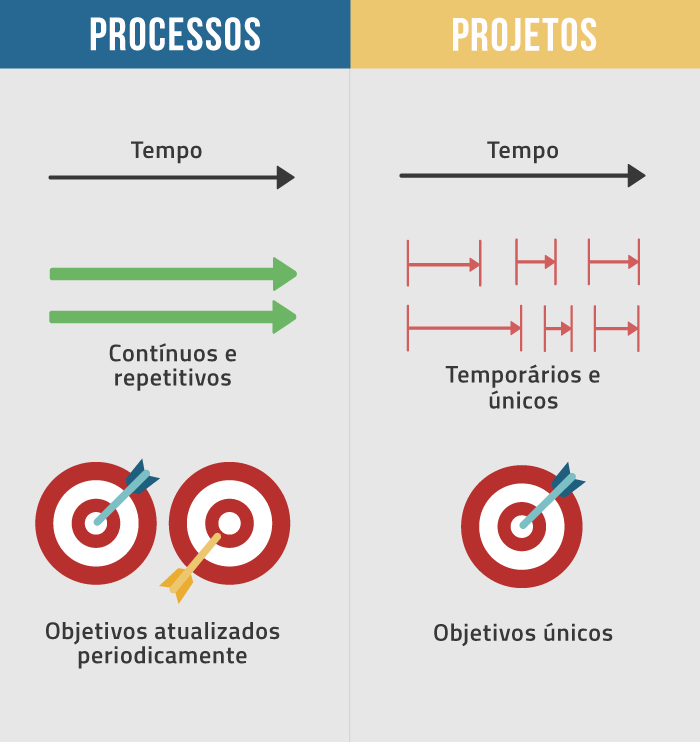
This way, to build a project schedule, just follow these steps:
1. Define the project tasks
The first step in how to build a project schedule is to identify all the tasks needed to carry it out. That is, the scope of the project to be worked on, defining what will actually be done.
You do not need to worry about a specific order or about details at this first moment. Just write down everything you believe is needed to reach the project’s results and the ideal delivery deadline.
One material that can help you with this is our free resource “The complete guide to Project Managementopens in a new tab” (in Portuguese). With it, you will be able to build a good plan so that the final result is just as you planned it!
2. Make a WBS
The WBS is the Work Breakdown Structure and, to make one, you should create a list of tasks that need to be carried out for each deliverable. This structure is like the breakdown of the scope, important for listing all the work and deliverables in a way that is easier to manage.
Also identify the dependencies between tasks, which will help you in the next step, determining the order in which to carry them out. These dependencies can include, for example:
- That task “A” must be completed before task “B” starts
- That task “A” must start before task “B” starts
By analyzing these dependencies more closely, you prepare to avoid and eventually handle future scheduling problems.
3. Set priorities
Now that you have all the activities listed, start setting execution priorities. Besides considering the most important activities, at this stage it is worth assessing which tasks, in order to start, need to wait for a previous one to finish.
Taking care of this sequencing of activities is a way to prepare everyone to deliver the project on time, on schedule and without confusion.
The idea is to avoid rework and wasted time fixing errors that could have been avoided just by paying attention to the schedule.
If you need help building an action plan and also setting priorities for the stages of your project schedule, you can download our 5W2Hopens in a new tab spreadsheet with the GUT tool to support you in a very practical way!

4. Identify the resources needed
The next step in how to build a project schedule is to assign resources to each task.
This planning is essential, since a resource may be assigned to another project in parallel and you need to prepare for the unexpected. So, ask yourself which resources will be needed to carry out the proposed actions, what budget is available, and so on.
As a project manager, you also need to know exactly who will be doing what, outline a clear work plan and thus ensure that all tasks have adequate follow-up and, consequently, excellence in their execution.
5. Estimate the time to complete the tasks
How long does each activity you listed in your schedule take?
Even if they are already organized and in priority order, you need to estimate their duration to complete the schedule. This is perhaps the most important step in scheduling, since it can affect project costs.
Duration is the time needed to complete a task, whether days, weeks or months. Do not underestimate the time each task needs, and always focus on the time needed to deliver quality work.
Consider holidays, vacation periods and absences, and your company’s productivity levels. A tip for making estimates efficiently is to analyze historical data from previous projects with similar characteristics.
Besides, of course, talking to the team and the professionals who would be involved in the tasks.
See the 5 best project tracking tools →opens in a new tab
6. Analyze the customers and suppliers involved
To better understand deadlines according to the people involved in the project, also try to identify and analyze which customers and suppliers will be linked to the established tasks.
7. Keep the project schedule up to date
The project has started, and the schedule is working? Great. But that does not mean your estimates will not be subject to change. For this reason, you need to keep the schedule up to date at all times.
Any and all data can be relevant to ensure accuracy in the schedule and help every professional find their place in their tasks.
Never leave the project schedule aside, since it will be the main tool for seeing project status and helping ensure quality delivery.
Want more project tips? Then watch this video from our YouTube channelopens in a new tab (in Portuguese):
Why is a project schedule important for a company?
First, the project schedule helps set clear and realistic deadlines for completing tasks. This is crucial for keeping everyone involved in the project aligned and focused on the objectives. Setting milestones and deadlines contributes to team motivation, since it creates a sense of urgency and progress as tasks are completed.
In addition, the project schedule is an essential tool for risk management. By identifying dependencies between tasks in advance, managers can anticipate possible bottlenecks and resource conflicts, allowing proactive decisions to mitigate these risks.
Another important point is that the project schedule makes communication easier among all stakeholders. It gives a clear view of project progress, allowing customers, suppliers and team members to be aware of progress and expectations.
Next steps
Making use of an organized project schedule lets project managers and teams understand whether they are succeeding and which adjustments are needed to reach results in the future.
This project management software allows full visibility and management of your activities, closely monitoring schedule progress. And there is more! This business management system lets you track performance indicators to make decision-making faster and more accurate.
You can use more than one of these tools, using them properly, each for its specific function. Stratws is corporate management software used by large corporations with enormous success.
Revolutionize your company’s management with Stratws


About the author
Equipe Siteware
Content produced and reviewed by the Siteware team, curated by internal experts in strategic management and corporate performance.