
Cases
MRS Logística: how continuous improvement groups moved off spreadsheets
See how MRS Logística standardized its Continuous Improvement Groups and gained reliable data with Stratws, Siteware's management software.
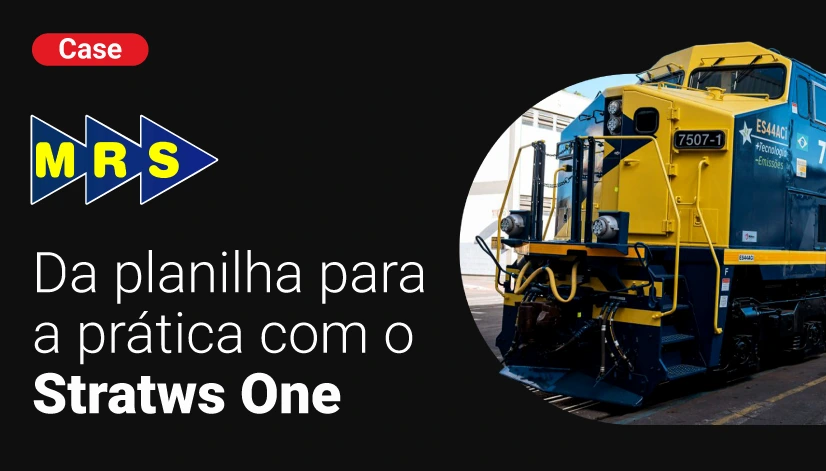
MRS Logística replaced the loose spreadsheets used by its Continuous Improvement Groups (CIGs) with Stratws, Siteware’s management software. That solved a problem that kept growing along with the program: unreliable information. With the new system, the company standardized its teams’ method and sped up decisions based on real data, not scattered spreadsheets.
MRS operates a 1,643-kilometer rail network across the states of Minas Gerais, Rio de Janeiro, and São Paulo, moving mining, steel, container, and agribusiness cargo. Part of that operation is fine-tuned constantly inside the CIGs, where employees from operational areas analyze recurring problems in their own areas and propose solutions connected to the company’s strategy.
What challenges did MRS’s Continuous Improvement Groups face?
Before Stratws, every registered CIG had its own spreadsheet. Evaluations were done in loose forms and then manually consolidated into a Power BI dashboard that said little about how projects were actually progressing.
The more the CIG program grew at MRS, the more fragile the control over what was written in each spreadsheet became, and the more exposed the governance process got.
The spreadsheet allowed frequent, constant edits on key project information, and that brought a loss of reliability we considered quite harmful to the project's analysis and to how the stages progressed.
Between the program’s second and third year, the number of employees and initiatives registered in the CIGs grew substantially, exposing the fragility of spreadsheet-based control even further.
Why did MRS choose Stratws?
Three points shaped MRS’s choice of system: the user-friendly interface, the flexibility to build problem-solving reports, and the ability to consolidate initiatives in a single place.
The main criteria for choosing Stratws were the system's user-friendly interface, the flexibility to build the problem-solving report, and the ability to manage strategy alongside participative programs in one place.
How was Stratws adopted by operational teams?
Switching systems tends to run into resistance, since it changes teams’ routines. At MRS, adoption was high and resistance was low. To make that happen, the company built an intuitive, standardized form for entering information and complemented it with short support videos.
Validation meetings for each stage started happening inside Stratws itself, with the employee presenting the project’s progress live. Because these meetings now happen inside the system, they cut out an entire step of manual follow-up work and keep what gets recorded closer to the project’s reality.
What results did MRS get from continuous improvement with Stratws?
In the first cycle with full use of the system across CIG programs, MRS reported gains on several fronts:
| Area | Result |
|---|---|
| Engagement and completion | More groups completing the cycle successfully |
| Analysis quality | Built-in quality tools, such as Pareto charts and Ishikawa diagrams |
| Decision speed | Faster follow-up, with everything gathered in one tool |
| Traceability and access | Information centralized and visible to all CIG members and managers |
| Knowledge management | History of projects from previous cycles available for reference |
In the CIG flow, these quality tools come in at specific points of the analysis. In the observation stage, the group uses the Pareto chart to prioritize which problems to tackle first. In the next stage, it turns to the Ishikawa diagram to map the causes behind each problem.
Before Stratws, that cross-analysis depended on separate spreadsheets, outside the project flow. Today both tools live inside the same system, alongside the rest of the analysis.
One of the main gains was decision-making speed. Having everything at hand in a single tool made our follow-up much faster.
The project history also extends indicator monitoring beyond the CIG’s own cycle, tracking how each initiative evolves year after year.
What’s next for MRS’s continuous improvement program?
More than 5,000 people at MRS are eligible to join a CIG. The team’s next mapped step is to create post-project forms, to follow up on each initiative after it closes and sustain the results groups achieve over time.
If I had to sum up how using the system improved things at MRS, I'd put it in three points: reliable information, centralized information that everyone connected to the project can access, and standardized use of the method, thanks to the tools and the standard form available for teams to fill in.
MRS Logística’s experience shows what changes when Continuous Improvement Groups move off loose spreadsheets and adopt a standardized method, with reliable data and a history everyone involved can access.
Does your company still run action plans on spreadsheets?
Explore Stratws' Routine Management and Continuous Improvement solution and see how to centralize your company's CIGs in a single system.

About the author
Equipe Siteware
Content produced and reviewed by the Siteware team, curated by internal experts in strategic management and corporate performance.