
Variable Compensation
Variable Compensation: What It Is, How to Calculate and Implement
Learn what variable compensation is, see the types, calculation models and the step-by-step to implement a fair, auditable policy in your company.

Variable Compensation (VC) is the part of pay tied to goals, results and performance. In companies, it can take different forms, such as commission, bonus and profit sharing (PLR).
When well managed, it is a management strategy that directs the focus of work and reinforces a performance culture.
The big challenge for many organizations is that VC programs, although they look well structured on paper, end up generating data that triggers questions, disputes and rework for management.
No wonder 83.5% of companies struggle with a medium or high effort to close the cycle.
In this guide, we demystify VC models, calculation best practices and the step-by-step to implement a policy that is fair, transparent and, above all, scalable for your business.
National Variable Compensation Overview
Download the full research, with data and analysis from compensation experts (in Portuguese).
What is variable compensation?
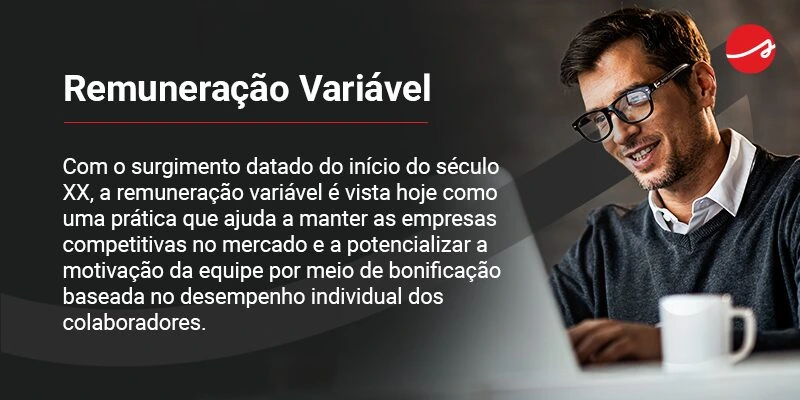
Variable compensation is a portion of pay given on top of the fixed salary, conditioned on reaching specific goals or results. It is a management strategy that uses models such as commissions, bonuses and PLR to steer behavior, reinforce strategic priorities and strengthen a high-performance culture in companies.
To do that, it needs clear, predefined criteria: what goes into the calculation, how it is calculated, how it is measured and the payment period.
In general, forms of variable compensation can be designed for different levels of performance.
- Individual (e.g., sales commission, performance bonus);
- By team or area (e.g., team goals, quality, productivity);
- Company-wide (e.g., PLR/PPR tied to corporate results).
A good way to build a compensation policy or structure a VC plan by role is to make sure these three questions are answered from the start of the process:
- Who participates?
- Which indicators will be considered?
- How will the calculation be done and audited?
To avoid noise in corporate communication, it is also important to be clear about what variable compensation is not:
- It is not an extra payment without rules: metrics, weights and criteria must be defined before the cycle starts;
- It is not a goal without a reliable source: every indicator needs an owner, a frequency and a clear data source;
- It is not a subjective calculation or a surprise: employees need to understand the whole process.
What is the difference between variable compensation and salary?
Salary is fixed, recurring pay, defined in the contract and paid regularly for the work done. Variable compensation is conditional: payment depends solely on reaching goals, results or performance, according to previously established calculation rules, such as sales commissions or profit sharing.
In practice, the difference is clearer when you look at three characteristics: predictability, purpose and calculation rules.
| Predictability | Purpose | Calculation rules | |
|---|---|---|---|
| Variable Compensation | Varies with results | Steer behavior and reinforce strategic priorities | Requires governance (goal definition, data source, validations and audit). |
| Salary | Is predictable | Pay for the role | Follows contractual logic |
What are the main types of variable compensation?
There are different models of variable compensation, and the choice between them depends on each business’s context.
Below are the most common VC types and examples of what tends to work in practice:
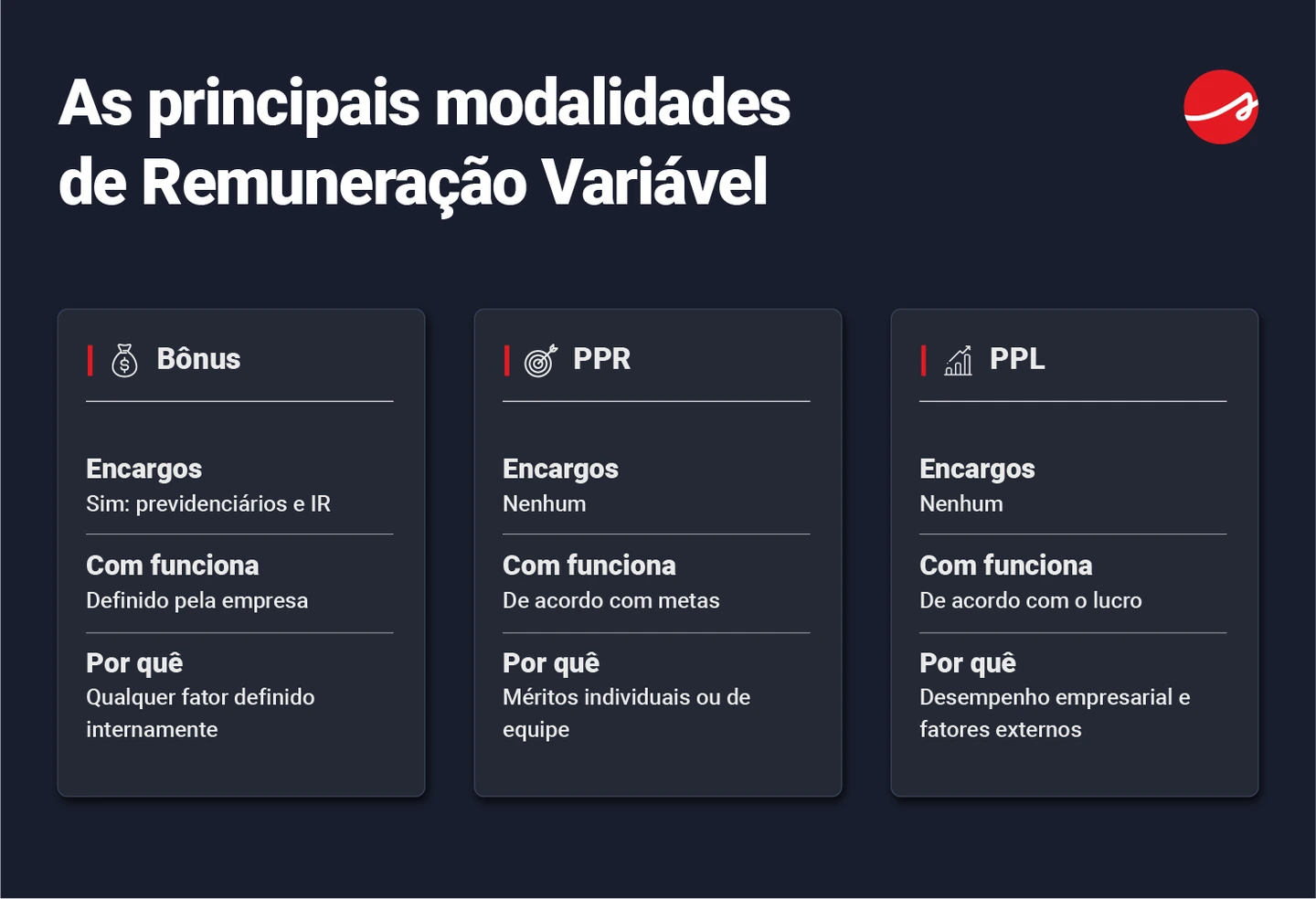
Commission
Commission is a variable compensation model tied to revenue generation. The employee receives a percentage or fixed amount on each sale made or contract closed.
It is widely used in sales areas because it has simple, direct rules and clear performance metrics tied to cash coming in.
Bonus
A bonus is usually conditioned on individual or area performance against goals that are not always sales, such as productivity, quality, efficiency, deliveries and so on.
It is a common form of recognition for professionals in leadership positions or strategic roles, such as specialists.
One point of attention when calculating a bonus is that the criteria must be simple and clear enough for the employee to understand why the amount is what it is.
Results Participation Program (PPR)
The PPR is a structured model to reward the achievement of previously agreed goals and results.
Unlike a commission, the PPR can consider goals by area, by team or company-wide (e.g., SLA, productivity, quality, NPS, reduced rework).
The main point of attention in this model is that, without minimal governance, the PPR can frequently lead to disputes.
That is why applying this model correctly requires maturity to define indicators, weights, achievement ranges and the calculation cycle.
Profit and Results Sharing (PLR)
Profit and Results Sharing relates to the company’s overall performance.
The amount distributed to employees depends on the profits earned in the period and must be formalized through a collective agreement or convention, ensuring transparency and alignment with corporate goals.
Long-term incentives (stock options, multi-year bonuses and vesting)
Beyond the more traditional models, long-term incentives (LTI) have been widely used in startups and technology companies, where talent retention, accelerated growth and alignment with long-term value are priorities.
LTIs are variable compensation mechanisms designed to encourage tenure and sustainable results.
Payment and benefit are conditioned on meeting a deadline (vesting), multi-year goals or both.
What does Brazilian labor law (CLT) say about variable compensation?
The CLT does not treat variable compensation as an isolated topic. What it helps clarify is how some amounts paid to the employee are characterized and why that matters in practice.
In general, variable compensation should follow some guidelines aligned with the CLT depending on the type.
Commissions
Article 457, paragraph 1, of the CLTopens in a new tab (in Portuguese) establishes that commissions are part of the salary. They must be paid according to the sales or services provided by the employee.
In addition, the amount of a sales commission must be clearly defined and agreed between employee and employer, usually through a contract or collective agreement.
Awards and bonuses
Awards are amounts paid to the employee as recognition for exceptional performance or for reaching specific goals.
Under article 457, paragraph 2, of the CLT, awards and bonuses must also be agreed in advance and have clear, objective criteria for granting them.
Long-term incentives
The CLT has no specific rules for long-term incentives. In practice, the care lies in understanding how the amount may be interpreted: whether it works as consideration for work, with pay-related effects, or as an incentive with its own rules, conditioned on time, goals or risk.
This classification usually starts from what the CLT defines as remuneration and salary in art. 457opens in a new tab (in Portuguese).
PLR
PLR is regulated by Law 10,101/2000opens in a new tab (in Portuguese), which establishes that companies may distribute part of their profits or results to employees.
For PLR to be valid, there must be a collective agreement or convention that defines the criteria and conditions for payment.
Beyond the legal details, keep in mind that what is paid frequently and is directly tied to the work tends to require more care and full transparency.
The safest path is to have rules formalized in advance, objective criteria and consistent communication throughout the cycle.
What are the advantages of variable compensation for companies and employees?
When well structured, variable compensation stops being a financial incentive and becomes a management tool.
The gains are seen in companies and in employees’ own feedback, especially when the rules are simple, clearly communicated and followed up throughout the cycle.
Among the main benefits for the company, a few stand out:
- Directs focus to strategic priorities;
- Improves execution and performance predictability;
- Supports a culture of meritocracy and internal recognition;
- Helps attract and retain talent;
- Connects corporate, area and individual goals;
- Reinforces a sense of belonging and cultural fit;
- Strengthens trust between leaders and team members;
- Drives the achievement of results.
What are the disadvantages of implementing variable compensation?
Although it is a great ally of performance, variable compensation can become a problem when poorly planned.
If employees do not understand the “why” behind the amount or cannot check and follow the numbers, the whole process becomes a source of questioning.
There are also other risks:
- Excessive calculation complexity can lead to rework and errors;
- Broken trust or a sense of unfairness due to lack of transparency;
- Internal competition and misalignment between areas;
- Labor risks and communication noise;
- Loss of budget control.
If variable compensation generates more discussion than results, the problem is usually not the model, but the design of the program.
In the next sections, we show how to structure rules, indicators and calculation to keep VC fair, auditable and sustainable.
How to implement a variable compensation program step by step?
The best way to implement competency-based compensation is to treat the program as a process: define rules and criteria, measure with reliable sources and follow up before the cycle closes.
Below is a checklist to structure it properly and reduce disputes in the calculation:
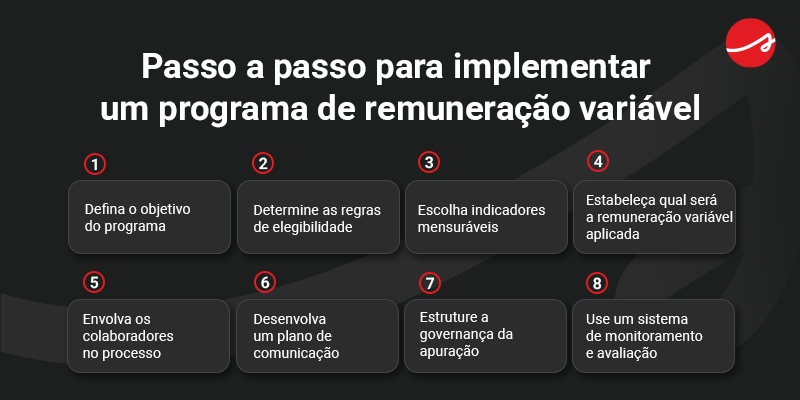
1. Define the program’s objective (what you want to encourage)
Before thinking about calculating VC, it is important to define which behavior or result the company wants to reinforce through the program.
Examples: grow revenue, increase margin, reduce rework, raise productivity, improve quality, increase retention.
To do that, think about the following points:
- Which results should be achieved?
- In how much time?
- Which areas or roles influence those results?
2. Determine the eligibility rules
At this stage, the scope of the program is structured to avoid future noise. Clearly define:
- Which roles and areas can participate;
- Whether or not there will be a minimum tenure to be eligible;
- How to handle hires, leaves, terminations and transfers during the cycle.
3. Choose measurable indicators
Determine which performance indicators (KPIs) will be used to measure employees’ success.
These indicators must be related to the company’s strategic objectives and easy to measure.
4. Establish which variable compensation will be applied
The VC model chosen will depend on the business’s objectives and goals, the organizational culture and the areas covered by the program.
As you already know, the most common VC options include:
- Commissions;
- Awards;
- Performance bonuses;
- PPR and PPL.
5. Involve employees in the process
Involving employees in creating the variable compensation process can increase acceptance and commitment to the proposed initiatives.
Hold meetings, internal surveys and workshops, and collect feedback to make sure the cycle is coherent and motivating for everyone.
6. Develop a communication plan
Create a communication plan to make sure all employees are aware of the new variable compensation system.
Use different communication channels, such as in-person meetings, emails and intranets, to share the information.
In many companies, it is common to implement variable compensation software.
Specific systems bring more visibility and accuracy to the calculations, and also save managers’ and HR’s time.
7. Structure the governance of the calculation
This is the step that will protect your variable compensation program.
To optimize governance, define who is responsible for consolidating and validating the numbers and which method the company will use to ensure the traceability of the final data.
Implementing a monitoring system will be a competitive differentiator for an audit trail, for example.
8. Use a monitoring and evaluation system
Implementing tools to monitor and evaluate employee performance against the defined KPIs is a move toward management maturity.
This can include performance management software or integrated systems, which make it possible to follow performance while ensuring the accuracy of the variable compensation cycle.
Stratwsopens in a new tab lets you track individual performance indicators and goal progress, with easy visualization of the VC process.
In addition, Stratws operates with security controls audited and approved under the AICPA standard, making Siteware a SOC 2 compliant company.
Read also: How to automate your company’s variable compensation?opens in a new tab
How to calculate variable compensation for your company?
The variable compensation calculation changes from company to company, but almost always depends on the same definitions that will support the calculation:
- Which type of VC will be used?
- Which objectives does the program need to encourage?
- Which goals and indicators will be considered?
From these decisions, the general calculation can be understood as follows:
VC = goal achieved x bonus percentage
In practice, it should cover four aspects:
- Base and trigger: what the calculation base is (salary, revenue, margin etc.) and which event confirms payment (closed sale, recognized revenue, goal reached).
- Goals, weights and ranges: which indicators count, the weight of each and the achievement ranges (minimum, target and cap), when it makes sense.
- Cycle rules: eligibility and exceptions (e.g., cancellation, default, goal review, role changes, hires/terminations).
- Calculation with traceability: a single source for the data, validation and a history of versions/approvals.
As a VC program grows, many companies stop relying on spreadsheets and adopt specialized systems, such as Stratws.
That way, they ensure more accuracy in the data, automation of calculations, governance (with audit trail and validations) and security throughout the process.
Practical example of variable compensation calculation
To illustrate the application of the models presented earlier, we prepared practical examples that show how to calculate variable compensation in day-to-day management.
Use these formulas as a reference to structure your company’s plans, ensuring transparency and ease of understanding for employees.
1. Direct percentage calculation (simple commission)
When to use: commission on sales/revenue with a linear rule.
Formula:
VC = Base × Percentage
Example:
- Base (eligible revenue in the month) = R$180,000
- Percentage = 2.5%
Calculation:
VC = 180,000 × 0.025 = R$ 4,500
2. Goal achievement calculation (performance factor)
When to use: bonus/PPR tied to one main goal.
Formula:
Achievement (%) = Actual ÷ Goal
VC = Target amount × Achievement (%)
Example:
- Target bonus amount (month) = R$ 3,000
- Goal = R$ 200,000
- Actual = R$ 170,000
Calculation:
- Achievement = 170,000 ÷ 200,000 = 0.85 (85%)
- VC = 3,000 × 0.85 = R$ 2,550
3. Calculation with multiple indicators (weights)
When to use: bonus/PPR with more than one KPI (e.g., result + quality + individual).
Formula:
Final factor = Σ (Weightᵢ × Achievement)
VC = Target amount × Final factor
Example:
- Target amount (quarter) = R$ 12,000
- Indicators and weights
- Area result: 50%, achievement 90% (0.90)
- Quality: 30%, achievement 105% (1.05)
- Individual: 20%, achievement 110% (1.10)
Calculation:
- Final factor = (0.50×0.90) + (0.30×1.05) + (0.20×1.10)
- Final factor = 0.45 + 0.315 + 0.22 = 0.985 (98.5%)
- VC = 12,000 × 0.985 = R$ 11,820
4. Proportionality and internal moves (month/area/role)
When to use: when the person changes area/role or joins/leaves in the middle of the cycle.
4.1. Proportionality by time in the cycle
Formula:
Proportional VC = Cycle VC × (Eligible days ÷ Cycle days)
Example:
- VC calculated for the month = R$ 2,000
- Days in the month = 30
- Eligible days (hired on day 10) = 21
Calculation:
- Proportional VC = 2,000 × (21 ÷ 30) = 2,000 × 0.70 = R$ 1,400
4.2. Area move (apportionment by period)
Formula:
Total VC = (VC_A × %time_A) + (VC_B × %time_B)
Example:
- The employee spent 60% of the month on Team A and 40% on Team B
- VC calculated if they had stayed the whole month:
- Team A: R$ 1,800
- Team B: R$ 2,500
Calculation:
- Total VC = (1,800×0.60) + (2,500×0.40)
- Total VC = 1,080 + 1,000 = R$ 2,080
5. Floor and cap on payment (minimum and limit)
When to use: to reduce “all or nothing” and control the cost of the program.
5.1. Floor (minimum payment trigger)
Rule:
- If Achievement < Floor, then VC = 0
- If Achievement ≥ Floor, then VC = Target amount × Achievement
Example:
- Floor = 80% (0.80)
- Target amount = R$ 5,000
- Achievement = 75% (0.75)
Calculation:
- 0.75 < 0.80 ⇒ VC = R$ 0
Now with 85% achievement:
- 0.85 ≥ 0.80 ⇒ VC = 5,000 × 0.85 = R$ 4,250
5.2. Cap (payment ceiling)
Rule:
- Final VC = min (calculated VC, Cap)
Example:
- Target amount = R$ 5,000
Calculation:
- Achievement = 140% (1.40)
- Calculated VC = 5,000 × 1.40 = R$ 7,000
- Cap = 120% of target = 5,000 × 1.20 = R$ 6,000
- Final VC = min (7,000, 6,000) = R$ 6,000
Summary of VC calculation formulas:
- Direct percentage: VC = Base × %
- Achievement: VC = Target amount × (Actual ÷ Goal)
- Multiple indicators: VC = Target amount × Σ(Weight×Achievement)
- Proportionality: VC = Cycle VC × (Eligible days ÷ Cycle days)
- Apportionment by move: VC = Σ(VC per area × %time)
- Floor/cap: VC = min (VC, Cap) and if Achievement < Floor ⇒ VC = 0
Doing these complex calculations manually in spreadsheets increases the risk of errors and team disputes. See how to automate VC calculation with security and auditability!
What happens when an employee is promoted or joins in the middle of the cycle?
In most companies, this is solved with two simple rules: proportionality (pro rata) when the employee joins in the middle of the cycle; and apportionment by period when there is a promotion or role change.
The key is to put this in writing in the program’s policy, so it does not become a “decision at closing”.
1. If the employee joins in the middle of the cycle: proportional payment (pro rata)
The recommendation is to pay VC proportional to the eligible period within the cycle (month/quarter/semester).
Formula:
Proportional VC = VC calculated in the cycle × (Eligible days ÷ Cycle days)
2. If the employee is promoted in the middle of the cycle: apportionment by period (before/after)
A promotion usually changes the target amount, goals or weights. To avoid distortion, apply the role’s rule in each period and add them up proportionally.
Formula:
Total VC = (VC of period A × %time A) + (VC of period B × %time B)
For commissions, there are two common approaches:
- By date of sale/closing (before/after the promotion);
- By trigger date (invoicing/recognized revenue), if that is the program’s criterion.
Whichever you choose, it is important to document it.
For PLR, the rules must also be provided for in the program’s agreement. In that case, the most important thing is to consider eligibility, proportionality and criteria for entry and promotion.
Remember that Law 10,101/2000 defines that profit and results sharing must be the subject of negotiation and that the instrument must contain clear, objective rules (including frequency and measurement mechanisms).
Improve variable compensation management with specialized software
As a variable compensation program matures, complexity grows: more participants, multiple goals, exceptions and new review cycles appear.
Trying to manage that volume manually not only consumes precious HR time, but also puts governance and data traceability at risk.
That is why technology is the foundation to sustain a program that is scalable, transparent and, above all, safe for the company and the employee.
Specialized VC software brings data accuracy, automates calculations and the methods for validation and transparency in tracking.
Summary of the main questions
1. What does variable compensation mean, in practice?
Variable compensation is a form of reward that complements fixed pay. It is tied to performance (individual, team or company) and can include commissions, awards, bonuses and PLR.
2. What is the difference between remuneration and salary?
Salary is the fixed contractual amount. Variable compensation, in turn, is the salary, the benefits and the extras, as a reward for performance.
3. What is the difference between variable compensation and the benefits predefined in the employment contract?
Predefined benefits are part of the fixed, predictable pay package, which follows contractual logic and is paid regularly for the work done. Variable compensation is conditional: its payment is not guaranteed and depends solely on reaching goals, results or performance, according to the rules and criteria previously established by the company.
4. What are the most common variable compensation models?
The main types of variable compensation include commissions, bonuses, awards, PPR, PLR and long-term incentives. The choice between models depends on each business's strategic objectives, culture and context.
5. Who can receive variable compensation?
The company defines the eligibility rules and can direct variable compensation to any employee. Payment can range from individuals and specific teams (through commissions and bonuses) to all employees of the organization (as in PLR).
6. What does the CLT say about variable compensation?
Commissions are part of the salary (art. 457), awards/bonuses require clear criteria and PLR follows Law 10,101/2000, with rules defined in a collective agreement or convention.
7. Are PPR and PPL the same thing?
No. PPR rewards the achievement of goals/results; PPL distributes part of the profits to all employees (with possible weights by role).
8. Does technology help manage VC? How?
Yes. Specialized software, such as Stratws, automates calculations, customizes formulas, connects goals/indicators and keeps calculation "snapshots" for governance and audit.

About the author
Equipe Siteware
Content produced and reviewed by the Siteware team, curated by internal experts in strategic management and corporate performance.