
Strategy and Goals
How to do visual management and bring more engagement to your business?
Want to know how to do visual management at your company? Find out what it is, which methods to use and the main steps to apply it.
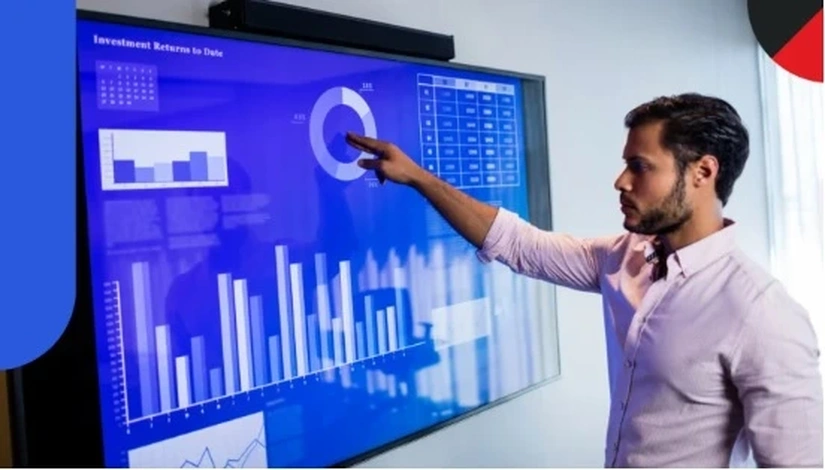
Visual management has stood out as a practice that boosts engagement and team performance across many business sectors.
Engagement is a real challenge. According to Gallup’s State of the Global Workplace 2026opens in a new tab report, with 2025 data, 20% of workers worldwide are engaged, and 32% in Brazil. Visual management addresses this point: it makes goals and results visible, so each person understands how they contribute to them.
Given this scenario, this article presents practical strategies to implement visual management at your company, aiming to boost engagement and improve organizational results.
You may also like (in Portuguese):
What is visual management and how does it work?
Visual management is a management model used in business administration that refers to a communication and management strategy. Its goal is to make information about the organization’s performance visible to all employees.
Through visual management, every department and team, regardless of hierarchical level, can understand the current state of the business, the strategic objectives, the goals to be reached and the progress toward them.
This is often achieved with bulletin boards, control panels, digital screens and other visual tools that display key performance indicators (KPIs), goals and achievements, among other things.
In the past, visual management was mostly done on physical boards placed strategically around the company. Today, that has changed and corporate performance management (CPM) software is used for it.
The logic is that by running visual management on computer, phone and tablet screens, integration between areas becomes easier, information is easier to see for everyone and day-to-day decision-making is easier.
Which methods to use for visual management?
There are different methodologies, tools and platforms to implement visual management. Below, we explain the most common ones.
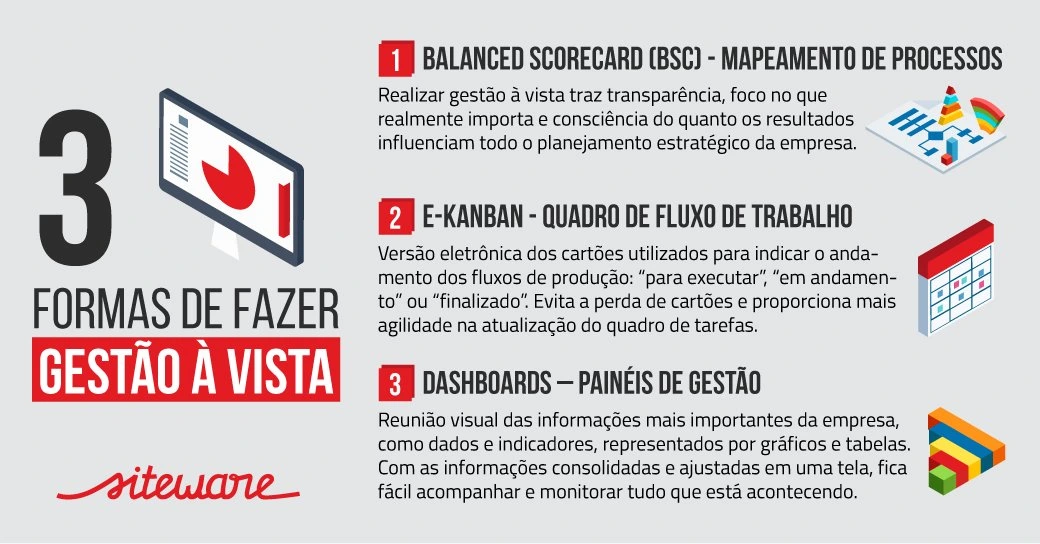
1. Balanced Scorecard (BSC)
Also known as Balanced Indicators of Performance, the Balanced Scorecard (BSC) is a method that includes defining a strategy map, objectives, indicators, goals and action plans.
The methodology is based on four pillars, or perspectives, within the company:
- financial;
- customers;
- internal processes;
- learning.
The advantage of the BSC for those who want to implement visual management is that it presents clear performance indicators for several areas of the company, which fits very well with the idea of visual management.
2. e-Kanban, workflow board
The e-Kanban is an electronic version of Kanban, a method that uses cards to indicate the progress of production flows: “to do”, “in progress” or “done”.
There can be more columns, with other specific tasks, depending on the type of activity the company carries out.
It is already adopted by many companies because, unlike the physical version, the e-Kanban prevents lost cards and makes updating the task board faster.
3. Dashboards and management panels
A dashboard, or control panel, is the visual management of the company’s most important information, such as data and indicators, shown in charts and tables.
With the information consolidated and organized on one screen, it is easy to follow and monitor everything that is happening, such as performance and objectives reached.
To meet the concepts of visual management, the panel must be updated constantly, so decisions can be made sooner, aiming to improve business results.
4. Tools and software
Digital platforms take visual management beyond the physical board. Stratws, by Siteware, brings strategic objectives, performance indicators and goals together in one place and makes them accessible to all employees, wherever they are.
With real-time performance tracking, managers and teams make data-based decisions and spot deviations earlier, which speeds up corrective actions.
Why do visual management in companies?
Visual management is important because it promotes transparency, engagement and focus on objectives. This clear display of indicators and goals creates an environment of trust, aligning the team around a common purpose.
It also makes it easier to identify problems and opportunities for continuous improvement, driving the search for corrective actions and encouraging effective communication among members of the organization.
It also promotes learning and knowledge sharing, allowing everyone to easily understand what is happening and thus contribute to the company’s progress.
What are the challenges of implementing visual management?
As with all changes, implementing visual management in your organization may not be simple, since it can face resistance from many employees.
That is because many leaders still fear openly communicating future plans, the organization’s real revenue, operating costs, failures and successes.
In this case, visual management is nothing more than making available to all employees: performance data, department indicators, strategic planning, negotiations, management indicators, codes of conduct and other relevant company information.
In addition, the information shared should be studied according to the impact it will have on each department, making the use of suitable internal communication tools even more relevant.
Doing visual management is not simply showing information that will not make sense to those who read it.
Employees need, in some way, to feel responsible and able to make changes in pursuit of the proposed objectives.
Moreover, implementing a real-time results tracking system, with dashboards available to everyone, is one of the most practical ways to achieve the desired transparency, as we will see later.
What are the advantages of doing visual management?
Visual management brings many advantages to the business, such as greater engagement, goal control, real-time results management, a better team relationship and focus on what really matters, among others.
Let’s talk a little more about each of these advantages.
1. Awareness of their importance to the company’s results
Employees need to understand the environment they are in and why they are there. That way, they can be aware of the reach of their actions and how much those actions influence results.
The goals and objectives of the strategic plan must be clear to everyone. So they cannot contain difficult words or drift away from employees’ reality.
2. Goal control
When goals are in sight, everyone can follow progress and make adjustments whenever necessary.
Continuous improvement stops being an abstract concept and becomes an effective way to reach results.
Besides, tracking goals in real time quickly shows the effect of each employee’s actions on reaching results.
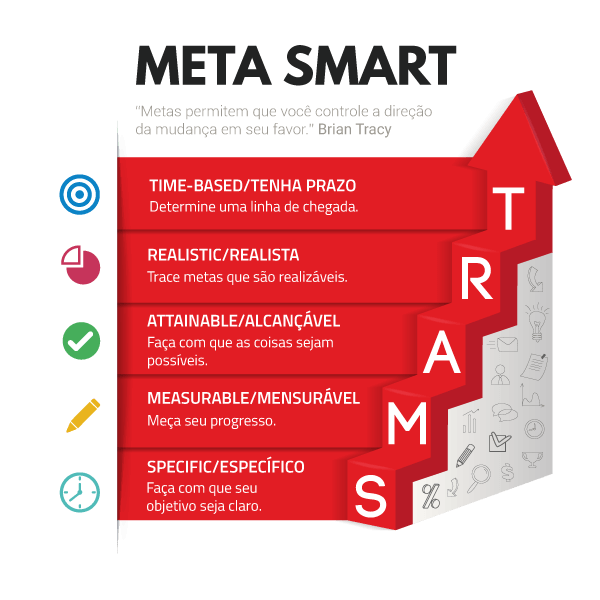
The best way to define goals is through the SMART methodology. See the summary:
3. Higher engagement and productivity
When employees have autonomy and feedback on their efforts, their emotional commitment to the company only grows, which ensures greater effort and team engagement.
The goal becomes internal motivation and this directly results in higher productivity.
4. Better relationships
With everyone fighting for the same objective, people tend to come together. And when the whole company unites to achieve a result, values and knowledge are exchanged in ways that are decisive for success.
An environment that recognizes the team’s effort and respects each person naturally awakens employees’ wish to “wear the shirt”.
Collaboration and teamwork become powerful tools in employees’ hands, and this is one of the fundamental advantages.
5. Focus on what matters
With access to all the information, without wearing themselves out to learn what is happening or wasting time on unnecessary things, it becomes possible to focus on what really matters.
How to keep visual management working
Visual management works when the right information reaches the people who need it, when they need it. Physical boards, BSC, e-Kanban and dashboards help you start, but constant updating is what keeps the practice alive.
To sustain this routine, indicator software centralizes performance management, cascading strategy, connecting projects and executing action plans. This way, the company follows corporate performance in a connected way and monitors strategic, tactical and operational indicators, which makes decision-making easier.
Goals, indicators and action plans in plain sight
Get to know Stratws and see how to track objectives, indicators and goals in real time.
Frequently asked questions
What is visual management?
Visual management is an organizational transparency practice that makes the company's most relevant data visible, such as goals, indicators, project status and results. This lets all employees follow the organization's performance in real time.
Why is visual management important?
Visual management aligns teams and encourages collective responsibility. When everyone sees the same data, there is more clarity about what is working and what needs attention, which speeds up decision-making.
How does visual management increase employee engagement?
By showing results and goals clearly, employees better understand their role in the company's strategy. This builds a stronger sense of belonging and clarity of purpose.

About the author
Equipe Siteware
Content produced and reviewed by the Siteware team, curated by internal experts in strategic management and corporate performance.