
Strategy and Goals
What is an integrated management system (IMS)? Why use one?
An integrated management system (IMS) centralizes company data and standardizes processes. See its benefits, standards and who uses it.

Management is the center of a company’s activities. To keep everything running, managers rely on several tools, and one of the main ones is the integrated management system (IMS).
An integrated management system is business management software, usually adopted by larger companies. It brings more security and efficiency to the daily routine of organizations.
Keep reading to understand what an IMS is and how it can help your company.
What is an integrated management system (IMS)?
An integrated management system (IMS) is a type of management software that gathers all of the company’s information and lets you organize operations in one place, making internal processes easier to run.
Today, many companies use a different software for each department. HR has one system, accounts payable has another, finance has a third, and so on.
Integrated management software combines the functions of all of them. Its main characteristic is integrating different aspects of the company’s operations.
An IMS prevents duplicated information and rework. Think of a task that involves more than one department. Without an integrated system, each department enters its part in its own system, and at least two people do nearly the same work.
With an integrated system, one person enters the data and the other already has it available. A simple change frees up the time of at least one employee.
Now imagine that change applied across the whole company and at every operational level. This is how an IMS contributes to the business’s productivity gains.
Productivity can be measured, and the video below shows how to calculate it:
Goal of an integrated management system
The main goal of an IMS is to unify management. That means centralizing the company’s essential activities in one place, with fast access for everyone involved. This supports more efficient quality management.
Another goal is process standardization. All procedures follow the same standards and are carried out the same way, which reduces errors.
An IMS also brings more security, because the information entered in it stays protected.
Advantages of an integrated management system
The first advantage is the one that appeared at the start of the article: optimizing the company’s resource planning, as business management software does. Without rework between employees, the team gains hours of productivity.
The next advantages reinforce why an IMS matters.
Data centralization
Centralized data makes management simpler. Instead of spreadsheets that circulate by email and are not always up to date, you have everything in one place.
Employees access information quickly and securely, always in the current version.
Greater information security
An IMS is a secure environment, accessible only by password. Some systems let you create different areas for users, with access only to what is relevant to each person.
Since all changes are made in the system, it is also easier to keep a history and find out when and which changes were made.
Faster decision-making
To decide well, a manager needs good information. In many companies, this means chasing contacts in three departments and waiting for answers.
With an IMS, the information is already available, and decisions come faster.
The data gathered also feeds deeper analysis. See how to implement Big Data in your company’s management.
Cost reduction
An IMS reduces costs both directly and indirectly. Indirectly, the team makes better use of its time and produces more within the same working week.
Directly, a single system reduces spending on employee training and on equipment and software maintenance.
What are the main IMS standards?
The main requirement of an IMS is to serve the needs of different areas. The tool must handle quality and environmental management, as well as social responsibility and occupational health and safety.
Each of these areas has specific standards, such as ISO 9001 and ISO 14001. That is why the system must meet the specifics of each one to integrate the company’s different areas.
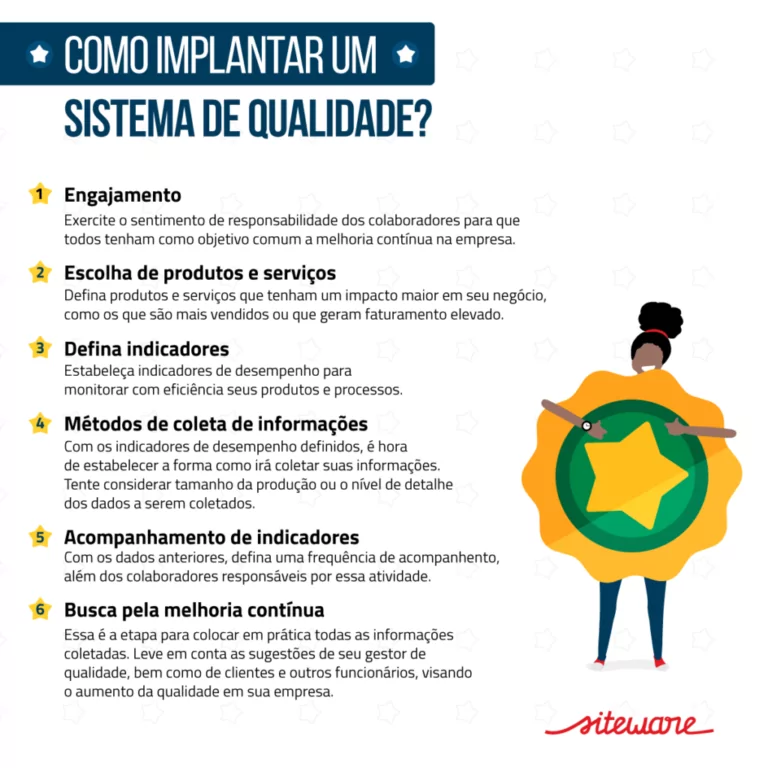
For those about to implement a quality system, the infographic below summarizes 6 steps:
Types of companies that use an IMS
In recent years, automation has gained ground in companies from very different fields. Today there are IMS options for many profiles and segments, and they are more affordable.
Below are examples of companies that use an IMS or could benefit from one.
E-commerce
Online stores grew and gained importance after the Covid-19 pandemic.
Day to day, these businesses handle customer service, logistics, order preparation for shipping and much more.
An IMS gathers the information needed for the order to reach the final consumer, using as few resources as possible.
Fintechs
Online banks and other fintechs handle sensitive data and must process it efficiently. Their service is also built on simplicity.
An IMS provides the security the processes need, along with speed and operational efficiency.
Retail companies
Producing or distributing products for retail demands optimized operations. With an IMS, the company’s departments communicate better and work more dynamically.
The system can also automate part of customer service, such as frequently asked questions.
Other sectors
Other segments also benefit from an IMS. One example is Grupo Vittia, which operates in agriculture. See in the Vittia caseopens in a new tab how Stratws supports the group’s integrated management.
From integrated management to quality management
An IMS gathers information and standardizes processes. What keeps the system alive is the handling of anything that falls outside the standard: the recorded deviation, the analyzed cause and the corrective action with an owner and a deadline.
Without this, the standard exists on paper, but the problem repeats. With the record linked to the requirement that originated it, the company shows in an audit that every deviation was handled and that the fix worked.
In the Stratws non-conformance and quality management solution, standards and requirements are registered and each treatment is born linked to its source requirement. The cause is analyzed with a tool, the corrective action has an owner and a deadline, and no treatment closes before effectiveness is verified.
The treatment is also linked to the quality indicator and goes into the area’s results meeting, so the quality leader follows the full cycle in the same place.
From record to proof of effectiveness
Standards and requirements registered, cause analyzed, corrective action with owner and deadline, and effectiveness verified before closing.

About the author
Equipe Siteware
Content produced and reviewed by the Siteware team, curated by internal experts in strategic management and corporate performance.