
Variable Compensation
What Are PPR and PPL in a Company? Is It Worth It?
Learn what PPR and PPL are in a company, how each Brazilian program works and the advantages for businesses and employees.

PPR (Programa de Participação nos Resultados, the Brazilian results-sharing program) is one of the initiatives that make up variable compensation programs in companies. When done correctly, this kind of strategy supports employee satisfaction and productivity.
Despite the similar names, PPR and PPL are not synonyms. The differences lie in the payment conditions. In this article, we explain what PPR is and how it works, the main differences between PPR and PPL, and the advantages of each model.
Both programs belong to Brazilian labor law (Lei nº 10.101/2000), so every rule described here is the Brazilian one.
What is PPR in a company and how does it differ from PPL?
PPR stands for Programa de Participação nos Resultados (results-sharing program). PPL stands for Programa de Participação nos Lucros (profit-sharing program).
In the first case, the goal is to reward employees with extra pay when they reach previously set targets.
In the second case, that pay depends on the profit the company makes in a specific period.
With PPL, the bonus is distributed among employees based on the company’s total profit. That is: if there is no profit, there is no variable compensation.
With PPR, however, the company must pay the agreed amount whenever the targets are met, even if no profit was recorded in that period.
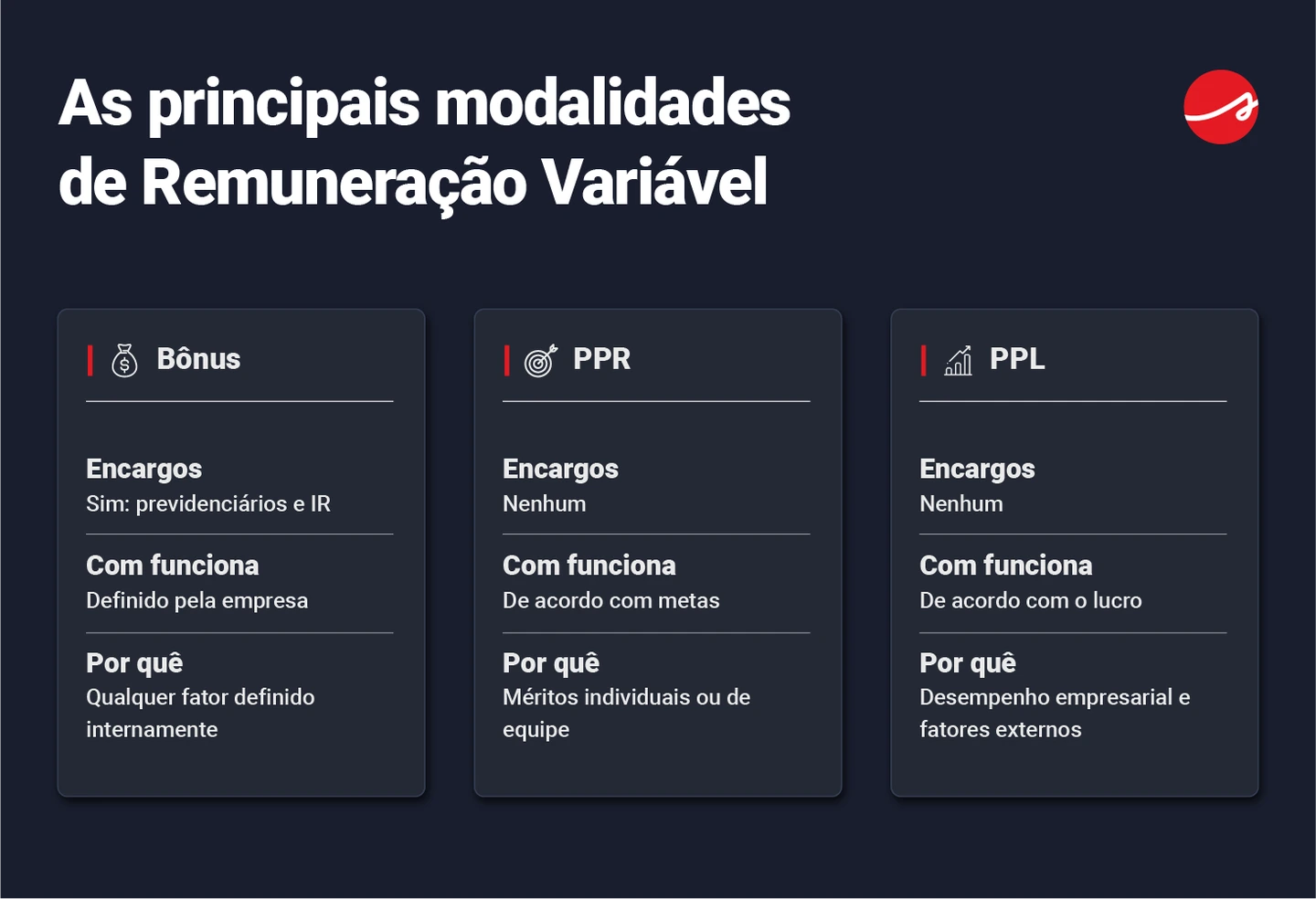
With PPR, meeting the targets and earning the bonus depends solely on the teams’ own efforts.
With PPL, on the other hand, external factors can affect the company’s profit, which changes the amount each employee receives.
See more details on variable compensation and strategic compensationopens in a new tab in this video:
How do PPR and PPL work?
Now that we have defined PPR and PPL, it is worth explaining how the results-sharing program and the profit-sharing program work in practice.
Under the Brazilian law that defines and regulates both initiatives, a company that wants to implement them must create a joint committee (comissão paritária).
Besides a union representative, the committee must have the same number of company and employee representatives.
Information about the company’s results must also be available to all representatives. The committee is then responsible for setting the rules of the chosen program, PPR or PPL, clearly and objectively.
Among those rules, the eligibility criteria for the program must be included.
What are the most common eligibility rules for PPR?
A few rules guide how PPR programs are used in Brazilian companies. They are:
- being on the company’s active payroll on the closing date of the results period;
- applying the proportionality principle to people hired during the period;
- applying the proportionality principle to people dismissed during the period;
- not having been away from work for more than 180 days.
Under Brazilian law, the bonus tied to PPR is not considered salary. This means that PPR variable compensation is exempt from payroll charges for the company. The employee, however, must include the amount received in their income tax return (IRPF).
When does the company pay PPR?
There is no fixed date set by law. Payment happens after the closing of the results period defined in the PPR agreement, which can be semiannual or annual. The only legal requirement is to respect the limit of 2 payments per calendar year, with a minimum interval of 3 months between them.
This is because, if the company makes more payments during the year, the amount paid is treated as salary and taxed with payroll charges.
What are the main advantages of PPR?
Wondering whether PPR is really worth adding to your company’s variable compensation? Here are some of the main advantages:
- higher motivation, satisfaction, engagement and commitment of employees to company goals;
- exemption from payroll charges on the amount paid as variable compensation;
- a better relationship between company and employees, built on trust and partnership;
- higher productivity;
- better talent retention and attraction.
Which indicators should you use to calculate PPR?
The most common are individual goals, team goals and corporate or strategic goals, often combined in the same program. What is measured in each type of goal varies by company and management model.
According to the Panorama Nacional de Remuneração Variável (Brazil’s National Variable Compensation Overview), a survey Siteware ran in 2026 with professionals from different Brazilian companies, 61% of variable compensation panels use individual goals, 60% use corporate goals and 54% use team goals.
As we saw, PPR and PPL solve different problems within variable compensation: one rewards the team’s effort even without profit in the period, the other ties payment directly to the company’s financial result.
The choice between the two models, or a combination of them, depends on how closely the company wants to link pay to individual and team performance.
In practice, what decides whether the program works is the clarity of the indicators and the transparency of the variable compensation calculation throughout the whole cycle, not only at payment closing. To follow that calculation in one place, see the Profit Sharing and Variable Compensation solution of Stratwsopens in a new tab.
Brazil Variable Compensation Overview
Download the full survey, with data and analysis from compensation specialists.
Frequently asked questions
Are PPR and PPL the same thing?
No. PPR is the Programa de Participação nos Resultados (results-sharing program), which pays when agreed goals are met. PPL is the Programa de Participação nos Lucros (profit-sharing program), which pays based on the company's profit.
Are PPR and PPL forms of variable compensation?
Yes. Both are variable compensation instruments used to motivate and recognize employees and to raise productivity, with payment tied to results or profit instead of a fixed amount.
Do PPR and PPL have a legal basis in Brazil?
Yes. Both are regulated by Brazilian Law 10.101/2000, which sets the rules, payment limits and governance, including the joint committee that defines the program and the exemption from payroll charges.
How many times a year can a company pay PPR or PLR?
Under Brazilian law, up to 2 payments per calendar year, with a minimum interval of 3 months between them. More payments than that cause the amount to be treated as salary and taxed with payroll charges.
What are the advantages of adopting PPR or PLR?
They raise motivation, engagement with strategy, productivity, satisfaction and retention. They also improve the relationship between company and employees and, when set up in line with Brazilian law, exempt the amount from payroll charges.
Do PPR and PPL work for any area?
Yes. They can cover the whole company, which must include all employees, with rules suited to the reality and goals of the business and defined by the joint committee.
Is there software to calculate PPR?
Yes. Variable compensation management systems, such as Stratws from Siteware, automate the PPR calculation and remove the dependence on manual spreadsheets. This reduces calculation errors and shows employees how the amount was determined.
How do you calculate PPR on salary?
The most common calculation applies a percentage of the employee's salary according to goal attainment: reaching 100% of the goal pays the full planned amount, and partial attainment pays a proportional amount. The company sets the exact percentage with the joint committee.

About the author
Equipe Siteware
Content produced and reviewed by the Siteware team, curated by internal experts in strategic management and corporate performance.