
Variable Compensation
Strategic compensation: main models, benefits, and how to implement it
Learn what strategic compensation is, how to build an efficient system, and the benefits of tying financial incentives to business results.

Well-designed incentive policies are one of the main engines of sustainable growth in high performance organizations. Companies use strategic compensation to connect what employees deliver every day to the corporate objectives set by the executive board.
Many companies lose talent and watch engagement drop on the operational front line. Paying rewards tied to real value delivered, through variable compensation, clears those bottlenecks and lifts productivity across the company.
Structuring that kind of payout, however, requires data governance, clear targets, and a definitive break with manual controls.
In this article, we detail the main compensation models on the market, the implementation steps, and the practices that protect your management routine from operational failures.
What is strategic compensation?
In practice, strategic compensation is a system of financial rewards tied directly to the achievement of targets and indicators defined in advance by the organization.
In other words, the company financially recognizes the professionals who contribute most to the growth of the business.
This financial compensation complements the fixed salary, and it requires objective criteria, data traceability, and formally documented calculation rules.
Unlike fixed pay, which compensates the role, variable pay grows in proportion to the employee’s performance.
The model also lets the company steer team behavior toward the products, services, or indicators with the greatest impact on revenue.
Main strategic compensation models
A mature compensation and benefits strategy moves across the following incentives:
- Bonus: a reward tied to targets that offset seasonality, encourage teamwork, and push specific products.
- Meritocracy: individual performance indicators, widely used in consulting firms, law offices, and hospitals.
- Results sharing program (PPR): bonus payouts based on the results achieved by a specific area of the company.
- Profit and results sharing (PLR): a benefit required by Brazilian law that distributes part of the corporate profit among employees through a union agreement.
The 2026 National Variable Compensation Report, produced by Siteware, shows that 44.6% of Brazilian companies use PLR or PPR as their main reward format.
At the same time, 40.6% of executives point to poorly defined targets as the biggest pain in running these programs.
Panorama Nacional da Remuneração Variável
Baixe a pesquisa completa, com dados e análises de especialistas em remuneração.
Benefits of strategic compensation
When it rests on transparent rules, a strategic compensation system delivers several benefits focused on operational efficiency.
The main gains from this practice are:
- Higher motivation: a direct way to lift team engagement and support continuous professional development.
- Stronger employer branding**:** the organization consolidates itself as a strong employer brand, which makes it easier to attract highly qualified professionals.
- Tangible recognition: employees see that the company acknowledges and rewards their effort, which avoids the feeling of a stalled career.
- Connection to purpose: incentives go beyond a simple financial exchange and reshape the culture of the business. According to Siteware research, 50.5% of respondents associate variable pay with a direct connection to the company’s purpose.
How to build a strategic compensation system?
A strategic compensation system requires technical rigor to keep corporate cash flow safe. The company needs to structure the policy in clear steps to avoid internal frustration.
First, the organization has to set measurable targets, each with a deadline and a direct owner.
It also needs to communicate openly how the process will translate into financial gains, matching the challenges to the technical capability of each employee.
Success in this operation therefore depends on a smart combination of incentives and on the flexibility to adjust course during the year.
In parallel, the company needs to unify its calculation methodology to remove any risk of a labor dispute.
Calculation examples
Payout calculations require mathematical standardization to keep areas of the company on equal footing and to sustain the team’s trust.
The main calculations used in high performance incentive programs are:
- Direct percentage: this format multiplies the financial base generated by the employee by the percentage agreed in advance.
- Performance factor: the operation divides the result achieved by the target set, then multiplies that index by the target value of the award.
- Multiple indicators: management adds up the result of each target multiplied by its weight, producing a final bonus factor for complex scorecards.
- Cycle proportionality (pro rata): the company pays late hires or promotions by multiplying the award by the days worked divided by the full length of the cycle.
- Budget limits: a floor requires a minimum level of delivery before any payment starts, while a ceiling caps the maximum amount paid out.
Read also: Compensation policy: what it is and how to create one
How to apply the compensation strategy by hierarchical level?
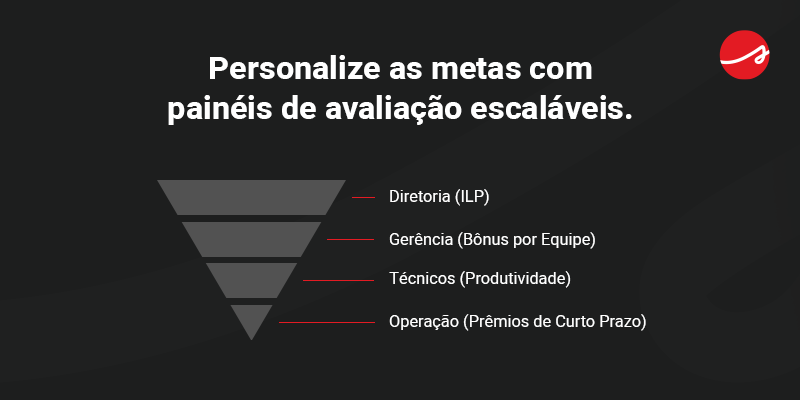
The incentive structure has to reflect the range of responsibilities in the company org chart. An efficient compensation strategy therefore calls for adjustments at each professional level:
- Executive board: the focus is on long term results, mixing incentives such as stock options, multi-year bonuses, and retirement plans.
- Leaders and managers: payouts link bonuses to the manager’s individual results and to the financial performance of their team.
- Technical professionals: the model applies variable pay tied to productivity and professional development.
- Operational roles: rewards need to be immediately tangible, with awards for efficiency, quality gains, and paid overtime.
Operational risks of manual spreadsheets
Despite the clear benefits, companies destroy their team’s trust when they run on imprecise management processes. The 2026 Variable Compensation Report shows that 61.3% of Brazilian companies still use manual spreadsheets to close variable pay cycles.
That fragmented setup creates a large hidden cost for the organization. Today, 83.5% of businesses face high or medium effort to produce the numbers, and 70.4% of companies work without any real data integration.
The heaviest impact, though, falls on the employee base. The research shows that 76.8% of employees depend on intermediaries to check their own performance indicators, which stalls communication and feeds doubts about payouts.
Automate payouts and protect your organization’s cash
Tracking efficiency indicators in scattered files puts a ceiling on the growth of your brand. Structured organizations need secure platforms to audit payouts and give employees full transparency.
Stratws unifies performance tracking across your operation and runs the financial calculations for the full cycle through its variable compensation module. The platform consolidates precise visual scorecards and operates entirely within the SOC 2 international data security standard.
That way, the company stops losing hours double checking math and puts the routine back on generating revenue. Talk to an expert in Variable Compensation and raise the maturity of your strategic compensation.
Summary of the main questions
Can more than one calculation format apply in the same cycle?
Yes. Success usually calls for a combination of incentives. Management can assess a team using multiple indicators and, at the same time, apply cycle proportionality (pro rata) to newly hired employees.
What is the main difference between a target bonus and PLR?
Profit and results sharing (PLR) is a benefit required by Brazilian law that depends on a union agreement to distribute part of the corporate profit. Ordinary bonuses and meritocracy, on the other hand, are internal policies the company defines freely, with no union validation needed.
Is company cash at risk in a downturn, when targets fall short?
No, as long as the company applies the right technical rigor. The model is protected by budget limits: a floor sets the minimum delivery required before payments start, and a ceiling caps the maximum amount paid.
How do you keep engagement up across long target cycles?
Visual management is the best option here. Depending on intermediaries to check results stalls communication and creates doubt. With software such as Stratws, the company provides detailed visual scorecards. Employees then follow their own progress in real time, gaining autonomy and holding motivation until payout.

About the author
Equipe Siteware
Content produced and reviewed by the Siteware team, curated by internal experts in strategic management and corporate performance.