
Strategy and Goals
4 productivity indicator examples to track
See 4 productivity indicator examples (sales contacts, profitability, production capacity and quality) and how to track each one.
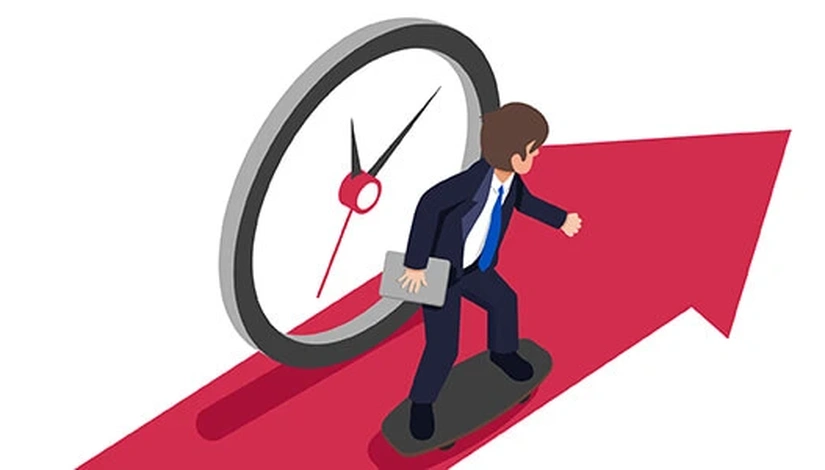
Productivity is producing more with the same resources and making good use of working time to deliver better results. To know whether that is happening, the company needs to measure it.
Productivity indicators show what to measure and how. With them, you can tell whether the company really has a productive work environmentopens in a new tab (in Portuguese).
In this article, you will see what productivity indicators are and 4 examples to track.
Definition of indicators
Indicators show current performance and the performance trend over time. They are commonly called KPIs (Key Performance Indicators).
Each indicator brings together three elements:
- an objective;
- the activity that needs to be carried out;
- a numerical index that represents performance quantitatively.
KPIs are the key metrics for measuring and assessing each action carried out inside the company.
Productivity indicators are the KPIs that show the results of operations in practice. What sets them apart from the rest is the focus on measuring output or execution over a given period of time.
If one employee produces more in a day than another, in the same role and with the same working time, they were more productive for the company. When the desired productivity is not reached, the indicators show where the improvement points are, and the company starts to work better.
Productivity indicator examples
Productivity is always measured against a resource, such as time, cost or people. To see how to calculate it, watch the video (in Portuguese):
Contacts made for sales
When thinking about productivity tied to results, the first place to look is the sales area, because it brings resources into the company. Low productivity in this area has a big impact on the organization.
In a business that depends on communication between the salesperson and the prospective buyer, the more contacts are made, the better the chances of closing sales. That is why one example of a productivity indicator is the number of contacts made per salesperson.
With this KPI, you know who has the highest level of productivity and you identify improvement points for the other employees in the department. They can use a colleague’s results to improve their own approach, and the group’s result improves.
Profitability
Tracking the level of profitability over time shows how productive the company is. It is one of the easiest indicators to see: the more the company produces and sells, the better the chances of raising profit.
It is also worth measuring profitability KPIs for each department, to understand which ones are directly tied to the company’s overall result.
Read also: how to calculate the profitability index
Production capacity
Comparing everything produced with previous periods is one of the main examples of productivity indicators. To cut the average time each process takes to produce, track this KPI continuously.
Start by measuring the time of each production stage and use the indicator to find out whether performance is improving. If it is not, analyze the process and work out the improvement. To see how to measure industrial output, see our post on industrial production indicators.
To implement KPIs: how to implement KPIs in your company in 9 steps
Quality level
Progress in productivity does not help without keeping the focus on qualityopens in a new tab (in Portuguese). The quality level of what is produced is a counterweight: it prevents producing a large number of outputs “in a rush”, with many unsuitable for the end customer.
Measuring quality in each product or service delivery shows whether raising productivity has a negative impact, with quality falling, or a positive one, with quality kept or improved. To go deeper, see our post on total quality management.
How to track productivity indicators in Stratws
Stratwsopens in a new tab is the management platform created by Siteware to track productivity indicators by area. Each area has its indicators in its management unit, and the feature called Farol shows that unit’s main indicators in real time, with comparison against previous years.
To see how sales contacts, profitability, production capacity and quality would look in your company’s Farol, talk to an expert in goal and indicator deployment.
Productivity tracked by area
Indicators by management unit, from corporate to team.

About the author
Equipe Siteware
Content produced and reviewed by the Siteware team, curated by internal experts in strategic management and corporate performance.