
Management Methodologies
The 5 Management Methodologies of Large Companies
See the management methodologies large companies use, such as BSC, PDCA, GPD, 5W2H and the Ishikawa diagram, to optimize processes and improve results.

Managing a company or a team is no easy task. The market keeps getting more demanding, pushing managers to find ways for their teams to deliver better results every time. That is why we decided to share some of the management methodologies of large companies that are being applied today.
Management methodologies are techniques companies use for process optimizationopens in a new tab, higher productivity, better employee engagement and more. There are many such models on the market, and this article presents five of them.
What are the main management methodologies of large companies?
Using management methodologies can change the reality of a team and, as a result, of a company. To do that, the manager needs to know how to apply these techniques based on the reality of the organization and its people.
1. Balanced Scorecard (BSC)
Until the mid-1990s, many companies measured success only through financial indicators. If gross revenue was growing, nothing needed to be reviewed.
That view changed over time, largely under the influence of the Balanced Scorecardopens in a new tab (BSC), one of the main management methodologies on the market. These large companies began to work more broadly, in both people management and business management.
The BSC was first described in 1992, in an article by Robert Kaplan and David Norton. In short, it says that to reach objectives in a healthy way, a company needs to think in 4 perspectives. They are:
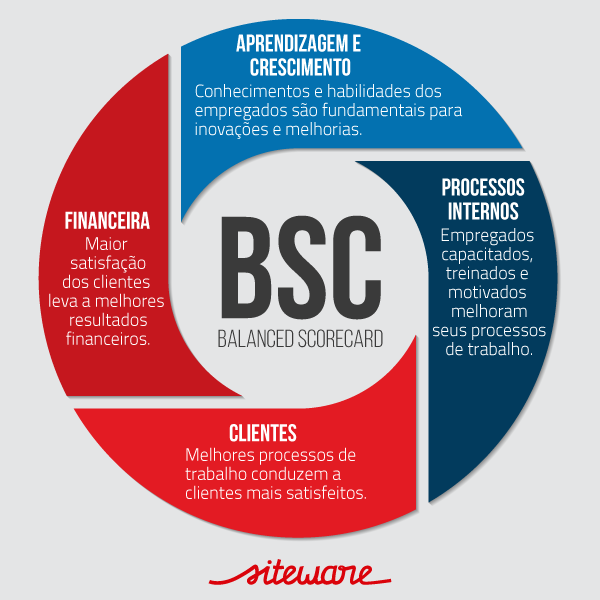
1. Financial perspective:
Financial indicators cannot be the only ones used to measure a company’s success. Still, it is important that they are one of the pillars. After all, there is no way to operate without money, right?
2. Customer perspective:
Customers must be at the center of any business. That requires good services and a good relationship with your audience, in order to gain more acquisition, retention and loyalty.
3. Internal processes perspective:
For an organization to work and deliver good results, it needs optimized internal process management. Aspects such as productivity, innovation and organizational communication must have a place in the strategy.
4. Learning and growth perspective:
Worrying only about the present is not good for any company. It is important to think about the growth of the organization, and that includes all employees. This can be done through skills development, training, an improved organizational climate and so on.
It is also worth stressing that the 4 perspectives of the Balanced Scorecard do not work in isolation, but together. For example, more satisfied and better trained professionals have better internal processes, which supports better deliveries to customers and generates higher revenue for the company.
To put the BSC into practice, Siteware gathered free materials that help you build the strategy map and break the four perspectives down into objectives and indicators:
- BSC Strategy Map Templateopens in a new tab
- E-book: Balanced Scorecard: How to Put It Into Practice?opens in a new tab
2. PDCA
Executing any kind of strategic planning and making good decisions requires methods and processes. In these moments, different management methodologies are used to support the plan. The PDCAopens in a new tab is one of the management methodologies most used for problem solving.
The PDCA can be divided into 4 steps (Plan, Do, Check, Act), which go from identifying the problem to standardizing the process. Let’s look at them:
1. Plan:
In this step, the manager and the team must identify and observe the problem. To do that, ask: “What is happening and how does it affect our results?”.
After identification, the problem must be mapped, that is, employees need to find its origin. From those conclusions, it is possible to draw up an action plan. This is probably the longest step of the PDCA Cycle.
2. Do:
This is the moment to take the action plan off paper and carry it out. For that, it is important to involve all employees, who must work in sync throughout the process.
3. Check:
Steps 3 and 4 are what set the PDCA methodology apart, and make it one of the market favorites. That is because, after applying the action plan, managers and their teams often relax and act as if the problem were already solved.
But it does not always work that way. To be sure a challenge was solved, you need to check several times and make sure what was done lasts.
That is why the third step of the cycle is exactly checking. Everyone needs to analyze whether the strategy succeeded and whether the results were satisfactory. This can be done through performance indicators and KPIsopens in a new tab.
4. Act:
Based on the results observed in the previous step, there are two possible paths:
Did the action plan work? In that case, the team should share everything that was done with the company, to pass on the lessons the process brought. The techniques used should also be standardized for solving future problems.
Did the action plan not work? Often, even with a lot of analysis and observation, the strategies used do not succeed. Then it is necessary to reflect on what was done and change the approach. To do that, start the PDCA Cycle again.
3. GPD (Policy Deployment)
Running a company is a complex activity that takes the effort of different people working in sync. That requires everyone, at every level, to be aligned and to have goals that match their role, while knowing how their work affects the whole.
For that, there is Policy Deploymentopens in a new tab, known as GPD (from the Portuguese Gerenciamento pelas Diretrizes).
The GPD is a strategic business tool that helps the company align every level. Goals are cascaded down to each level, and results must be checked routinely and, in some cases, daily.
How to apply Policy Deployment in a company?
Policy deployment was developed by the Japanese strategic planning specialist Yoji Akao. In Brazil, the methodology was spread and refined by consultant Vicente Falconi.
Check out the 100% free Practical Guide that Siteware prepared for you:

Before applying the technique in the company’s daily routine, it is important to understand its three pillars. They should guide the whole process:
- Pillar 1: The results of strategic planning are directly tied to everyone involved in the process, at any hierarchical level of the organization;
- Pillar 2: Innovation is extremely important in any company. It must always be practiced and encouraged;
- Pillar 3: The proposed changes must happen. Everyone needs to commit to the process. There is no point in planning strategically without a real intention to change the reality of the organization;
With these three pillars in mind, you can apply Policy Deployment techniques in the company. For that, the manager must design a strategy that covers every level of the organization, where one level’s performance affects the other’s goals.
Learn everything about the GPD in our video:
To make these management methodologies of large companies easier to understand, see the example below:
Company ALFA has the goal of increasing profit by 50% in one year. To get there, the person in charge of the GPD must align with the CEO on what needs to be done. The CEO will have goals and activities to carry out with this objective in mind.
However, it is not possible to reach satisfactory results alone. So the CEO passes the objectives and the planning on to the managers. They, in turn, also have goals and activities directly tied to the objective.
Finally, a lot of action and work is needed. Managers pass the full plan on to their respective teams. Each person then has goals and activities that directly affect the result of the others and, consequently, of the whole company.
4. 5W2H:
Productivity is one of the most important concepts in a company. For results to be satisfactory and help reach the organization’s goals, everyone needs to be engaged and deliver on time.
To support this search for productivity, there are several simple but very useful methodologies. The 5W2Hopens in a new tab is a widely used management methodology, focused on process optimization. It has seven guidelines:
- What?
- Why?
- Where?
- Who?
- When?
- How?
- How Much?
Looking at the pillars of this technique, it is easy to see where its name comes from: there are 7 questions, the first 5 starting with W (5W) and the last 2 with H (2H).
5. Ishikawa Diagram
In business, problems come up all the time, and solving them quickly and efficiently is the path to success. Many tools and methods are used for that. The Ishikawa Diagramopens in a new tab is one of these methodologies.
It is much easier to identify a problem as a group, with suggestions from the whole team. That is exactly the idea behind the tool: identifying opportunities and threats. It uses a chart that looks like a fish skeleton (which is why the method is also known as the Fishbone Diagram).
Created by Kaoru Ishikawa (hence the name), its main goal is to identify the causes of a problem. From that identification, you can draw up strategies that lead to the final solution.
How to make an Ishikawa Diagram?
As mentioned, the Ishikawa Diagram is a visual methodology that uses graphic strategies to identify a problem. You can create one in several ways: with specific tools, an online board or even on a sheet of paper.
First, draw an arrow from left to right. At the end of the arrow, draw a square and write the problem you are facing. Along the “body” of the arrow, add diagonal lines tilted to the left.
Each of these lines will identify a category of possible causes of the problem. For each category, we recommend adding two causes.
Hard to picture? Siteware prepared an example of an Ishikawa Diagram to help:
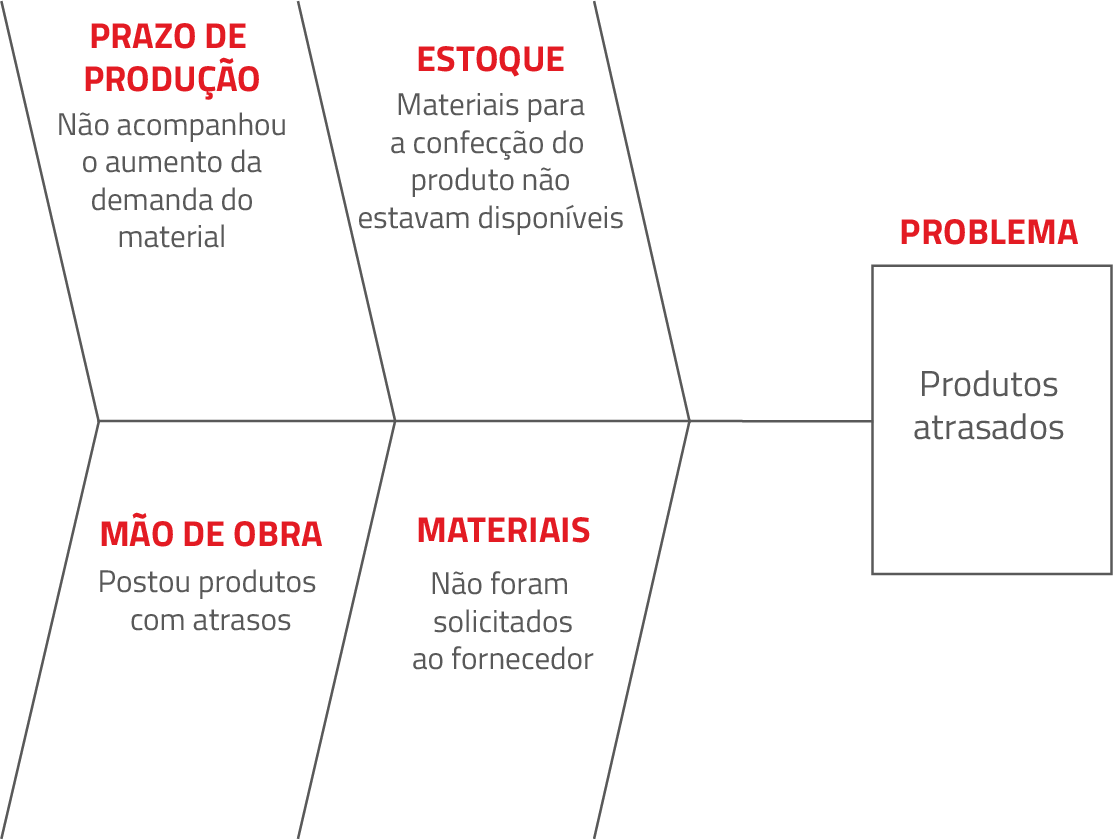
In the example above, the problem is product delays. To understand why, four categories of causes are listed: materials, labor, production lead time and inventory. One possible cause was identified for each category.
In its original version, the diagram was proposed with 6 categories of causes, known as the 6Ms. Kaoru Ishikawa’s proposal had six pillars to consider when applying the methodology. They are:
- Method: do the methods used in the work influence the problem? How?
- Machine: does the equipment used in the work influence the problem? How?
- Measurement: do the metrics used in the work influence the problem? How?
- Environment: does the surrounding environment influence the problem? How?
- Material: does the raw material used in the work influence the problem? How?
- Manpower: do the employees involved in the work influence the problem? How?
To define the causes, hold meetings with the team, who will point out possible errors that lead to negative consequences. Once those causes are identified, you can draw up an action plan that eliminates the problems at the root.
How to choose the right methodology for your company
We know a team manager must always align the organization so everyone works in sync and productivity grows. That makes it possible to optimize processes and improve results. This demand is even stronger in large companies, where the number of employees is higher.
In that sense, the management methodologies of large companies can be great allies. There are hundreds of tools and methods in use on the market. They help with many processes, such as identifying problems, carrying out an action plan or even aligning the different hierarchical levels of the organization.
However, be careful: management methodologies should be used as support for strategic planning. It is necessary to consider the different needs of each area and adapt the proposed methods. With that in mind, you can raise the level of any company and help it reach its objectives.
Chose a methodology and now need to track its execution?
Stratws brings together the goals, indicators and action plans of the methodologies your company already uses.

About the author
Equipe Siteware
Content produced and reviewed by the Siteware team, curated by internal experts in strategic management and corporate performance.