
Strategy and Goals
What is business strategy and how to build one in 4 steps
Learn what business strategy is, see 4 types and 2 tools (OKR and BSC) and follow 4 steps to execute the strategy in your company.

Business strategy defines where the company is going and what it does today to get there. Many companies build detailed plans but waste the effort because they cannot put them into practice.
This text explains what business strategy is, presents 4 types and 2 tools and shows how to execute the strategy in 4 steps.
What is business strategy?
Business strategy is the definition of the actions the company takes today (short term) to trigger action plans (medium term) and reach the desired results (long term). It rests on the study of the past, a reading of the present situation and the outlook for what is coming.
In other words, you need to act today to shape the future scenario. That is why strategy management cannot rely only on past experience or on the future you wish for.
The focus is on the present, on implementing the strategic plan, which is one of the hardest stages of this journey.
4 types of business strategy
Business strategies can be classified in several ways, depending on the objectives, the market and the structure of the organization. These are the 4 most common types:
Growth strategy
It focuses on expanding the business. It can involve new products or services, new markets, a larger market share or acquiring other companies. The goal is to increase revenue and the size of the company.
It can also involve diversification: adding products or services similar to the current ones (related diversification) or entering completely different business areas (unrelated).
Innovation strategy
It involves creating and implementing new and improved ideas, products, services or processes. It matters for companies that operate in fast-changing, highly competitive sectors.
Retrenchment or reduction strategy
It applies when the scope of operations needs to shrink, whether by selling divisions, divesting or cutting operations in areas that do not make a profit.
Internationalization strategy
It takes the company’s operations to international markets, through exports, joint ventures or branches in other countries.
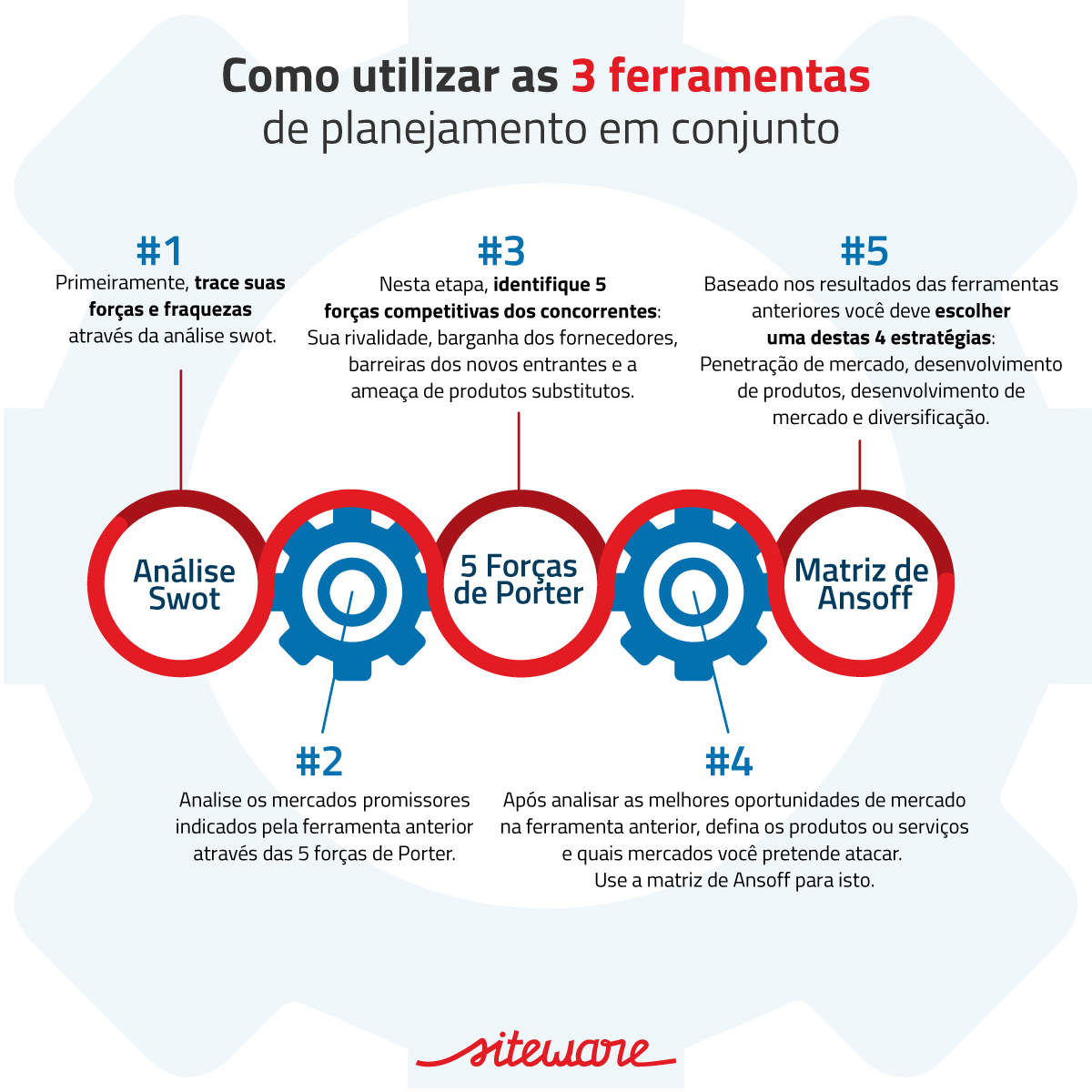
To choose among these paths, three planning tools can be used in sequence.
SWOT analysis shows the company’s strengths and weaknesses. Porter’s Five Forces help analyze promising markets. The Ansoff matrix points to one of four growth strategies: market penetration, product development, market development and diversification.
2 business strategy tools
Knowing what business strategy is is the first step. The second is to know methods to build it and track it. These are two widely used tools.
OKR
The essence of OKRs is to set clear, ambitious and inspiring objectives (Objectives) and link them to specific, quantitative and verifiable key results (Key Results). Objectives define what the company wants to achieve, and key results show how that objective will be reached.
The method stands out for its simplicity and focus, and lets you concentrate effort on the areas that matter.
OKRs promote transparency and alignment across the organization. From senior management to employees, everyone knows what needs to be achieved and how individual contributions fit into the company’s strategy.
OKRs also encourage challenging goals. By setting ambitious objectives, companies are pushed to go beyond limits and look for creative solutions.
BSC
The Balanced Scorecard, proposed by Robert Kaplan and David Norton in 1992, is a management framework that translates vision and strategy into a coherent set of performance indicators. It looks beyond financial data and uses four perspectives to evaluate the company:
- Financial: measures the company’s economic performance and its impact on results.
- Customers: focuses on customer satisfaction and retention and on winning new customers.
- Internal processes: evaluates the efficiency and quality of the company’s processes.
- Learning and growth: covers the development of capabilities and innovation, including training, organizational culture and alignment of resources.
See more in this video:
How to execute a business strategy
Good execution comes from a disciplined process: a logical set of activities connected across the whole organization. Lawrence Hrebiniak, a professor at Whartonopens in a new tab, argues in the book Making Strategy Work that strategic objectives are only reached with a planned approach to execution.
People management comes before strategy and operational processes. People are the ones who know how the market changes, who create strategies based on that knowledge and who put them into practice.
Many managers prefer to put out fires rather than prevent them, and they fail to execute the business plan because they lack a repeatable methodology in the organizational climate. The way out is to connect the strategy to each employee’s individual objectives.
These are the 4 steps to execute the strategy well:
Step 1: define priorities
A common mistake is to set too many priorities and finish none of them. Focus on the ones you know you can deliver.
If there are many opportunities, pick the one with the best chance of working. The choice can consider the business’s market, the budget, team motivation and how relevant the project is to growth.
When you reach one objective, move on to the next. Concentrating focus on one goal raises the chance of good results. Trying to pursue several goals at once lowers the team’s performance and dedication.
Step 2: collect and analyze data
Entrepreneurs usually set measurable goals in the strategic plan. But when the plan starts to go wrong, the project can be shelved and forgotten.
To make sure it gets executed, choose performance indicators (KPIs) that can be measured and monitored continuously.
Get the data from those indicators and evaluate the results against the schedule, which can be monthly, quarterly or annual. If the results are not satisfactory, improve whatever is needed to raise performance.
If process flowsopens in a new tab (in Portuguese) are not working as expected, adjust them quickly so the loss does not grow.
Step 3: keep a meeting routine
Without continuous communication, employees lose touch with the organization’s objectives and goals, and the strategy stays on paper.
Over time, the team and managers can drift from the main focus. To keep the organization in sync with the plan, the team should meet often and update itself on how projects are going.
The routine can be daily meetings, at the start of the day, lasting up to 15 minutes, to clarify reports and changes and quickly correct whatever is off track.
After each meeting, record what was discussed in minutes and send it to those involved. That way everyone sees where they need to act.
Step 4: evaluate the strategy
Besides the meetings with employees, the manager should meet, monthly or quarterly, with the team responsible for execution and with those in charge of management, to evaluate the progress of the strategic plan.
These meetings should go deeper, and serve to decide whether the intended changes are really necessary and how to make them.
They should discuss the company’s strengths, weaknesses, opportunities and threats, in the process known as SWOT analysis. It helps the company know itself better.
Want more strategic planning tips? Watch this video:
Business strategy with Stratws
Communicating the strategy to everyone is part of execution.
A one-page plan or a shared dashboard helps each employee understand how they contribute to the company’s result, which raises engagement. This is a principle of visual management. It is worth reviewing what will be shared, so as not to expose confidential information.
Stratws, the management platform created by Siteware, brings this routine together in one place and integrates methodologies such as OKR, BSC and PDCA. In the feature called Scorecard, objectives sit on a cause-and-effect map, broken down into indicators, goals and projects. Farol tracks the indicators on a visual dashboard, and meeting management keeps the history of decisions and pending items.
That way, strategy stops being a plan and becomes routine: objective, indicator, meeting and evaluation linked to each other.
Take the strategy off paper
See how to link objectives, indicators and the meeting routine in one management system.

About the author
Equipe Siteware
Content produced and reviewed by the Siteware team, curated by internal experts in strategic management and corporate performance.