
Strategy and Goals
What Are OKRs? How to Use the Method to Reach Your Goals
Learn what OKRs are and how to use this management method to set objectives and key results that keep your whole company aligned on its goals.

Imagine a scenario in which the entire team is aligned, working toward the same objectives and knowing exactly how to measure success. That sounds like every leader’s dream, right? It is no accident that companies of every size are trying to understand what OKRs are and how they can help.
The truth is that reaching goals has never been so challenging. In an increasingly competitive market, it is common for teams to get lost among conflicting priorities, unclear objectives and metrics that are hard to track.
Popularized by giants such as Google and LinkedIn, the OKR method has helped companies turn their ambitions into tangible results. And the best part: any company can start using it, regardless of size or industry.
Are you trying to understand what OKRs are? How do they work? How are they different from indicators? Keep reading and I will tell you everything!
What Are OKRs?
The OKR method (Objectives and Key Results) can be defined as a set of interconnected individual or collective goals that, once achieved, allow a company or organization to reach its overall goals. In simple terms, OKRs are each of the objectives and key results of the company’s strategy.
To understand what OKRs are, the idea is simple: you set an inspiring objective (what you want to achieve) and define measurable key results (how you will know you are on the right track). This combination creates a practical and efficient system to make sure everyone in the company knows what the priority is and how success will be measured.
The methodology was created by the executive John Doerropens in a new tab, initially at Intel. He later implemented it himself at Google, shortly after the company was founded. OKRs quickly became popular, especially among technology companies, because of their ability to mobilize the most varied teams in an organization through bold goals in pursuit of superior results.
The basic premise of the OKR method is very simple. It shows the path to a given objective (Objectives) and how that success will be measured (Key Results). Maybe it is clearer now what OKRs are, right?
What Are OKRs in Practice?
To understand what OKRs are in practice, you need to be clear, with examples, about the two components of the method: Objective and Key Results.
Objective: the objective is the qualitative, inspiring description of what you want to achieve. It should be clear, ambitious and motivating, working as a compass that engages the team and connects daily efforts to the organization’s larger purpose. Usually, senior leadership defines the objective, giving a guiding star for where the organization should grow.
- Example: “Be the benchmark in customer service in our industry.”
Key Results: key results are metrics that indicate whether you are achieving the objective. They are quantitative and specific, and they should be challenging yet still achievable. Each objective usually has 2 to 5 key results that help measure progress.
- Example: “Increase NPS (Net Promoter Score) from 75 to 90.”
- Example: “Reduce average support response time from 12 hours to 4 hours.”
In other words, if you reach these two Key Results, you are likely to reach the Objective given as an example earlier.
Essential Characteristics for Success with the OKR Method
Now that you know what OKRs are, we have prepared a list of the main aspects that are part of the analysis and goal-setting logic of the OKR methodology. That way you will also understand how to apply it in your company. See:
1- Simplicity
The golden rule for defining an objective through OKRs is that it must be simple and objective, so that everyone can understand it. It must also be measurable, meaning you must be able to measure its progress.
2- Transparency
The concept of what OKRs are should be shared knowledge across the company. That way, everyone can understand how each employee’s goals are interconnected, reinforcing engagement and team spirit.
Usually, each employee’s Key Results are published on the company intranet, or companies opt for OKR software, such as Stratws, which gives managers visibility into how the indicators are progressing.
3- Culture
To deliver concrete results, the OKR method must be aligned with company culture. It should reflect the organization’s mission and be a decisive factor in pursuing the long-term vision of the business.
It should stay in employees’ minds day to day and be part of the onboarding training for those joining the company. That makes it possible to build, in every area, a behavior of constantly seeking superior performance, focused on results.
4- Goals Defined by Employees
But knowing what OKRs are is not enough: teams also need to feel part of them. Objective setting should respect the following proportion: 40% Top Down, meaning from leadership to employees, and 60% Bottom Up, coming from the employees themselves.
The share that comes from company leadership acts as a guide, presenting the organization’s major goals. From there, each employee defines their own contribution toward that result, which yields their individual goals.
5- Short Cycles
Goals set through the OKR methodology are generally defined for a period of three months. This makes goals more agile and allows quick adaptation to change.
However, as employees’ maturity with their own goals grows, it is possible to define longer-term Key Results.
6- Stretch Goals
Stretch Goals is a practice that sets truly challenging goals, requiring teams to look for new ways of working to achieve them.
The idea is that goals should be challenging, to motivate employees to keep reaching further, but they must be realistic.
If the company grows 10% a year, for example, there is no point in setting a 50% growth goal.
7- Learning
Now that you understand what OKRs are, it is important that when a given objective is not achieved, you formulate a justification of what did not work. More than just getting feedback, the idea is to detect the error and learn from it, serving as a guide for setting a new goal.
8- Adaptation
Google adopted the OKR method when it was less than a year old and had only 40 employees. It still uses the methodology today, which shows that OKRs can be successfully implemented in organizations of every size and at different stages of business maturity.
9- Compensation vs. Evaluation
For teams to set challenging objectives, it is important to separate goals from compensation. Some companies adopt metrics for results-based pay, which generates labor savings and raises productivity.
With these basic principles, it is much easier to picture what OKRs are and how to use the methodology in your company. But to make it even clearer, let’s walk through a detailed implementation guide. Follow along!
How to Use OKRs to Reach Your Company’s Objectives
Now that you know what OKRs are and how they work, it is time to understand how to apply them in practice to reach your company’s objectives. The method, although simple, requires planning and discipline to be truly effective.
Below, we present a step-by-step guide to implementing OKRs and turning them into an engine for your business growth.
1- Define Clear and Inspiring Objectives
OKRs start with well-defined objectives. Remember: the objective should be something meaningful and motivating, that inspires the team to strive to achieve it. Ask yourself:
- What is the strategic priority for the company right now?
- What do we want to achieve that will truly make a difference?
Example:
Objective: “Expand our presence in the international market.”
2- Set Measurable Key Results
For each objective, define 2 to 5 key results that are quantitative and can be clearly measured. Key results should indicate whether you are on the right track and whether you have reached the objective.
Example Key Results for the objective above:
- Close contracts with 5 new international customers.
- Increase revenue from foreign markets by 30%.
- Implement multilingual support for the main markets by the end of the quarter.
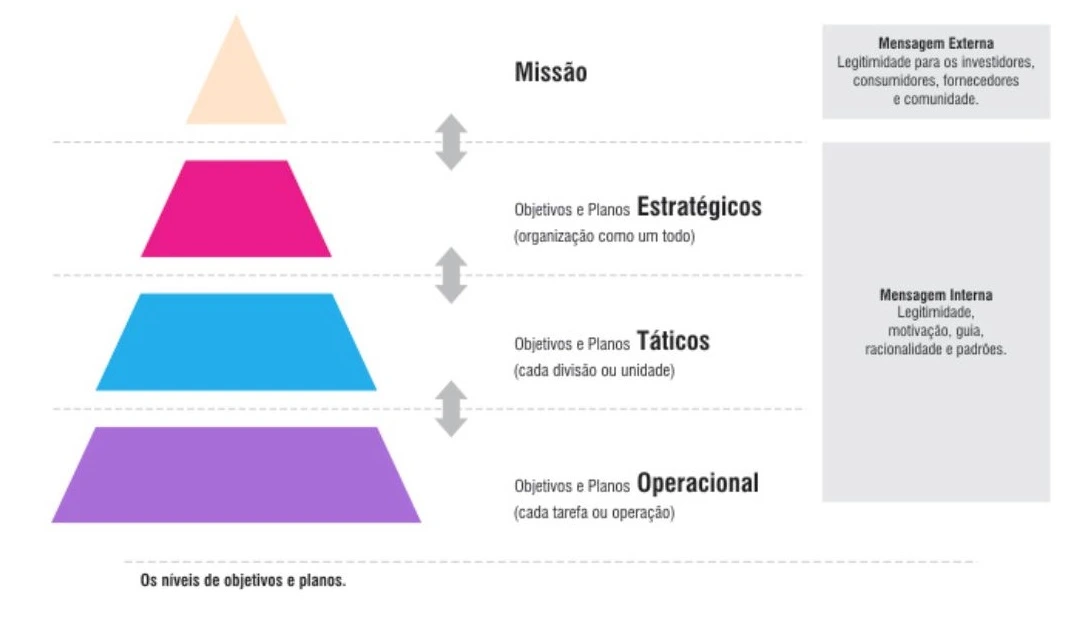
3- Connect OKRs to the Different Levels of the Organization
One of the great strengths of OKRs is their ability to align the whole organization around strategic objectives. This means it is essential that these goals are broken down for teams and individuals, creating a clear flow of how each action contributes to the larger objectives.
Imagine the company’s objective is to “increase international presence.” For this objective to be reached, it must translate into concrete actions in different areas.
For example, the marketing team can focus on specific campaigns for foreign markets, while the sales team focuses on building relationships with new international customers. Technical support can work on adapting systems to serve different languagesopens in a new tab (page in Portuguese).
This breakdown, starting from what OKRs are, makes each employee understand not only their daily tasks, but also how they affect the final result. In addition, OKRs connect individual work to the company’s purpose, increasing the sense of belonging and engagement.
It is important to remember that, even with this alignment, OKRs should be flexible. They do not need to be hierarchical in every case. Different teams can have independent OKRs, as long as they contribute to the organization’s overall objectives. The key is to ensure clarity and transparency about how everyone is contributing to the same direction.
4- Review and Track OKRs Regularly
Understanding what OKRs are and defining them is only the beginning. The real impact of the method is in continuous, disciplined tracking. This review process ensures OKRs are not just forgotten documents in a spreadsheet, but living tools that guide decisions.
In this way, tracking OKRs regularly means creating a space where teams can review their progress, adjust strategies and solve problems before they become bigger barriers.
These reviews can happen at different cadences, such as weekly, biweekly or monthly meetings, depending on the team’s dynamics and the complexity of the defined objectives.
In addition, tracking OKRs regularly is also a way to maintain engagement. When people see progress, even small, it generates motivation and reinforces the importance of the work they are doing.
Continuous tracking also promotes accountability, making sure everyone knows their responsibilities and how they are contributing to the company’s overall results.
Finally, remember that tracking should not be only technical or numerical. Use these reviews to discuss lessons learned, celebrate achievements and adjust expectations. This humanizes the process and strengthens the teams’ connection to the defined objectives.
5- Learn from the Process
At the end of each cycle (usually quarterly), review the results and evaluate what worked and what can be improved. This moment of learning helps refine OKRs for future cycles and ensures they are always aligned with business priorities.
Important questions:
- Did we reach the key results? If not, why?
- Were the objectives clear and inspiring?
- What can we do differently in the next cycle?
Next Steps
Now that you know what OKRs are and how to use them to reach your company’s objectives, it is time to think about tools that can make this process more efficient. Implementing OKRs requires organization, constant alignment and real-time tracking, and that is exactly where Stratws stands out.
Stratws is robust, complete software designed to help companies turn strategy into action. It offers everything you need to implement and manage OKRs in a practical and efficient way, eliminating the confusion of scattered spreadsheets and making sure everyone is on the same page.
With Stratws, you not only understand what OKRs are, but also have the tools you need to use them as a true competitive advantage. Try it and see how this methodology, combined with the power of strategic software, can take your management to a new level.


About the author
Equipe Siteware
Content produced and reviewed by the Siteware team, curated by internal experts in strategic management and corporate performance.