
Strategy and Goals
KPI and OKR: what is the difference and how do you use both together?
Understand the difference between KPI and OKR, see practical examples, and learn how to use both methods together to measure and reach results.

KPI and OKR are the two acronyms mentioned most often when the subject is goal setting and results measurement, and the two most often confused. A KPI (Key Performance Indicator) is an indicator that measures the performance of a process already under way. An OKR (Objectives and Key Results) is a method that connects an ambitious objective to measurable key results.
The most common question is not which of the two to pick for measuring corporate performance, but how to use KPI and OKR together.
This article explains the difference between KPI and OKR, shows how the two connect in day to day management, and brings a practical example of how an operational indicator becomes the key result of a strategic objective.
What is a KPI?
KPI stands for Key Performance Indicator. It is a metric that evaluates the success of a process, a team, or a specific activity.
KPIs measure what is already under way. They do not define where the company wants to go; they measure whether the current path is working. That is why each area uses a different set of indicators, according to what it needs to track.
In a manufacturing company, for example, the most common production KPIs are:
- OEE (Overall Equipment Effectiveness): measures the real productivity of a line or machine against its maximum potential.
- Scrap rate: the percentage of parts or batches rejected for not meeting quality standards.
- Average machine downtime: time lost to unplanned stops in production.
A common mistake is copying another company’s KPIs without adapting them to context or understanding what the business needs. Indicators only make sense when they relate to the specific objectives of each organization.
To go deeper into how to structure this stage, see how to manage KPIs in 6 practical steps or, specifically for the industrial sector, how to use OEE indicators in manufacturing.
What is an OKR?
OKR stands for Objectives and Key Results. It is a goal setting method created by Andy Grove at Intel and popularized globally by Google, where John Doerr introduced it in 1999.
The OKR structure has two parts:
- Objective: a short, qualitative, inspiring sentence. It answers the question “where do we want to get to?”.
- Key results: two to five quantitative indicators that will prove whether the objective was reached. They answer the question “how will we know we got there?”.
To make it concrete, think of a manufacturing company that needs to cut production losses:
Objective: reduce unplanned stops on the production line.
Key results:
- cut average downtime from 12 to 6 hours per month;
- implement predictive maintenance on 100% of critical equipment;
- train the entire maintenance team on the new method by the end of the quarter.
Unlike a KPI, an OKR is normally set by cycle (quarterly or annual) and has an owner, a deadline, and regular check in rituals. For the full step by step on writing your own, see the guide on how to define OKRs or the complete OKR method.
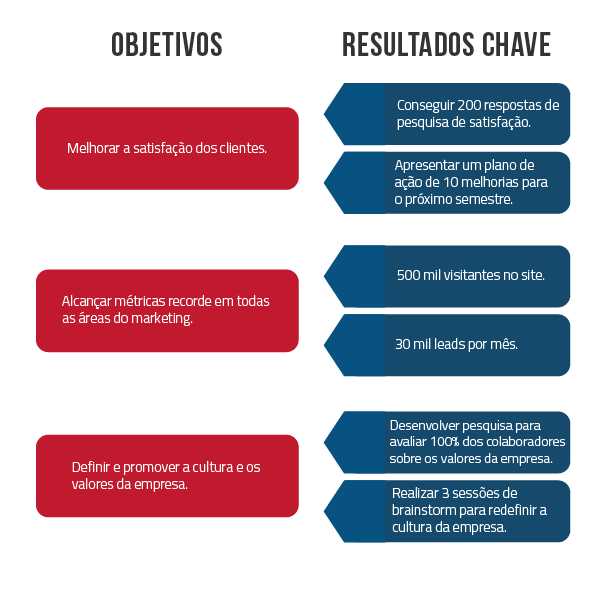
See these examples as well:
So what is the difference between KPI and OKR?
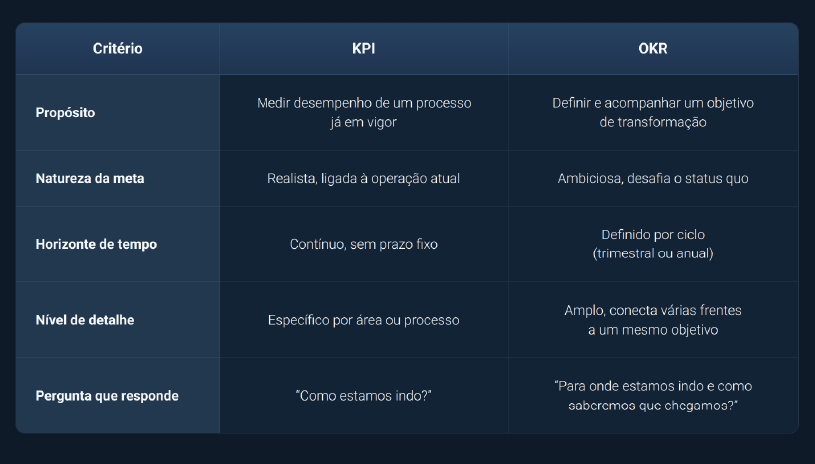
A KPI monitors the health or progress of a continuous process; an OKR steers the organization toward a specific change within a cycle.
That difference explains why treating the two concepts as competitors is a common strategic mistake: they work in different layers of management, and they do not compete for the same space.
How do KPI and OKR work together in practice?
In practice, a KPI that needs to improve usually becomes the starting point of a key result. That is how the two concepts connect, and it is also where most companies get it wrong.
Imagine Carla, production manager at a mid sized manufacturer. She already tracks the OEE of the main line month by month, a routine KPI. In the last quarter of the year, OEE fell from 78% to 65%.
That number does not change the factory’s strategy, but it does signal a real problem. To propose an OKR for the next quarter, Carla uses that KPI as her base.
Objective: recover the operational efficiency of the production line.
Key results:
- raise OEE from 65% to 75%
- cut average unplanned downtime by 20%
- implement predictive maintenance on the three critical pieces of equipment on the line
Note that the first key result is, in practice, the very KPI that was falling, now with a target, a deadline, and an owner. The OKR does not replace the indicator; it gives it strategic direction.
When in doubt, remember the practice we always take to our own clients: KPIs that are fine to track stay routine indicators; KPIs that need to move to a new level become key results of an OKR.
This relationship between operational indicator and strategic objective is what characterizes companies with real execution capability. According to McKinsey researchopens in a new tab (2024-25), only 21% of executives say their company’s strategy meets at least four of the ten strategic quality criteria the firm uses, a 40% drop compared with fifteen years ago.
Seguros Unimed is a real example of a company that aligned its OKRs closely with the overall management of the business, turning strategy into a living, measurable routine.
How do you track KPIs and OKRs on a single indicator panel?
The biggest risk of running KPIs and OKRs in parallel is fragmentation. When indicators live in one spreadsheet and objectives in another, the result is usually little or no traceability between objectives, indicators, initiatives, and actions.
The consequence is action plans disconnected from the indicators, low visibility over the progress of strategic initiatives, and dependence on manual effort to consolidate status and prepare presentations.
Siteware developed Stratws to solve exactly these issues. Through a solution built for goal deploymentopens in a new tab and visual management, each area’s KPIs sit side by side with the strategic objectives they feed, with real time updates and history available to the whole team.
To see everything the tool makes possible, talk to an expert in Corporate Performance and see how to bring your KPIs and OKRs into consolidated, integrated panels.
Frequently asked questions about KPI and OKR
What is the difference between KPI and OKR?
A KPI is an indicator that measures the performance of a continuous process. An OKR is a method that defines an objective and the key results that prove whether it was reached. One measures the present; the other steers the future.
Can KPI and OKR be used together?
Yes, and using them together is the recommended approach. KPIs monitor day to day operations, while OKRs steer specific changes. Often, a KPI that needs to improve becomes the basis of a key result.
Can a KPI become the key result of an OKR?
Yes. When a routine indicator is below expectations, it usually becomes the target of a key result inside that cycle's OKR.
Does every company need OKRs, or are KPIs enough?
It depends on where the company is. KPIs alone are enough to monitor stable operations. Companies that need a change of direction or accelerated efficiency gains benefit from adding OKRs to the indicators they already track.
Which should I implement first: KPI or OKR?
Usually the KPI. It is simpler to structure and, with the data you already have, it reveals where the company needs a more ambitious objective. That makes defining your first OKRs easier.

About the author
Raquel Marinho
Raquel is a Journalist and works as a Marketing Analyst at Siteware, where she writes about management, performance and people. With more than 5 years producing content on these topics, her work is translating complex strategic management subjects into clear, useful content for those who lead teams and results day to day.