
Continuous Improvement
How does the FCA method (Fact-Cause-Action) help solve problems?
The FCA method (Fact-Cause-Action) solves problems by tracing them to their root causes. Learn how to use it in management and process improvement.

Identifying problems is part of every manager’s routine. The real challenge, however, is not noticing that something went wrong, but understanding why it happened and how to keep it from happening again. This is where the FCA method (Fact-Cause-Action) stands out.
This structured approach to analysis helps companies organize information based on facts, investigate the root cause, and define corrective actions.
Instead of treating only the symptoms, the method steers decision-making toward more effective and sustainable solutions.
Widely used in continuous improvement initiatives, this tool can be applied on its own or alongside practices such as PDCA, 5W2H, and the 5 Whys.
In this article, you will learn how this analysis model works, when to apply it, and why it is so effective for structuring problem solving in organizations.

What is the FCA method?
The FCA method (Fact-Cause-Action) is a structured approach to problem analysis that organizes the investigation into three steps: identify the fact that occurred, find its root cause, and define effective corrective actions.
This diagnostic model is used when a result falls below expectations (such as missed goals, operational failures, or a drop in performance) and seeks to understand what really caused the deviation, avoiding decisions based only on assumptions.
It is simple to apply and can be built into different organizational contexts. The structure works as follows:
-
Action: defining corrective or preventive measures to eliminate the problem and keep it from recurring.
-
Fact: an objective description of what happened, based on data, indicators, or concrete evidence.
-
Cause: an investigation of the reasons that led to the problem, focused on identifying the root cause.
Because it is a practical and easy-to-apply tool, it can be used correctively, after a problem has been identified, or preventively, in the analysis of risks and improvement opportunities.
In addition, this approach is often applied to tracking goals and performance indicators.
When expected results are not achieved, the Fact-Cause-Action structure helps you understand the deviations and define consistent plans for the next cycle.
FCA extends to many areas of the company, such as production processes, sales, project management, and team development, strengthening a culture oriented toward analysis, continuous learning, and better results.
What is FCAR?
FCAR is an evolution of the Fact-Cause-Action structure that adds a fourth element: result.
In this model, besides identifying the problem, its causes, and the corrective actions, you also monitor the impact of the measures implemented.
Adding the “R” reinforces the importance of measurement. In other words, defining and executing actions is not enough: it is essential to track indicators and verify whether the measures adopted really solved the problem.
In practice, the process works like this:
- Fact: what happened?
- Cause: why did it happen?
- Action: what will be done to correct it?
- Result: what was the impact of the action implemented?
This addition strengthens a data-driven management culture, because it turns the method into a more complete cycle of analysis and validation. Besides solving problems, the organization starts to measure how effective its solutions are.
For FCAR to work consistently, it is advisable to have a management tool or system that centralizes information, records indicators, and allows results to be tracked in real time.
That way, data stays organized and accessible and supports more strategic decisions.
What are the benefits of FCA?
Applying the FCA method brings direct gains to management, because it structures problem analysis and turns critical situations into opportunities for learning and improvement.
1. Precise identification of the root cause
By separating fact, cause, and action, the tool avoids decisions based on assumptions. This significantly increases the chances of solving the problem for good, reducing rework and recurrence.
2. Reduced financial impact
Problems that are not handled properly tend to create a cascade effect: higher costs, lower productivity, lost margin, and even customer dissatisfaction.
By acting on the origin of the deviation, the company reduces waste and protects its results.
3. A stronger continuous improvement culture
When applied on a recurring basis, the Fact-Cause-Action structure expands the organization’s knowledge of processes, indicators, and risks.
This raises the management maturity level and contributes to more strategic decisions.
4. Risk prevention and greater predictability
Besides correcting failures, the method can be used preventively, anticipating bottlenecks and adjusting course before the impacts become critical.
To illustrate, imagine that at year-end a company records a result 15% below forecast.
Instead of blaming the drop only on market conditions, applying FCA makes it possible to analyze concrete data, identify the factors that hurt performance, and define specific actions for the next cycle.
This way, the organization stops reacting to symptoms and starts acting in a structured way on the real causes.
When supported by a strategic management solution, this approach becomes even more powerful.
With Stratws, for example, you can apply methods such as FCA and PDCA integrated with strategic planning, ensuring continuous tracking of indicators and greater effectiveness in executing actions.

How to apply FCA method analysis
Applying the FCA method follows a simple but structured logic: identify what happened, understand why it happened, and define what will be done from there.
When driven by data and indicators, this process significantly increases the effectiveness of decisions.
Here is the step-by-step:
1. Fact
The first step is to objectively identify the fact. This is the event or result that deviated from what was expected, whether in operations, performance, or strategic indicators.
Example: the company records a 15% increase in energy consumption compared to the previous month.
The fact must always be backed by concrete data.
That is why it is essential for the organization to work with well-defined metrics and indicators tracked regularly. Without measurement, there is no fact, only perception.
2. Cause
Causes are the reasons that trigger the problem for the company, and it is important to know them in order to control their effects.
The same fact can have multiple contributing factors, and the analysis must look for the root cause, that is, the element that actually originated the problem.
In the energy example, the investigation may reveal a significant increase in overtime during the night shift, raising electricity consumption.
Complementary tools, such as the 5 Whys or 5W2H, can deepen the analysis and prevent superficial conclusions. The goal here is to eliminate assumptions and work with evidence.
3. Action
This is the action plan the company must develop after identifying the causes of the facts, in order to correct the damage or repeat the successes.
In the example above, some possible measures would be:
- implementing internal policies for conscious energy use;
- reviewing goals to check whether they match the team’s operational capacity;
- adjusting working-hours and overtime management.
Besides correcting the current problem, the action must include follow-up mechanisms to ensure the deviation does not happen again.
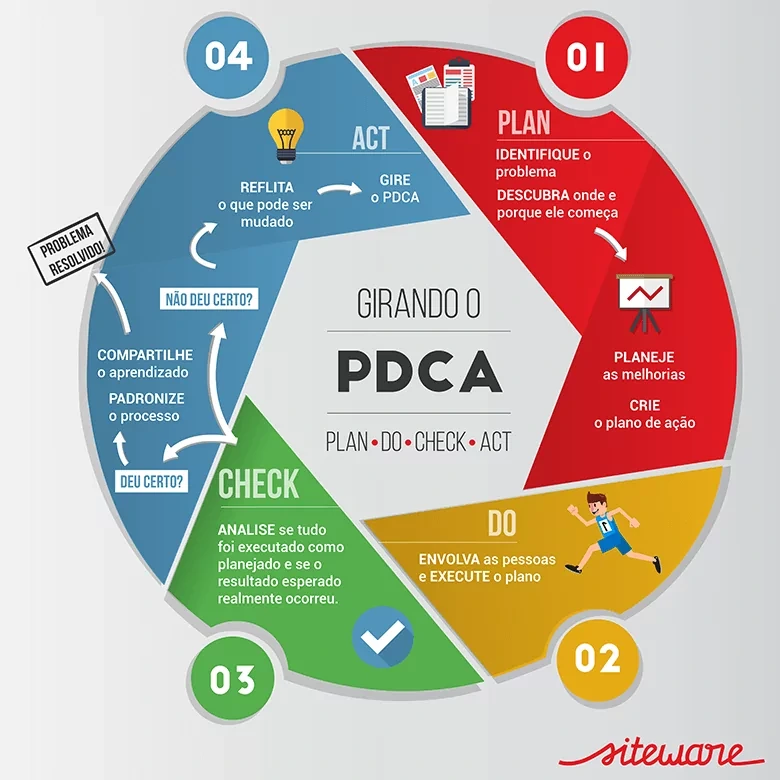
When integrated with other methods, such as the PDCA cycle, this approach becomes even more powerful, because it adds continuous monitoring and systematic review of the actions implemented.
Here is how it works:
Examples of applying the FCA method
To make the application clearer, let us look at a practical example in an organizational context.
Imagine that, at the end of the quarter, the finance department finds that net profit came in 15% below the target set in the strategic plan.
The fact is objective and measurable: financial result below expectations. Based on the indicators, the deviation from the established target is confirmed.
From the identified fact, the investigation begins to find the root cause. To deepen the analysis, you can use the 5 Whys technique:
-
Why did profit come in below forecast?
Because costs exceeded the planned budget.
-
Why did costs exceed the budget?
Because there were unforeseen expenses.
-
Why were there unforeseen expenses?
Because the department’s team changed frequently.
-
Why did the team change?
Because some hires did not fit the needs of the role.
-
Why were the hires not a good fit?
Because the recruitment process was not structured with appropriate criteria and tools.
At the end of the analysis, it becomes clear that the root cause lies not only in the financial result but in failures in the people management process.
With the cause identified, the company can structure corrective actions such as:
- reviewing the recruitment and selection process;
- defining objective hiring criteria;
- implementing tools to support people management;
- tracking turnover and performance indicators.
Note that the problem appeared in finance, but its origin was in HR. This is one of the method’s great differentiators: it enables a systemic analysis, avoiding superficial decisions and stopgap solutions.

When should the FCA method (Fact, Cause, Action) be applied?
The FCA method can be applied continuously, both correctively and preventively.
Corrective application
It is used when a deviation has already been identified, such as:
- a drop in performance on strategic indicators;
- an unexpected increase in costs;
- missed goals;
- recurring process problems.
In these cases, the Fact-Cause-Action structure helps investigate the problem in a structured way and define effective measures to solve it.
Preventive application
Besides acting after a problem occurs, the method can be built into the management routine as a tool for continuous analysis.
When applied preventively, the approach makes it possible to:
- anticipate risks;
- identify bottlenecks before they become critical;
- adjust processes based on evidence;
- increase the predictability of results.
Companies that use this logic on a recurring basis develop greater management maturity and significantly reduce the impact of operational failures.
Structured application of the FCA method strengthens the organization’s analytical capacity, improves the quality of decisions, and reduces the recurrence of problems.
By integrating this approach with strategic planning and indicator tracking, the company stops acting only reactively and starts operating based on data, evidence, and continuous improvement.
For this practice to be sustainable, it is essential to have a solution that centralizes information, organizes indicators, and makes it easier to track the defined actions.
With Stratws, you can apply methods such as FCA and PDCA integrated with the strategic plan, ensuring alignment between goals, indicators, and execution.
If you want to structure your company’s management with more predictability and control, request a demo and see in practice how to turn analysis into results.


About the author
Equipe Siteware
Content produced and reviewed by the Siteware team, curated by internal experts in strategic management and corporate performance.