
People Management
How to calculate employee turnover correctly
Learn how to calculate employee turnover, read the rate the right way and follow retention indicators in one integrated view with Stratws.

Understanding how to calculate employee turnover is a necessary step for any organization that wants to keep its finances and its people management in order. Turnover is not an isolated number; it reflects how well internal practices for attraction, engagement and retention are working.
In this article, we explain the concepts behind the metric, the calculation methods and why centralizing this data in an automated, secure system raises the maturity of the company.
What is turnover and why does it matter strategically for HR?
Turnover, also known as the attrition rate, is the indicator that measures the flow of people in and out of the company over a given period. Tracking and managing weekly and monthly indicators, with a focus on open positions, absenteeism and turnover, connects human resources to the real results of the business.
Monitoring this metric brings operational predictability. When turnover runs out of control, the organization faces a series of obstacles that hit its performance. The strategic value of mastering this indicator includes:
- Lower operating costs: recruiting, selection, training and severance charges add up to a high financial volume.
- Retained intellectual capital: losing professionals frequently erodes the accumulated record of technical knowledge.
- A stronger performance culture: a low turnover rate signals that the competency cycle, including performance reviews, the individual development plan (IDP) and feedback, is working.
- Goal alignment: stable teams find it easier to focus on goal deployment and continuous improvement.
What are the main types of turnover in companies?
To apply effective measures, you need to understand that not every departure happens for the same reason. Turnover is classified into different categories to make it easier to analyze the root of the problem. Here are the main divisions:
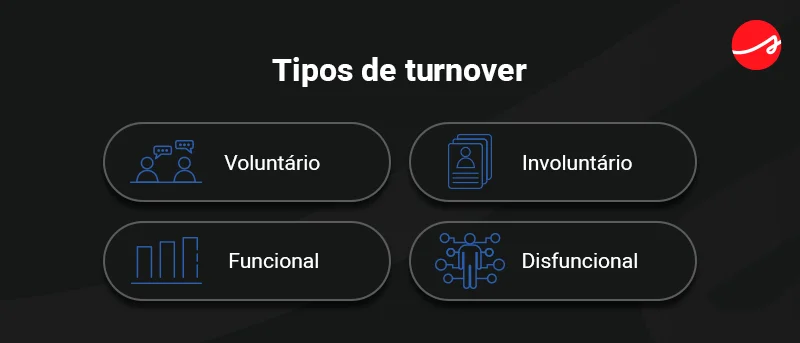
Voluntary and involuntary turnover
Voluntary turnover happens when the employee decides to end the relationship with the company. The most common causes involve more attractive financial offers in the market, dissatisfaction with the work environment, a lack of clarity in variable compensation policies or the absence of growth opportunities.
Involuntary turnover, in turn, happens by decision of the company itself. It is usually associated with low performance, conduct issues, misalignment with the intended culture or internal financial restructuring.
Functional and dysfunctional turnover
Within voluntary departures, the impact on the operation can vary. Functional turnover is the case where a low performing professional, someone who was no longer responding well to action plans and feedback, decides to leave. That opens space to attract new talent more aligned with the strategic objectives.
Dysfunctional turnover is the scenario that demands the most attention. It happens when the company loses a high performing talent, often well positioned in assessments such as the 9 box matrix. Losing this profile hurts productivity, team climate and the execution of the corporate strategy.
Read also: How to motivate a team: 8 smart ways to do it
How do you calculate overall company turnover?
The overall turnover calculation gives a macro view of attrition over a period of time, usually assessed monthly or annually. The standard formula takes the average of hires and departures, divided by the total number of active employees.
The formula is structured as follows:
Overall turnover (%) = [ (Hires + Departures) / 2 ] / Total active employees x 100
To illustrate, consider a company that started the half year with 200 active employees. Over six months, the organization recorded 15 hires and 25 departures.
- First, add the arrivals and the departures: 15 + 25 = 40.
- Then divide that value by two to find the average: 40 / 2 = 20.
- Next, divide the average by the total number of active employees: 20 / 200 = 0.10.
- Finally, multiply by 100 to get the percentage: 0.10 x 100 = 10%.
In this example, the overall turnover rate for the period was 10%. Whether that reading is positive or negative depends on the history of the organization and on the average for its market segment.
How do you calculate new hire turnover?
The new hire turnover rate focuses specifically on the people who leave the organization within a short period, usually the first six months. This indicator is a direct read on the quality of recruiting, selection and onboarding.
The formula used is:
New hire turnover (%) = (Departures with less than six months / Total hires in the period) x 100
In an organization that hired 30 new people during the year and saw six of that group leave before completing six months, the calculation is: 6 / 30 = 0.20. Multiplied by 100, the result is new hire turnover of 20%.
A high number on this metric points to possible gaps in aligning expectations during interviews or to difficulties adapting to the corporate culture.
Why drop spreadsheets when tracking HR indicators?
Running the competency cycle and following the progress of the company with manual spreadsheets and printed documents is a slow process.
When operational information sits scattered across local files that are not connected to each other, the organization loses visibility and governance.
Prolonged use of outdated spreadsheets is prone to operational error and makes real time tracking impossible. The lack of a standard makes results meetings less productive, with too much time spent manually consolidating reports, charts and presentations.
On top of that, legacy systems and disconnected spreadsheets make it harder to centralize the historical data of the company and compromise traceability, which hurts corporate governance and the speed of decision making.
Track your HR indicators and retain talent with Stratws
Stratws is a corporate performance management software that centralizes management from strategy to execution in the same system.
Developed by Siteware, the software delivers an integrated view of the business through eight complementary solutions. With the Talent Management module, you can automate and simplify the full competency cycle, covering performance reviews, individual development plans, goal deployment and professional growth processes.
For precise monitoring, the Visual Management module offers clear dashboards that keep a current view of key indicators such as turnover. That makes it faster to identify the areas that need intervention and supports corporate decisions based on consolidated data.
The whole Stratws operation runs under SOC 2 compliance, with international standard security (Azure/AWS cloud) and full privacy for strategic data.

About the author
Equipe Siteware
Content produced and reviewed by the Siteware team, curated by internal experts in strategic management and corporate performance.